
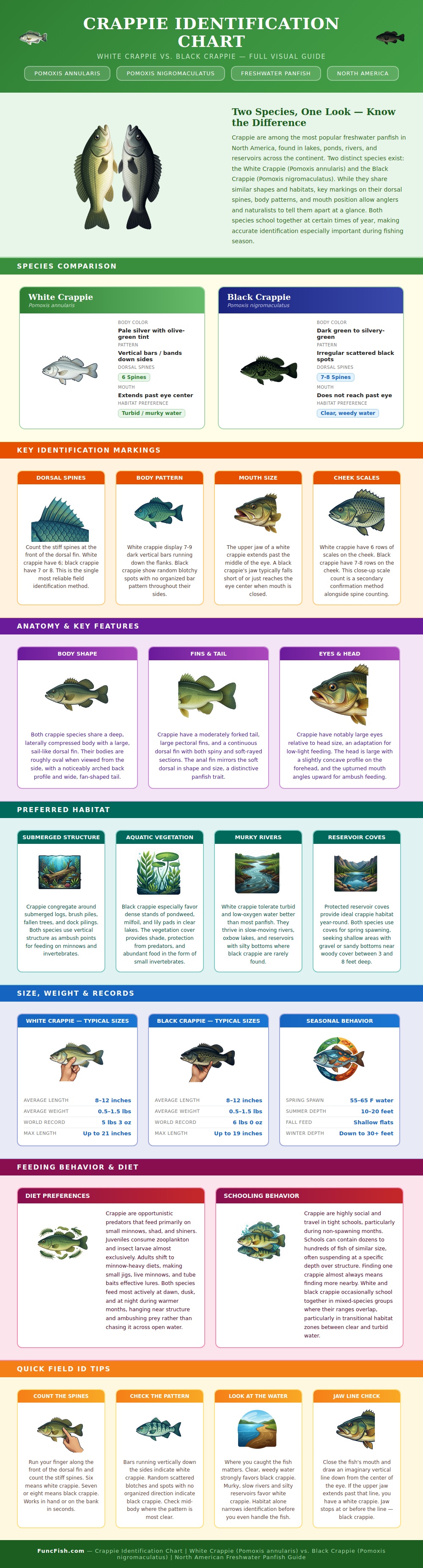
Most anglers know crappie when they see them in a keep net because they are flat and silver. If you’re just starting out it can be hard to tell if that’s a black or white crappie without counting their dorsal spines. There is some slight visual clues. However, it can get tricky especially in low light or dirty water.
It doesn’t really matter much in terms of taste. However, it does help you understand what type of habitat those fish are using and how they may react different. What species you catch determine your next step on the water. As the graphic above illustrates, they look alike but are different.
How to Tell Black and White Crappie Apart
Instead of the pattern, look at the number of spines along the dorsal (top) fin. Black crappie feature between seven and eight hard spines toward the front of that sail-like fin, whereas whites only has six. This is a body feature that’s consistent enough to be your main identifying factor. This isn’t rocket science; you don’t need a microscope for it. Simply pick up the fish and gently run your finger down its ridge. Count six bumps before the softer rays get going. That’s a white crappie. It is simple, repeatable and avoids any guesswork due to color which changes under different water conditions and stress levels.
Another big factor in identifying fish is habitat. White crappie prefer dirty water, namely murky, muddier back waters, silty reservoirs and cloudy rivers. Black crappie favor structure like docks, submerged timber and any type of cover found within their environment. Conversely, black crappie does well in clearer lakes with vegetation for cover. So if you’re trying to catch some black crappie out of that clear pond full of lily pads, chances are you’ll be after them. And if you’re jigging a silt-bottomed muddy river bend, you’re probably going to find white crappie relating to structure somewhere nearby. Knowing the habitat before you throw something at it is a good way to guess what you might have swimming around, and that’s half the battle right there.
Another clue is body patterning. But be careful… It’s deceptive under lowlight conditions. While white crappie has vertical bars giving them a striped look, black crappie show irregular spots resembling random blotches on flank. This illustration (above) clearly shows how contrasting bars are more organized then chaotic spotting. Keep in mind that you shouldn’t go by pattern alone, since stress can cause darkening and fading may hide markings altogether. Cross reference it with mouth size or spine count at all times to confirm.
Another anatomical giveaway is mouth position. When the jaw is shut, a white crappie’s upper jaw will extend beyond the mid-point of the eye, but a black crappie’s jaw stop well shy of this point. Although it’s in millimeter increments, this discrepancy shows how each species feeds. White crappie feed in open water for a wider range of prey, so they tend to have slightly bigger mouths. Black crappie often ambush from within weeds where precise delivery is more important than wide mouths.
Typical catches of both species average eight to twelve inches long. World records hover near five or six pounds, which are rare but memorable trophy specimens. They school tight, often by the dozens if not hundreds, so when you find one you typically has many more. Action peaks in spring as they move shallow to spawn once water temps reach the mid-fifties. As the weather warms, they pull back to deeper structure and drop into ten feet or more in the summer heat.
Knowing who you’re catching will not only tell you what to throw at ‘em but it’ll also clue you into how they’re holding. Whether you’re more of a mud river tough guy or a clear water stealth angler; knowing the fish sharpens your focus. So the next time you get a bite from that flat silver panfish, make sure to stop and count those dorsal spines. The answer is in the fin, waiting for you to find it.