Crayfish Molt Timing Calculator
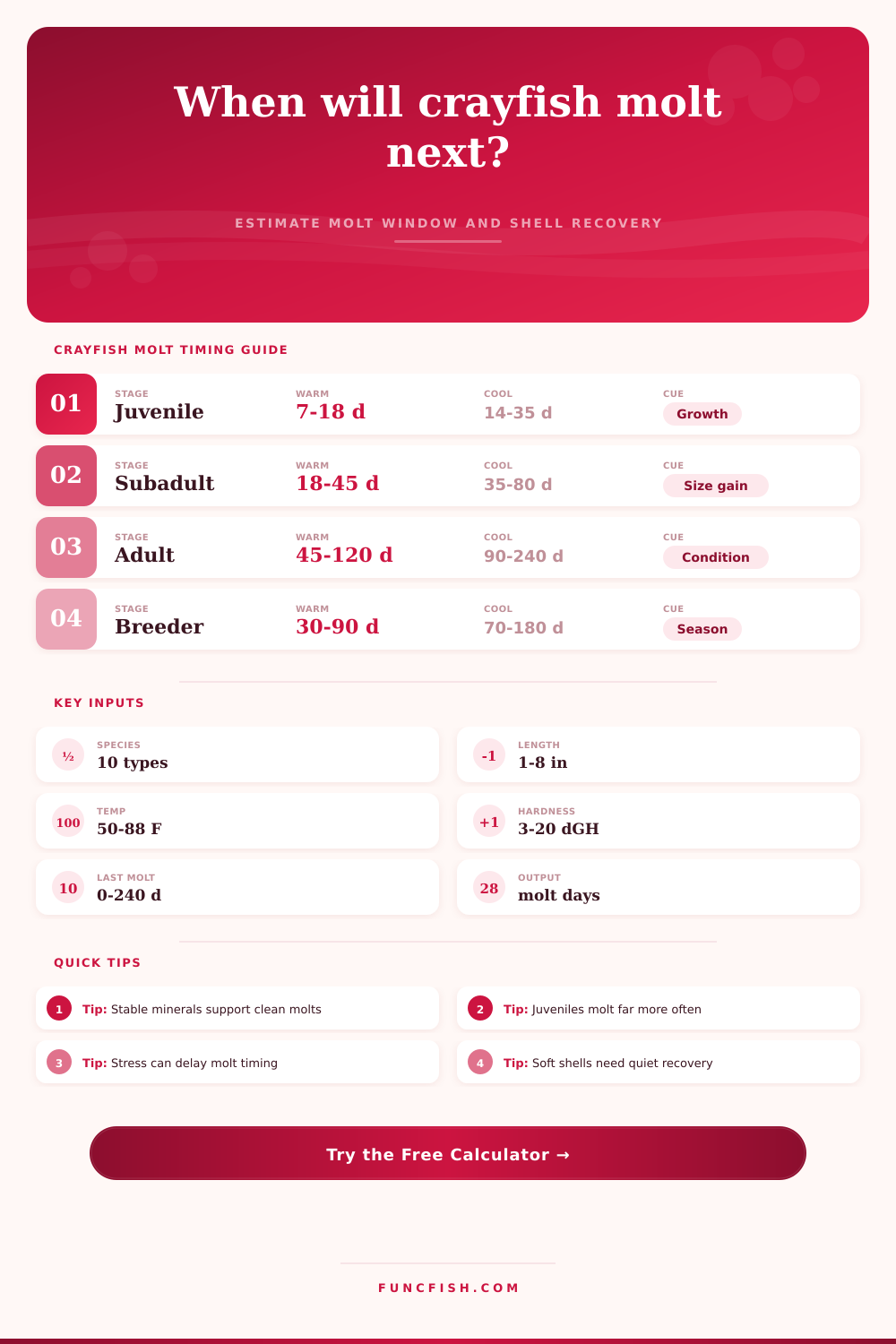
Estimate the next crayfish molt window from species, growth stage, body length, water temperature, mineral hardness, feeding level, and stress load.
📌Molt scenario presets
⚙Molt timing inputs
Molt timing estimate
Calculation breakdown
🦐Species comparison grid
Red swamp
Redclaw
Yabby
Dwarf orange
📊Reference tables
| Species profile | Warm adult interval | Preferred band | Typical size | Molt behavior note |
|---|---|---|---|---|
| Red swamp crayfish | 35-70 days | 68-82 F | 3-5 in | Fast molts when warm and well-fed |
| Virile crayfish | 55-110 days | 60-74 F | 3-5 in | Seasonal cooling stretches interval |
| Rusty crayfish | 50-100 days | 60-76 F | 3-5 in | Robust adults slow after maturity |
| Signal crayfish | 70-140 days | 54-68 F | 4-7 in | Cool-water profile lengthens timing |
| Australian redclaw | 40-85 days | 72-84 F | 5-8 in | Warm stable growout shortens interval |
| Dwarf orange crayfish | 18-45 days | 68-78 F | 1-2 in | Small adults molt on shorter cycles |
| Water chemistry band | dGH range | Molt effect | Readiness impact | Watch item |
|---|---|---|---|---|
| Very soft | 1-3 dGH | Shell rebuilding may lag | Large penalty | Failed molt risk rises |
| Moderately soft | 4-6 dGH | Usable but not ideal | Small penalty | Track recovery time |
| Balanced | 7-14 dGH | Best all-around support | Positive | Keep stable between molts |
| Hard | 15-22 dGH | Usually workable | Neutral to mild penalty | Avoid sudden shifts |
| Very hard | 23+ dGH | May add stress if abrupt | Penalty | Confirm species tolerance |
| Growth stage | Base modifier | Length sensitivity | Common interval | Interpretation |
|---|---|---|---|---|
| Juvenile fast growth | 0.34x | Low | 7-25 days | Most energy goes into size gain |
| Subadult sizing up | 0.62x | Medium | 18-55 days | Still frequent but less explosive |
| Young adult | 0.90x | Medium | 35-90 days | Timing starts to depend on condition |
| Mature adult | 1.35x | High | 60-180 days | Maintenance molts replace fast growth |
| Breeder or post-berry | 1.18x | High | 45-150 days | Recovery and reproduction alter timing |
| Check day | Cycle progress | Readiness band | Expected sign | Shell status |
|---|
💡Molt timing tips
Mineral tip: use the same hardness test method each time. Molting estimates become more useful when the mineral reading is stable across the full molt cycle.
Observation tip: appetite drop, hiding, dull color, and a visible split line can mean the calculated window has shifted from "soon" to "very soon."
Molting is something of a silent event with a crayfish. They quit feeding, seek out their cave, and basicly dissapears into the tank’s background. This is when I’d suggest holding my breath, hoping for the best. A good molt is cause to celebrate, growth. The shell is soft. The future is open.
But a bad molt are tragic. And it really does boil down to luck, preparation, and timing. There’s no controlling the biology side, so there’s the environmental side. So estimation becomes a practical tool as well as an exercise in theory.
How to Use the Molting Calculator
You input your situation then the calculator do the work for you (above). No need to guess at any of the conversions or coefficients. This tool use the most critical variables as inputs and spits out a window of time to look for.
What’s the species? A signal crayfish doesn’t run on the same clock as a red swamp crayfish. One might favor cool water different than another that thrives in warmer temps. Get the species profile correct first. Everything else flows from there, and if you’re off-base with starting point, all calculations following won’t get you back on track. It is a little detail, but it is important nonetheless.
The engine of the process is temperature. Metabolism run faster in warm water and slower in cool water. This causes the crayfish to digest its food more quickly. It also stockpiles the energy it needs to shed. Slowing things down, cool water extend the time between molt dramatically. Understanding this thermal reality, the tool take this into account and provides a realistic expectation (not a textbook average).
The same goes for feeding. A crayfish with access to an abundant diet rich in protein will molt before a crayfish having to scrape by on spare bits of vegetation. Simple biology, you’ve got to have some gas in your tank if you want to raise a roof.
Stress is the wildcard. Too much stress from frequent handling, bad water quality, or even aggression from other animals can cause a molt to be delayed indefinitely. To account for this, the calculator lowers the readiness score when there is more disturbance, which shows that the animal might not be ready yet even if the calendar says it should of.
Bricks and mortar are minerals. General hardness is the available calcium and magnesium that the crayfish extracts from the water and old shell to help mineralize the new exoskeleton. If it doesn’t mineralize fast enough, there’s a potential for a failed molt if you have soft water. That’s why chart on the page shows how the best outcomes come with balanced hardness.
Aim for stable rather than perfect. Abrupt changes in hardness are equally stressful. The key is consistency.
You need to understand what you’re reading. Patience is required. This isn’t an estimate of when it’s going to happen. It’s simply a period where the odds is greater. Watch for behavioral clues within that window. Appetite reduction is your best indicator. He won’t move around as much. He’ll want to be left alone. It is not because he’s sick, because he’s getting ready.
Soft-shell recovery is fragile. Injury can be fatal from predators, tank mates, rough substrate, etc. Reducing interactions during this time is the best aid you can provide him. Offering shelter and cover will help as well.
Knowledge of the cycle shifts your perspective on keeping the animal. What was once viewed as a “hiding problem” becomes instead a natural rhythm to be respected. While the calculator shows when this rhythm peaks, observation confirms. By reading the behavior and signs in the water you learn to see it coming.
You don’t just want to keep the crayfish alive; you also want it to thrive. The success of the molt is a victory for both keeper and animal. Life is dynamic, fragil, and it’s worth protecting. That’s what a successful molt reminds me of.
When the color comes back and the shell hardens, the tension releases. The standoff is over. Growth has occurred.