Critically Balanced Rig Calculator
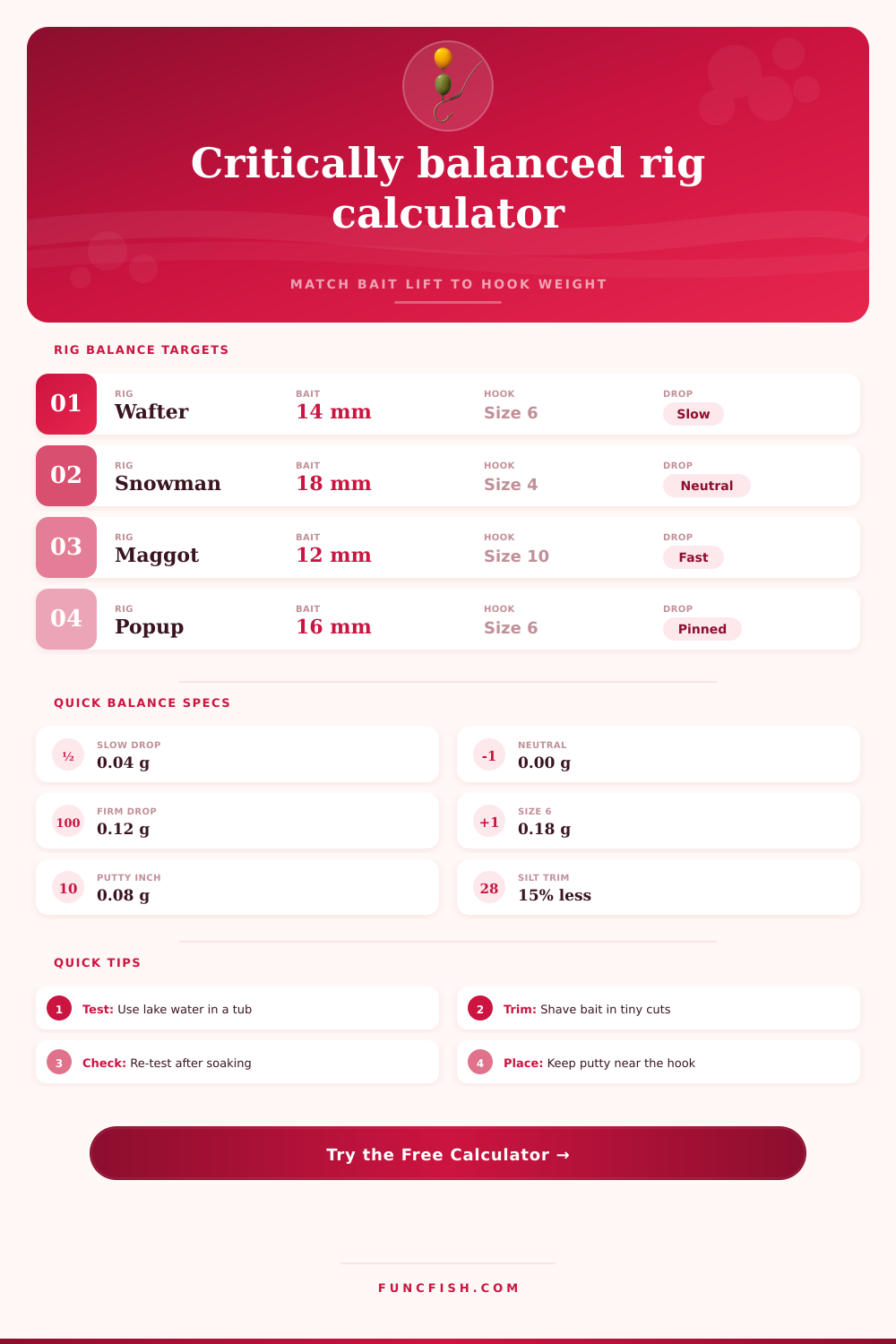
Balance hookbait lift, hook weight, putty, sink rate, and bottom type for wafters, pop-ups, snowman rigs, and light coarse rigs.
🎣 Rig Presets
⚙ Rig Inputs
Rig Balance Result
Calculation Breakdown
📏 Hookbait Buoyancy Data
Commercial Wafter
High Pop-Up
Cork Ball
Bottom Boilie
Density values are practical rigging estimates in grams per cubic centimeter. A real tub test still matters because handmade and soaked baits vary.
📊 Reference Tables
| Hook option | Estimated dry weight | Submerged pull | Typical bait range |
|---|---|---|---|
| Size 12 light wire | 0.045 g / 0.0016 oz | 0.040 g | 6-10 mm maggot, corn, bread |
| Size 10 light wire | 0.070 g / 0.0025 oz | 0.062 g | 8-12 mm corn or mini wafter |
| Size 8 medium carp | 0.115 g / 0.0041 oz | 0.102 g | 10-14 mm wafters |
| Size 6 medium carp | 0.180 g / 0.0063 oz | 0.160 g | 12-16 mm wafters and pop-ups |
| Size 4 heavy carp | 0.285 g / 0.0101 oz | 0.253 g | 15-20 mm snowman rigs |
| Size 2 heavy pattern | 0.410 g / 0.0145 oz | 0.365 g | 20 mm plus large pop-ups |
| Balance target | Net downward pull | Sink impression | Best use |
|---|---|---|---|
| Neutral hover | 0.00-0.02 g | Almost suspended | Soft feeding fish and delicate pickups |
| Feather sink | 0.03-0.06 g | Falls very slowly | Clear margins, cautious carp, light silt |
| Slow settled sink | 0.07-0.12 g | Drops but stays easy to inhale | General wafter and method feeder work |
| Firm anti-eject sink | 0.13-0.22 g | Positive hook turn | Hard bottom or nuisance small fish |
| Pinned near hook | 0.23 g plus | Deliberately heavy | River flow, chod leaders, low pop-up height |
| Species or venue | Common bait | Hook range | Balance note |
|---|---|---|---|
| Carp on clean gravel | 12-16 mm wafter | Size 8-6 | Slow sink, light putty near hook |
| Carp in silt | 14-18 mm pop-up | Size 6-4 | Feather sink, trim weight down |
| Tench over weed | Corn, worm, mini boilie | Size 12-8 | Neutral to slow, avoid burying |
| Chub in flow | Bread or meat | Size 10-6 | Firm sink to resist rolling |
| Bream on method feeder | 8-12 mm wafter | Size 12-8 | Slow sink with short hair |
| Counterweight | Approx. mass | Adjustment size | Rig effect |
|---|---|---|---|
| Tungsten putty pinch | 0.04-0.20 g | Infinitely trim-able | Best fine balance control |
| No. 8 split shot | 0.06 g / 0.002 oz | Small fixed step | Good for float and pole rigs |
| No. 6 split shot | 0.10 g / 0.004 oz | Medium fixed step | Quick wafter correction |
| No. 4 split shot | 0.20 g / 0.007 oz | Large fixed step | Pop-up anchor point |
| Sinker sleeve section | 0.12-0.35 g | Cut to length | Neat on hooklink or chod section |
💡 Balance Notes
Cold, dense water gives slightly more lift than warm shallows, and silty lake water can hide a bait that looked perfect in tap water.
Pop-ups and wafters slowly absorb water. A bait that hovers when tied may settle harder after several hours on the spot.
When you drop your rod tip and see your line fall limply into the water, you’re creating a presentation. You’ve got a perfectly balanced rig sitting at depth, neither sunk into deep silt nor floating over their head. It’s all about control. That’s what the calculator does for you.
It takes the weight of your pop-up or wafter and calculates how much weight change you’ll need to get a perfect hover. This spare you the guesswork of whether your bait will sink too quick or suspend where it spooks wary carp. So what’s the key? Buoyancy.
How to Get the Perfect Bait Balance
The problem with a regular boilie is that it’s heavier than water. A good pop up, however, is full of air bubbles and floats like a cork! When you stack them together on a snowman rig you change the physics… Or if you cut a wafer down and shrink diameter of the bait you do the same thing. By entering in exactly what your hookbait weighs and measures the tool takes all of this into account.
A bait that’s fifteen millimeters wide has less surface area and behaves differently in water than an eighteen millimeter bait does. And you’re not guessing at amount of putty needed to reach the right sinking level based on of some unknown amount of lift that particular bait will exert once in the water.
Then there are the hooks. Most people think that all hooks of a given size weigh roughly the same. Not true at all. Each pattern and each brand can vary drasticly on wire thickness. A size six heavy wire hook will pull down close to twice as hard than a size eight light wire hook.
The calculator has tables showing the submerge pulls to help you understand how a rig can feel heavy in your hand but stay perfectly balanced underwater. Simply select your hook size and computer tells you how much it should of pulling down. If you know exactly how much weight your hook pulls down you can override the estimate by entering your known number.
Getting this part right makes the difference between a good rig and a great one. It also ensure the hook bend needed to hold the fish doesn’t ruin the balance you spent hours perfecting.
This is also where novice anglers struggle, which is getting the putty in the right spot. You can easily add weight, but knowing exactly where to place it is the trick. Too much tungsten putty towards the top of your hair and you will create a lever arm that makes the rig unstable. The bait may be sitting flush upon landing, but the initial tug from a fish can turn hook out-of-place.
By using the calculator’s recommended distance for your counterweight, you keep it just near enough to the hook to provide stability while avoiding unnecessary bulk just above point. Not only does this minimize your likelihood of snags due to debris, but it help maintain a natural presentation. That’s a subtle detail, but one that alters the behavior of the rig as soon as a fish inhales it.
It’s worth noting that the type of water conditions you’re fishing are important too. Because cold water is heavier than warm water, your bait will float higher in colder months compared to warmer months. Gravel may highlight any balance issues you might have while silt can mask a perfectly balanced bait. Regardless, it’s best practice to wet your bait down and try it in a bucket of lake water prior to launching.
While the calculator provides a starting point based off theory, there are always real world variables that will tweak the numbers a little bit (ie: Temperature changes, algae build up). Small bites is better when trimming your putty, so make small tweaks instead of big ones.
To conclude. Balance is all about minimizing the work the fish has to do to eat the bait. If the bait doesn’t sink quickly but instead stays relatively neutral, then when the carp sucks the bait into its mouth, there’s no resistance against it at all. So he’s far less likely to be spooked by an unexpected move and far more inclined to take the bait if he feels a hook set.
Whether you’re targeting big carp on hard gravel or tench over weed, getting this correct shifts the situation from throwing a hooptie out there with hope to throwing a plan that executes. You spend more time watching the rod tip go down and less time wondering why you didn’t get a bite. That’s what the math is for: so you can do it before you even walk away from the bank.