Deep Drop Weight Calculator
Estimate the sinker weight needed to hold a deep-drop rig near your target angle by combining depth, current, braid diameter, rig drag, bait profile, sinker material, and bottom-contact margin.
🎯Deep drop presets
⚙Drop conditions and tackle
📏Deep drop line drag data
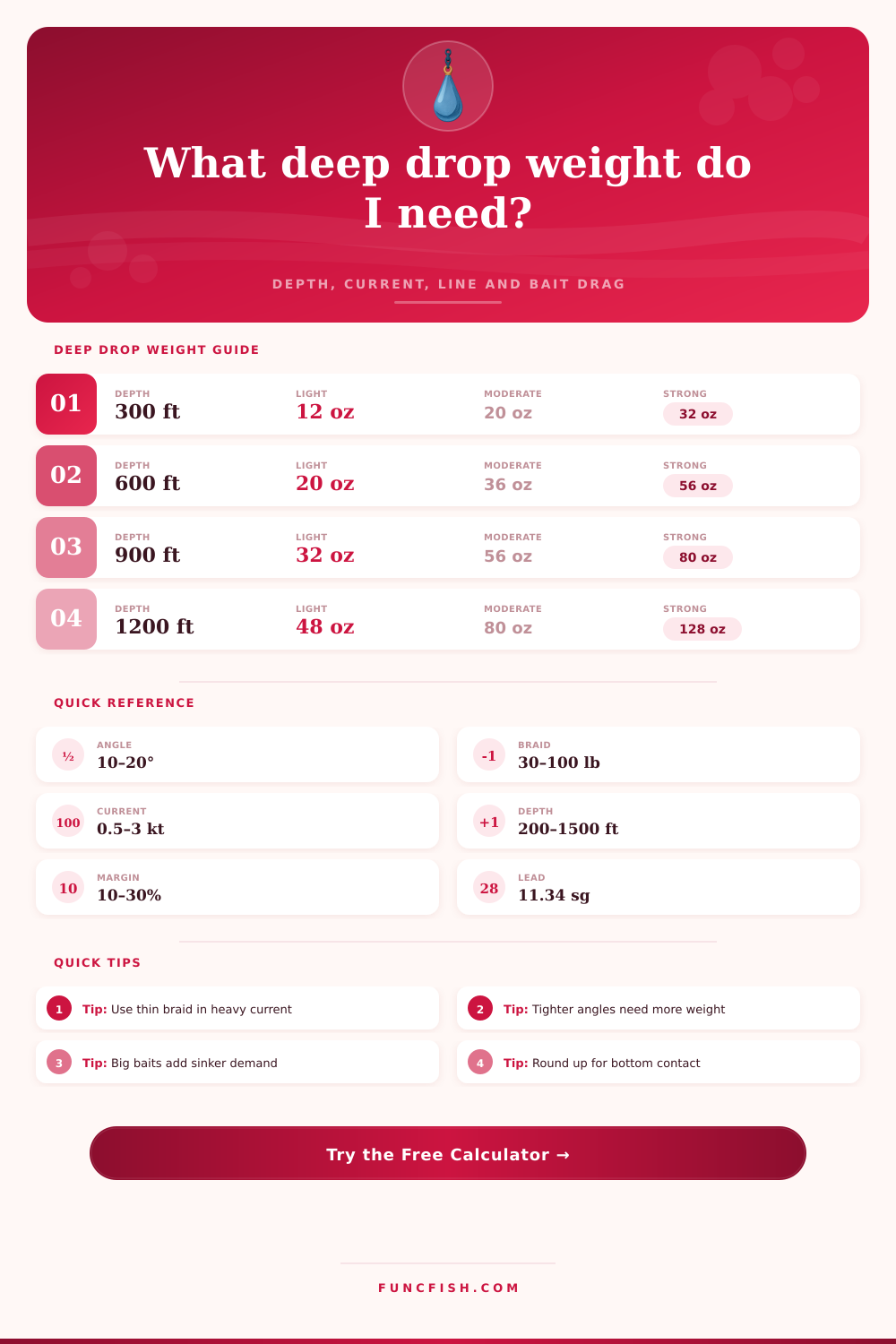
📊Starting weight table
| Depth range | 0.5 kt light | 1.0 kt moderate | 1.5 kt firm | 2.0+ kt heavy |
|---|---|---|---|---|
| 200-400 ft / 60-120 m | 8-16 oz / 225-450 g | 16-24 oz / 450-680 g | 24-40 oz / 680 g-1.1 kg | 40-56 oz / 1.1-1.6 kg |
| 400-700 ft / 120-215 m | 16-24 oz / 450-680 g | 24-40 oz / 680 g-1.1 kg | 40-64 oz / 1.1-1.8 kg | 64-96 oz / 1.8-2.7 kg |
| 700-1000 ft / 215-305 m | 24-40 oz / 680 g-1.1 kg | 40-64 oz / 1.1-1.8 kg | 64-96 oz / 1.8-2.7 kg | 96-128 oz / 2.7-3.6 kg |
| 1000-1500 ft / 305-460 m | 40-64 oz / 1.1-1.8 kg | 64-96 oz / 1.8-2.7 kg | 96-128 oz / 2.7-3.6 kg | 128+ oz / 3.6+ kg |
🧲Sinker material comparison
| Weight type | Relative size | Drag behavior | Buoyancy effect | Best use |
|---|---|---|---|---|
| Lead bank sinker | Medium | Moderate | About 9% lift in seawater | General bottom fishing |
| Cannonball lead | Compact | Low | About 9% lift in seawater | Deep water with current |
| Stick sinker | Long narrow | Low-moderate | About 9% lift in seawater | Snaggy bottom and ledges |
| Steel or iron | Large | Higher | About 13% lift in seawater | Disposable rough bottom |
| Tungsten | Very compact | Lowest | About 5% lift in seawater | Precise scout drops |
🐟Species and rig reference
| Target or use | Common depth | Main line | Rig drag | Angle goal |
|---|---|---|---|---|
| Vermilion and snapper shelf | 250-500 ft / 75-150 m | 30-50 lb braid | Two-hook strip bait | 15-25 degrees |
| Tilefish mud bottom | 500-900 ft / 150-275 m | 50-80 lb braid | Multi-hook bait rig | 10-18 degrees |
| Grouper ledge deep drop | 400-800 ft / 120-245 m | 65-100 lb braid | Chunk bait and heavy leader | 10-15 degrees |
| Swordfish daytime bait | 1000-1800 ft / 305-550 m | 65-100 lb braid | Large bait and lights | 8-15 degrees |
| Freshwater lake trout | 100-300 ft / 30-90 m | 20-50 lb braid | Spoon or bait dropper | 15-25 degrees |
💡Calculation notes
As the line goes down, you’re watching it peel off the reel standing on boat deck. You see where bottom is from your depth sounder. But what you don’t see is how hard current is pushing on your equipment. Deep drop fishing without this variable can be difficult. Rather than being tight to structure, many angler find themselves with slack line dragging across bottom.
There’s more to getting the weight right then gravity. Current pressure, drag, and sink all pull in different directions, it is a three-way tug of war. To simplify things for yourself, all you have to do is plug in your own conditions and calculator does the rest. This way, you won’t waste time wondering if an extra ounce will make a difference or if you are wasting space with unneeded bulk.
Why Current Matters for Deep Drop Fishing
Just know this: The diameter of your line create much greater resistance than you’d think. An eighth-inch, eight-carrier braid may appear beefy on paper, but it has surface area like a sail and catch water like crazy. That subtle variation in thickness add up to pounds of force trying to pull your sinker out-of-whack in two-hundred-feet of running water. So maintain as steep an angle to the bottom as possible without sacrificing enough weight to resist that side push.
The other factor is what you throw. For example, a small slender slice of squid go through the water easily, while a large piece of bait or even a whole mackerel on a hook act like a parachute. The tool handles that by allowing you to choose your bait shape. Aerodynamics applies underwater just as much as it does in the air. So if you’re throwing a big piece of an artificial teaser and you’re fishing in a heavy current, you better put a lot more weight on it so it doesn’t blow out of there.
People don’t understand that when they switch from scouting to hardcore fishing in deep water. Surprisingly enough material density also matter. While lead is typical (for good reasons), tungsten’s higher density in a given space provide an edge when fishing in a lot of current. It has less exposed surface area for the current to hang onto than lead do. If that doesn’t make sense go back and look at drag and buoyancy charts on the page. They give you a comparison for different materials. For instance, will spending a few extra bucks on a premium weight pay for itself over time due to keeping bait in the strike zone longer?
For the most part torpedo and cannonball shaped compact shapes outperforms chunky stick sinkers in heavy flow. Why? They cut through water column quicker and deflect less sideways. And what’s the deal with how far off vertical should I cast? Guides recommend casting fifteen to twenty degrees off perpendicular. Don’t go any steeper, or you risk losing bottom contact when a fish hit. Don’t go any flatter, or you’re fishing over the structure instead of on top of it. That sweet spot is where the sinker’s vertical pull balance the force of the current pulling you horizontally… And the calculator will help you find it.
It’s about more than reaching the bottom, it’s about holding onto it when the going gets rough. In the end, gear specifications is less significant than seasonal variations. Even if you use the exact same setup on both occasions, warmer water currents will tend to be slower and shallower then cold-water currents, requiring heavier weights. So while it’s important to understand your tackle, it’s equally critical to check local situation before launching. The difference between a great day of fishing and zero bites can depend entirely based off the change in current speed/density caused by changing water temperatures.
At the end of the day, precision and patience are the name of the game when it comes to deep drop fishing. Think of yourself as presenting a static target with a moving environment. Current speed, bait profile, and line drag is all important factors for getting your sinker selection correct. The next time you feel that tug on the reel, do you know whether it is a fish biting or just the water pushing back? Knowing that answer take the guessing game out of sinker selection and makes for a good day on the water instead of a frustrating drift.
You should of known about current! It actualy makes a big difference to your luck. If you dont use enough weight, the line dissapears from where it should be.