
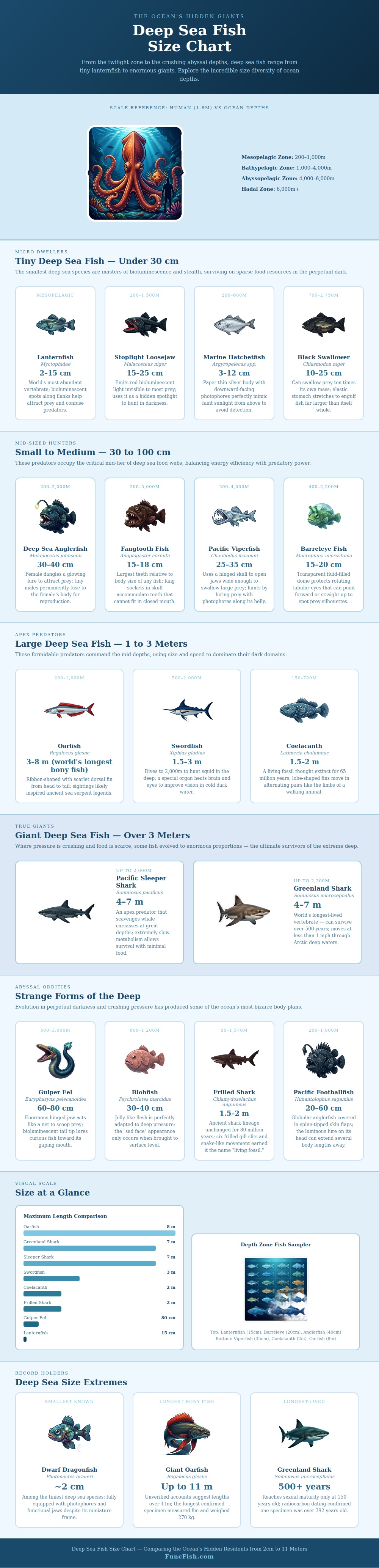
Don’t think the deep sea’s emptiness is due to pressure on creatures there. It’s full of stuff, but size matter most, as the visual guide demonstrates.
Size vs. Depth zones and human height. This reveals more than just physicality; it illustrates evolution’s tradeoffs. Because speed is costly, slow-and-steady giants rules here. Oarfish and Greenland shark dominate their area with patience and sheer volume. Slow-moving sharks swims at less than a mile per hour. They grow large and live a long time, with some reaching over 500 years. Today’s oarswimmers swam back then: Middle Ages. Their age defy common ideas of biological lifecycles.
How Different Sizes Help Deep Sea Creatures Survive
They are opportunistic hunters, not patient ones. The mid-sized predators is smaller, but well adapted. As the chart shows, that might include big clear teeth on the viperfish; or a glowing lure on the anglerfish. They inhabit an environment where food is scarce and randomly distributed. It’s not as though they can absorbs dinner very far. So they rely on trickery instead.
In the case of the viperfish, it waits with a big hinged mouth for unsuspecting prey and swallows them whole (which is why it has those giant translucent teeth). The anglerfish just waits in the dark with a glowing lure to attract anyone too curious to resist.
Often what we don’t see is the smallest creature on the list. One tiny dweller is called the lanternfish. Even though this little guy is small he helps support the food web in the deep sea. In fact, there are more lanternfish on earth than any other type of vertebrate. Every night they go vertical. They move up from deep depths all the way to the ocean’s surface to feed and then sink down again to hide away during the day. They transport billions of tons of nutrients around the ocean floor everyday. Without them the giants above them would of had nothing to eat.
An oarfish measures eight meters long and a dragonfish only two centimeters. They depend on one another despite the difference in their sizes. This is a different way of looking at what matters for biodiversity. We are used to thinking that more mass and being visible matters most. In the deep sea, we see that a few grams of something may matter just as much as a few tons. The lanternfish and the Greenland shark is both shown in the chart.
You have to think about surviving in darkness in a new way. To survive under pressure, some do it big and muscular. Others go gelatinous and sloooooow to save energy. Both are successful, which means the deep stays diverse even when conditions is harsh. In the middle are the mid-sized hunters (connectors). Connecting all the dots on this vast web. The gulper eel with its giant jaws and the barreleye fish with its see-through head are the creatures of the middle. And they demonstrates that evolution doesn’t take one road. It takes whichever route is most efficient for each individual niche.
Being aware of these size dynamics makes you think different about how to conserve the oceans. Not just focusing on protecting big animals overlooks the building blocks of this food chain. Those little lanternfish hold up the giants. Slow sharks keep everything together. Mess with any of them and you mess with the whole thing. Size diversity means functional diversity. And every creature has a unique place in maintaining the dark alive.