Dough Bait Ratio Calculator
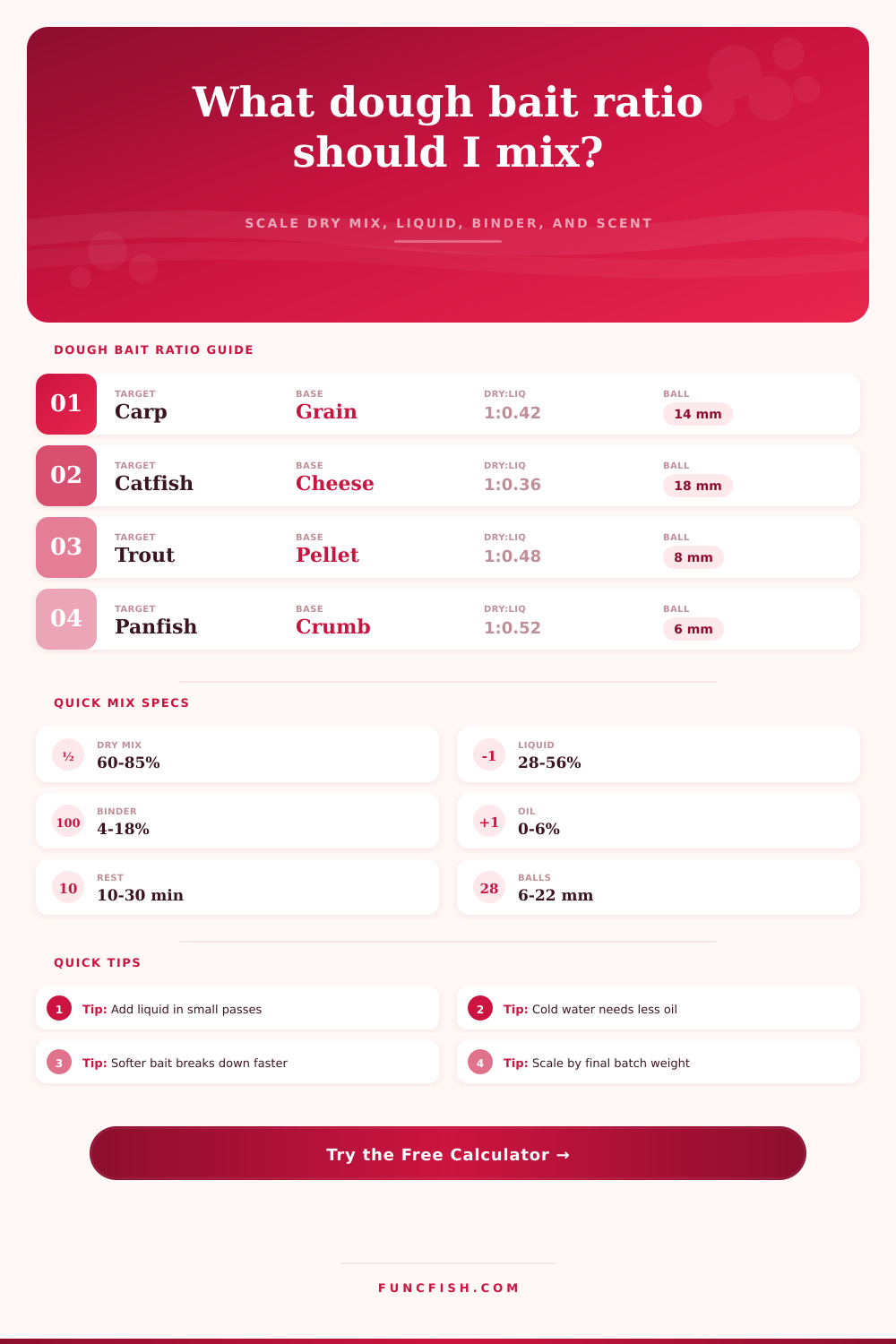
Scale a fishable dough bait mix by final batch size, base material, target species, water temperature, firmness, and ball size.
📌Dough bait presets
⚙Mix inputs
Dough bait mix result
Formula breakdown
📋Base material comparison grid
Ground oats
Bread crumb
Cornmeal
Crushed pellet
Wheat flour
Cheese base
Soy meal
Semolina
📏Dough ratio reference tables
| Dry base | Starting liquid per dry weight | Texture tendency | Rest window |
|---|---|---|---|
| Ground oats | 0.46 oz per 1 oz dry | Absorbs slowly, stays fibrous | 15-25 min |
| Bread crumb | 0.52 oz per 1 oz dry | Soft and fast swelling | 10-18 min |
| Cornmeal blend | 0.38 oz per 1 oz dry | Gritty, firms as it rests | 18-30 min |
| Crushed pellet | 0.55 oz per 1 oz dry | Dense, needs even wetting | 12-22 min |
| Wheat flour | 0.44 oz per 1 oz dry | Elastic, binder-like base | 20-30 min |
| Cheese powder base | 0.34 oz per 1 oz dry | Sticky with lower water demand | 15-25 min |
| Soy meal blend | 0.48 oz per 1 oz dry | Coarse and protein-heavy | 15-25 min |
| Semolina firm base | 0.36 oz per 1 oz dry | Springy and current-ready | 20-30 min |
| Target fish | Useful bait feel | Ball diameter range | Ratio nudge |
|---|---|---|---|
| Carp | Moldable with slow leak-off | 12-18 mm / 0.47-0.71 in | Moderate binder, mild oil |
| Catfish | Sticky and scent-heavy | 16-22 mm / 0.63-0.87 in | More attractor, less water |
| Trout | Soft pellet paste | 6-10 mm / 0.24-0.39 in | More liquid, low oil |
| Panfish | Small crumb dough | 5-8 mm / 0.20-0.31 in | Soft mix, light binder |
| Tilapia | Fine grain mash | 8-14 mm / 0.31-0.55 in | Balanced moisture |
| Sucker | Firm bottom dough | 10-16 mm / 0.39-0.63 in | More binder for bottom hold |
| Water condition | Liquid adjustment | Binder adjustment | Breakdown target |
|---|---|---|---|
| Pond or lake edge | Baseline | Baseline | Medium release |
| Slow river | -2% | +2% | Hold through drifts |
| Moderate current | -5% | +5% | Firm hook hold |
| Cold clear water | +3% | -1% | Soft low-oil bait |
| Warm stained water | -1% | +1% | More scent trail |
| Ball diameter | Approx weight | Common hook range | Use case |
|---|---|---|---|
| 6 mm / 0.24 in | 0.1 g / 0.004 oz | Size 12-8 | Small trout and panfish |
| 10 mm / 0.39 in | 0.5 g / 0.02 oz | Size 8-4 | Trout, tilapia, small carp |
| 14 mm / 0.55 in | 1.4 g / 0.05 oz | Size 6-1 | Carp and sucker bait |
| 18 mm / 0.71 in | 3.0 g / 0.11 oz | Size 2-1/0 | Carp and channel catfish |
| 22 mm / 0.87 in | 5.4 g / 0.19 oz | Size 1/0-3/0 | Large catfish dough balls |
💡Mixing calculation checks
Tip: Hold back about one tenth of the calculated liquid until the rest period is done. Oats, pellets, and cornmeal keep absorbing after the bait first feels finished.
Tip: If the dough tears when pressed around a hook, increase binder before adding more dry base. Too much dry mix can stop scent from releasing cleanly.
So now that we’ve defined our target, the calculator (above) does all the math for us which also spares us the guesswork of needing more binder or more water for our oats.
How many times have you been standing on the bank with what you know to be a perfect rig and then watched as the bait turn cloudy and dissolves before the fish ever get near it? Or you throw a lump of rock hard stuff that just sits there on the bottom like a brick and doesn’t give off a single bit of scent trail for inquisitive catfish and carp?
How to Mix Bait
The result is usually a frustration that comes back to this one variable you can’t perceive until it’s already too late: the ratio. It is not the amount you’re mixing together, but rather how they relates to each other in the bowl.
The dry ingredients form base of your bait. Cheese powder, wheat flour, cornmeal and ground oats all act different in liquid. Oats will slow-release water, soak it up and retain structure longer. Bread crumbs, on the other hand, are soft and fast-acting. They swell quickly and attract smaller trout or panfish that has been pressured. Cornmeal remains gritty, firms up with rest and remains that way. That choice sets the tone for everything else.
Your selection of base determines how much liquid you want, whether you desire something sticky (catfish), or denser and more moist (trout). The correct choice here avoids the typical error of assuming one dough base is like another.
Just add water and stir. Water is the most perilous ingredient (and also the one with the most muscle). Too much, and your bait turns into soup. Too little, and it’ll disintegrate on the cast. Based off anticipated water conditions as well as how firm or soft you want it to be, the calculator will adjust the amount of water added to the bait and the binder accordingly.
For example, a cold clear-water situation may require a touch more moisture to make a softer bait that appears more naturaly to skittish fish. Conversely, warm stained water may need a slight decrease in moisture to allow the scent trail to expand quicker. Again, these are subtle adjustments. But can have a huge impact.
It’s the Binder that ties it all together. Each of these (gelatin, wheat gluten, egg whites or xanthan gum) does something different. The gelatin firms up as it cools, so you can make bigger baits hold up better when being transported. Xanthan gum serves a different purpose to help keep the party together. Egg whites give some tackiness and add protein. Gluten gives elasticity for good hook holds. Each of those things has a place.
This also takes into account how much oil/solvent you’re using. Stronger liquid/oils can breaks down the binders if your ratio isn’t right. If you have strong attractant, there needs to be enough binder to offset the solvent in the attractants. That’s the thing that most anglers miss until they come home with an empty pack.
How Big Is Your Ball? Most people don’t think about this. But an eighteen-millimeter dough ball doesn’t act the same way as a six-millimeter dough ball. The bigger ones lasts longer. They also give you a larger hit zone for aggressive fish. The smaller ones come apart quicker and gives the angler a short window of opportunity.
The dough ball calculator calculates out approximately how much bait you’ll recieve per batch. This helps the angler prepare for the trip. You may need more small balls if you’re fishing a heavily pressured area so that you can continually replace the spot with fresh bait. Or perhaps you’re going after some night time giants, in that case you may not want as many larger baits.
No one discusses this enough, the secret ingredient that’s resting time. You can think your dough is finished absorbing water and then it keep soaking in. By holding some back until after the rest period, you’re in control. The dry ingredients has had time to fully soak up water while not getting soggy. That’s what turns your sticky mess into a consistent, moldable bait.
It’s both an art and a science to mix bait. Gettin’ the numbers will put you in the ball park but there are times where only your hands can tell you if it’s right or not. You should of used the tool as a place to begin and go with your gut for the finishing touches.
The greatest bait is the one that will stay on long enough to attract a bite yet come off quick enough for the fish to sample it. That takes practice, but getting the amount right from the start puts you in the game.