🎣 Downrigger Depth Calculator
Calculate true lure depth based on cable angle, ball weight, trolling speed & line setback
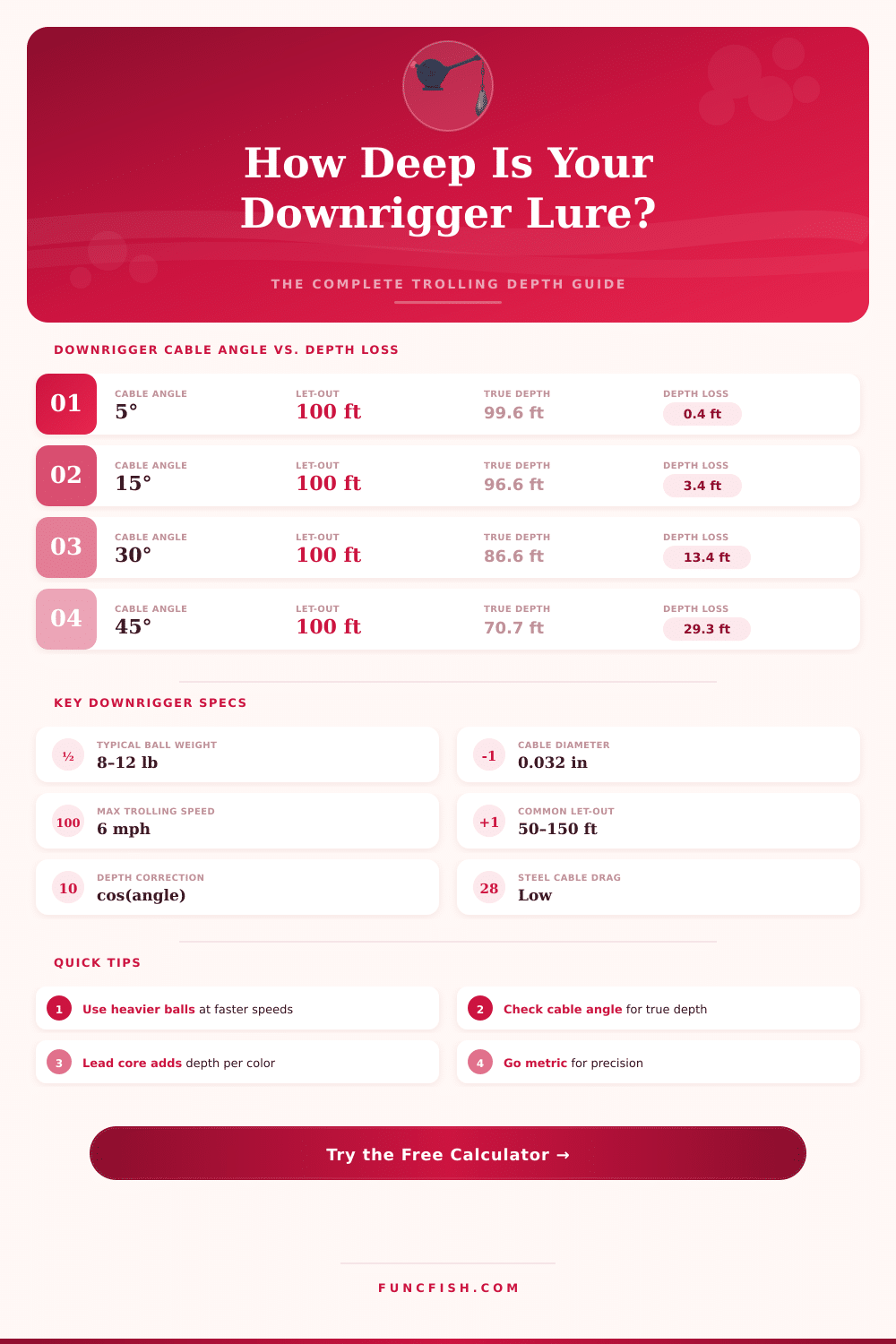
| Cable Angle | 100 ft Let-Out | True Depth (ft) | Depth Loss (%) |
|---|---|---|---|
| 0° (Ideal) | 100 ft | 100.0 ft (30.5 m) | 0% |
| 5° | 100 ft | 99.6 ft (30.4 m) | 0.4% |
| 10° | 100 ft | 98.5 ft (30.0 m) | 1.5% |
| 15° | 100 ft | 96.6 ft (29.4 m) | 3.4% |
| 20° | 100 ft | 94.0 ft (28.6 m) | 6.0% |
| 25° | 100 ft | 90.6 ft (27.6 m) | 9.4% |
| 30° | 100 ft | 86.6 ft (26.4 m) | 13.4% |
| 40° | 100 ft | 76.6 ft (23.4 m) | 23.4% |
| 45° | 100 ft | 70.7 ft (21.6 m) | 29.3% |
| Species | Typical Depth Range | Recommended Ball | Trolling Speed |
|---|---|---|---|
| Chinook Salmon | 60–180 ft (18–55 m) | 12–16 lb | 2.0–3.5 mph |
| Coho Salmon | 40–100 ft (12–30 m) | 8–12 lb | 2.5–4.0 mph |
| Kokanee | 30–80 ft (9–24 m) | 6–8 lb | 1.5–2.5 mph |
| Lake Trout | 80–200 ft (24–61 m) | 14–20 lb | 1.5–2.5 mph |
| Walleye | 20–60 ft (6–18 m) | 8–10 lb | 1.5–3.0 mph |
| Steelhead | 30–90 ft (9–27 m) | 8–12 lb | 2.0–3.5 mph |
| Striped Bass | 40–120 ft (12–37 m) | 10–14 lb | 3.0–5.0 mph |
| Brown Trout | 20–60 ft (6–18 m) | 6–10 lb | 2.0–3.0 mph |
| Cable Type | Diameter | Drag Factor | Best Use |
|---|---|---|---|
| Stainless Steel (0.032") | 0.81 mm | Medium | General trolling |
| Monel Wire (0.030") | 0.76 mm | Low–Med | Deepwater salmon |
| Lead-Core (0.040") | 1.02 mm | High | Shallow presentation |
| Spectra Braid (0.025") | 0.64 mm | Very Low | Minimal angle runs |
| Coated Cable (0.036") | 0.91 mm | Med–High | Versatile setups |
| Copper Wire (0.028") | 0.71 mm | Low | Great Lakes salmon |
True depth = Let-Out × cos(angle). At 30° you lose 13.4% depth. Use heavier balls or slower speeds to reduce cable angle and reach target depth accurately.
Lure setback (distance behind ball) adds horizontal distance but minimal depth. A 20 ft setback at 15° cable angle adds only about 5 ft of vertical offset — negligible at most depths.
A downrigger is a tool for fishing by trolling that puts the lure in the wanted depth. It has a three to six foot horizontal pole that holds a cannonball of around 10 to 15 pounds by a steel cable. The task of a downrigger is genuinely simple: it holds hundred feet of cable, lowers the weight through the water, holds it in the intended depth and then draws it back to the surface.
The counter shows how many cable is out and the fishing line binds to the line release
How to Use a Downrigger
By means of a downrigger you can put lures anywhere from 5 feet under the surface to 250 feet and keep them here faithfully. When you combine it with a depth sounder, you put the bait in the depth where the screen shows fish or marks. For depth control there is nothing better than a downrigger.
Eight pound weight works for fishing to around 50 feet depth and speed around 2.5 MPH. For 50 to 75 feet you require 10 pounds. Six to eight pounds suffice for many freshwater applications, while 10 pounds are standard for saltwater.
If you trawl in big sea with flow, use a heavier ball, otherwise it will clmib in the water and you will lose accuracy.
Remember that the line angle reduces the depth. At 3 knots you usually lose around 30 percent. So the bait is not at the right depth only because of the cable length, less because of the forward motion of the boat.
Stacking of several lines works well. First cast the bottom line and bind it to the ball, then lower the rig 5 to 10 feet. On the upper rod cast 10 to 15 feet more than below, clip the stacker release to the line and trim it to the downrigger cable.
Put the stacker 3 to 5 feet above the cannonball. During research space them, one at 20 feet, the other at 30. If fish are found, run downriggers 2 feet apart in the target depth.
Fish see only upward and forward, so keep lures above them and at least 30 to 50 feet behind the ship. The exact depth is not that important. Simply put the gear a bit above the target fish and they will come up.
Do not fish under the intended fish.
If you plan to trawl more than 35 feet depth, check the weight of the cannonball. Mini-rigs usually have a 2 pound ball, and 3 pounds helps keep the cable straight in big depth. Manual downriggers go to 100 feet or more, but electric models give advantages for bigger depth.