Downrigger Stacker Spacing Calculator
Estimate vertical lure separation, clip spacing along the cable, maximum stacker count, and tangle clearance for salmon, trout, kokanee, walleye, and lake trout trolling spreads.
📌Downrigger stacker presets
⚙Stacker spread settings
This is the shallowest lure in the stack after blowback is considered.
Use the lure depth closest to the cannonball, not just counter depth.
Measure the cable angle at trolling speed; steeper blowback needs more cable distance.
Long leads swing wider in turns and usually need more vertical separation.
Higher speed adds blowback and extra lure sweep, especially with flashers.
Enter 0 for automatic clearance from species, lure, release, setback, and water state.
Downrigger stacker spacing forecast
Calculation breakdown
📊Gear and species spacing grid
Kokanee Spoons
Trout Dodgers
Salmon Flashers
Laker Cowbells
📏Reference spacing tables
| Target and lure style | Calm minimum | Normal trolling gap | Rough or turning gap | Notes for stackers |
|---|---|---|---|---|
| Kokanee with small spoons or hoochies | 8 ft / 2.4 m | 10-14 ft / 3.0-4.3 m | 14-18 ft / 4.3-5.5 m | Short setbacks allow dense ladders near the thermocline. |
| Rainbow trout with spoons | 9 ft / 2.7 m | 12-16 ft / 3.7-4.9 m | 16-22 ft / 4.9-6.7 m | Long clear-water leads need added turn room. |
| Sockeye or coho with dodgers | 12 ft / 3.7 m | 15-20 ft / 4.6-6.1 m | 20-28 ft / 6.1-8.5 m | Dodger kick widens lure sweep behind the release. |
| Chinook with rotating flashers | 15 ft / 4.6 m | 20-28 ft / 6.1-8.5 m | 28-38 ft / 8.5-11.6 m | Keep flasher rigs below smaller spoons when mixed. |
| Lake trout with cowbells or gang trolls | 20 ft / 6.1 m | 25-34 ft / 7.6-10.4 m | 34-45 ft / 10.4-13.7 m | Wide rotating hardware should be the lowest rod. |
| Walleye with plugs or cranks | 10 ft / 3.0 m | 14-20 ft / 4.3-6.1 m | 20-28 ft / 6.1-8.5 m | Diving plugs may climb or dig during speed changes. |
| Cable angle from vertical | Depth loss at 100 ft cable | Cable distance for 10 ft vertical gap | Horizontal offset per 10 ft gap | Spacing effect |
|---|---|---|---|---|
| 5 degrees | 0.4 ft / 0.1 m | 10.0 ft / 3.0 m | 0.9 ft / 0.3 m | Almost vertical; clip marks match target depth closely. |
| 10 degrees | 1.5 ft / 0.5 m | 10.2 ft / 3.1 m | 1.8 ft / 0.5 m | Small correction, common with heavy balls and moderate speed. |
| 15 degrees | 3.4 ft / 1.0 m | 10.4 ft / 3.2 m | 2.7 ft / 0.8 m | Mark cable spacing slightly longer than vertical spacing. |
| 20 degrees | 6.0 ft / 1.8 m | 10.6 ft / 3.2 m | 3.6 ft / 1.1 m | Turning clearance starts to matter with longer setbacks. |
| 25 degrees | 9.4 ft / 2.9 m | 11.0 ft / 3.4 m | 4.7 ft / 1.4 m | Use fewer rods or widen the depth ladder. |
| 30 degrees | 13.4 ft / 4.1 m | 11.5 ft / 3.5 m | 5.8 ft / 1.8 m | Dense stackers become vulnerable during turns. |
| 35 degrees | 18.1 ft / 5.5 m | 12.2 ft / 3.7 m | 7.0 ft / 2.1 m | Consider a heavier ball or separate downrigger. |
| Release or attachment | Typical cable allowance | Best use | Stacking caution | Spacing adjustment |
|---|---|---|---|---|
| Pinch-pad stacker clip | 4-6 ft / 1.2-1.8 m | Trout, kokanee, mixed spoons | May slide on coated cable if overloaded. | Add 1-2 ft for long leads. |
| Dual snap cable stacker | 5-7 ft / 1.5-2.1 m | General salmon and trout | Clip hardware occupies extra cable length. | Add 2 ft when using flashers. |
| Adjustable tension release | 6-8 ft / 1.8-2.4 m | Chinook, stripers, heavy trout | High tension can trip adjacent rods in a surge. | Add 10% in rough water. |
| Rubber band on cable | 5-8 ft / 1.5-2.4 m | Sockeye, kokanee, light bites | Band stretch changes release angle before strike. | Add 1 ft for dodger rigs. |
| Fixed slider above ball | 8-12 ft / 2.4-3.7 m | Two-lure trout spreads | Slider can ride down after turns or weeds. | Keep below spoon-only rigs. |
| Heavy salmon release | 8-10 ft / 2.4-3.0 m | Deep flasher and meat rigs | Wide lure roll and long lead require room. | Add 25-45% clearance. |
| Stack layout | Best depth spread | Typical rods | When to use | Layout rule |
|---|---|---|---|---|
| Even ladder | 25-80 ft / 7.6-24.4 m | 3-5 rods | Searching suspended fish with similar lures. | Use equal target gaps from top lure to bottom lure. |
| Tight upper pair | 20-60 ft / 6.1-18.3 m | 3-4 rods | Fish are stacked above a thermocline edge. | Keep the widest hardware lowest in the spread. |
| Tight lower pair | 30-90 ft / 9.1-27.4 m | 3 rods | Bottom-oriented lakers, kings, or walleye. | Give the ball-line lure the cleanest lane. |
| Thermocline center | 20-70 ft / 6.1-21.3 m | 3-5 rods | Bait and marks are clustered around one band. | Place the middle rod at the temperature break. |
| Probe clearance | 35-100 ft / 10.7-30.5 m | 2-4 rods | Downrigger has a speed and temp probe. | Add room above the probe-side ball line. |
💡Stacker spacing notes
Mark the cable by corrected cable distance. If the calculator says 18 ft vertical gap at a 25 degree cable angle, the clip mark along the cable is longer than 18 ft because the cable is leaning behind the boat.
Put the widest-swinging rig lowest. Flashers, meat rigs, and cowbells roll through more water than spoons, so the bottom or deepest rod should get the cleanest lane and the largest adjacent gap.
It’s happening. You’ve got three rods on a downrigger cable. Your spoons are stacked up. You’re trolling a good-looking lake. On your fish finder, you see lots of bait suspended at mid depth. So you drop the ball to get down there. You put it on top clip. Then the next one. And then the last. All systems looks good as you begin to move along. Everything is great for a few minutes before you hit the corner. Make your turn to stay on the contour. The middle clip swings open wide, catches the rod below it, and now you have two lures wrapped together into a mess that takes half an hour to untangle back on deck of the boat.
It is not bad luck. It is bad math. Most folks use stacker clips that are all set to one vertical depth. They don’t consider how far out they need the cable to go or what angle will be. That’s where this calculator works out the geometry for you and converts your desired depths into actual length of cable needed to avoid interference between your lures.
How to Stop Tangled Fishing Lines
That’s really the point though: When you’re towing a downrigger, its cable doesn’t hang straight down. Ever. The line resists water and creates an angle between your lure and boat. That angle increases as you increase depth and/or trolling speed. So if you mark off 10-feet of cable with clips, expecting them to always be 10-feet apart vertically, chances are they won’t be. Depending on how far that cable leans back (the “blowback” angle), those clips should of actually be spaced farther apart on the wire to keep them evenly spaced vertically.
This nifty little tool does all of this calculation for you without making you guess how much additional slack you’ll add between release clips. Enter your trolling speed plus estimated cable angle and it figures out how much spacing you’d need to keep your lures in their proper lanes despite a leaning-backward cable.
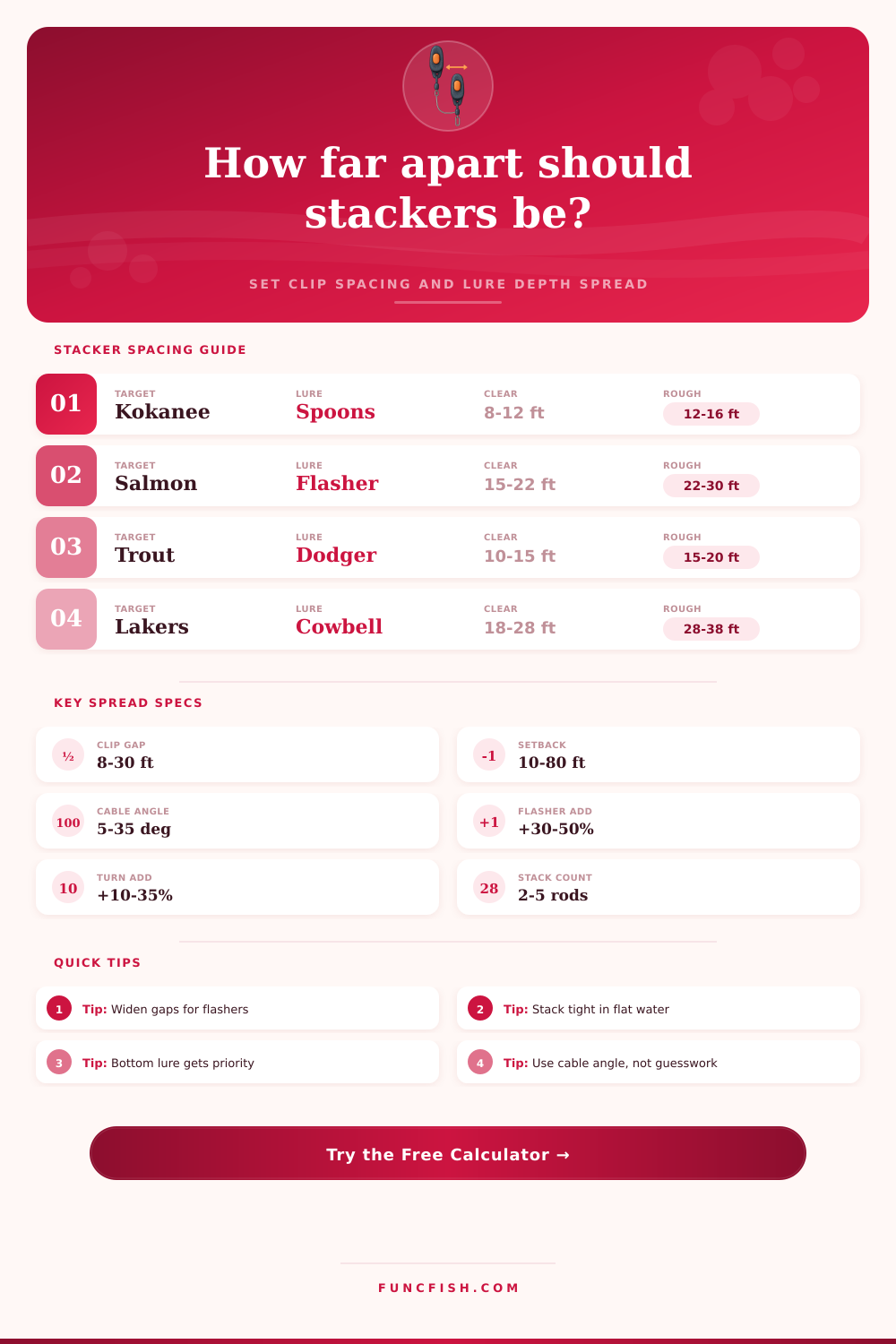
The amount of space required for these rigs to swing will depend heavily based off lure type. You can really stack your rods up in a narrow band of depth when using a small spoon for koke, since it’s not swinging out too far back from your line. On the other hand, cowbell/flashers really take up a lot of space horizontally as they dive and spin around. They’ll need much more space between them vertically to keep from getting in each other’s way. The tables on the page will break this down by lure type/sport so you can see that while you may be able to get away with eight to twelve feet apart between spoons in calm conditions, you’re probably looking at fifteen feet or more between flashers to even begin with.
When mixing lure styles, the rule here is: Bottom rod should have widest-swinging lure. Because the deeper lure has less chance of fouling anything above it, it also gets the cleanest wake. Putting something like a spinning flasher over a tight spoon is a recipe for disaster.
Your geometry changes with turns. Straight steering results in a fairly consistent train of lures following behind. Turns cause centrifugal force to push the outermost rod outward and pull inner rods inward, compressing them closer together. Compressing the rods causes a decrease in the vertical space between them (at least temporarily), the prime time for tangling. To account for this, the calculator allow you to enter how much you’re turning or what the water conditions are. For example, if you make frequent S-turns to cover structure, the system increases the spacing recommendations to give you some wiggle room. It takes a percentage from the baseline clearance and ensures the lures never intersect on the worst part of their turn’s swing.
That’s why we often see tournament boats with less rods per cable when making an aggressive maneuver or working in choppy conditions. The temptation is always there to put more stuff out there, but overdoing it with rod stacks is also something we see people do. At some point there are too many rods to safely position within the depth window. When you go too heavy… Say stuffing five rods into a twenty foot spread… Inevitably you’re going to either be overlapping the effective areas of lures, or the rods will clip each other upon release.
The formula use your overall depth range and the amount of clearance space required for the particular lures you’re using to come up with a safe number of rods to stack. So when it tells you that you can only use two rods, don’t take that as an option, take it as physics limiting what’s possible.
When you respect the physics, your gear stays in the water where it should be, rather than in your hand trying to unravel a tangle. You want to present consistently with no interference from your other lures. Each lure in your spread fishes at its target depth and lane. Spacing is everything. The fewer mistakes you make, the more you can fish. Less time troubleshooting translates to more time trolling. A disciplined approach becomes a planned system for covering water. If the math adds up, the fishing will feel naturaly. Don’t worry about the tangle; just focus on the bite. Peace of mind is what’s worth the few minutes it takes running the numbers prior to launch day.