Drag to Breaking Strain Ratio Calculator
Compare reel drag against the weakest true breaking link after knots, leader, rod pressure, reel range, line stretch, cover, and shock load.
📌Scenario presets
⚙Drag and line settings
Drag ratio forecast
Full breakdown
📋Line and drag reference grid
Monofilament
Fluorocarbon
8-Strand Braid
4-Strand Braid
Wire Leader
Fly Tippet
Dacron Trolling
Rod Limit
📊Ratio reference tables
| Line material | Typical safe ratio | Why it shifts | Watch point |
|---|---|---|---|
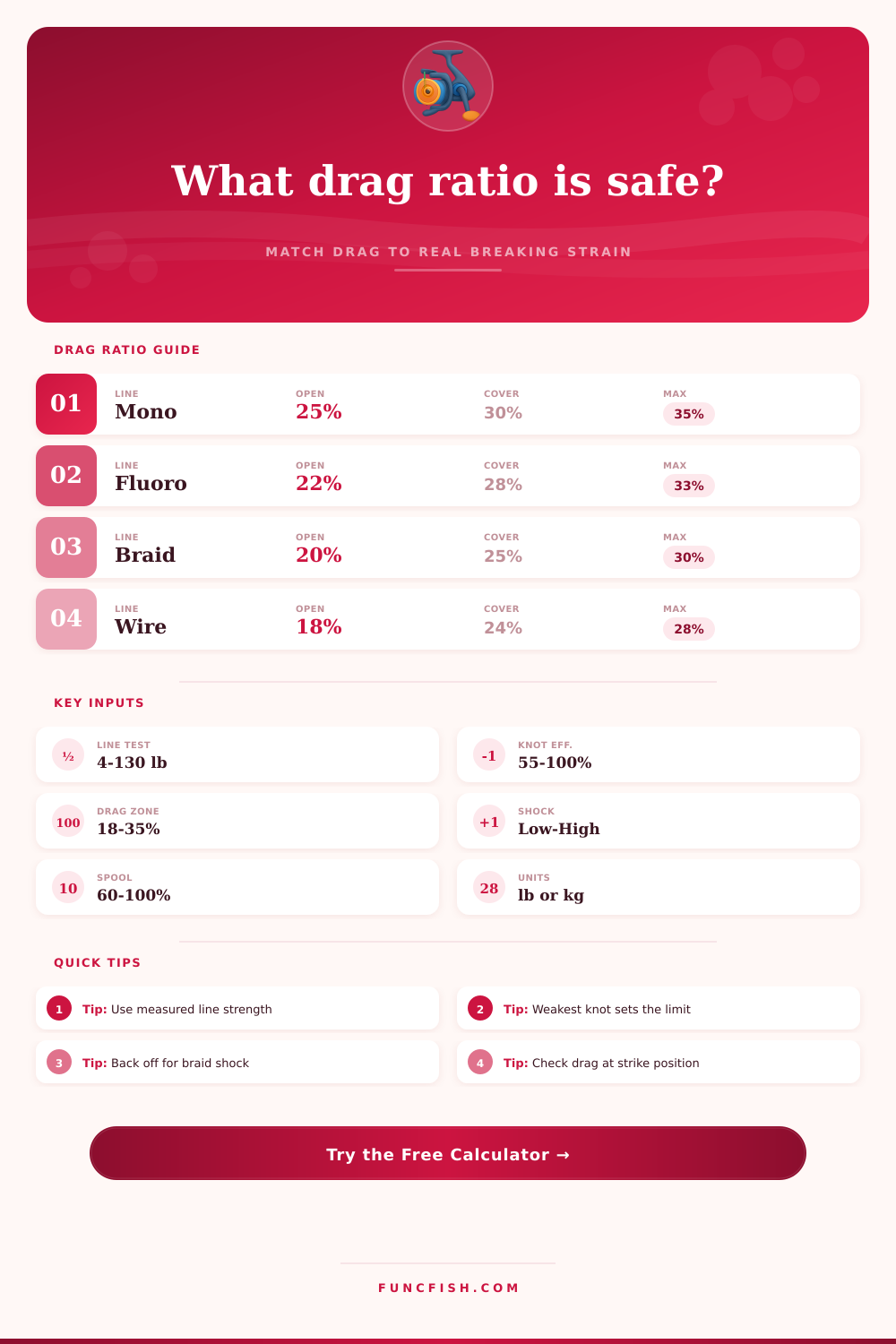
| Monofilament | 25-33% of true break | Stretch buffers shock load | Old mono can test below rating |
| Fluorocarbon | 22-30% of true break | Less forgiving around knots | Terminal knot often controls |
| Braid | 18-28% of true break | Very low stretch transfers shock | Leader knot and spool slip |
| Wire leader | 18-26% of true break | No stretch and crimp dependency | Crimps, sleeves, and rod tip |
| Fly tippet | 16-24% of true break | Fine diameter and sudden runs | Tippet knots and light rods |
| Fishing situation | Starting drag ratio | Adjustment | Reason |
|---|---|---|---|
| Open water spinning | 22-26% | Neutral | Fish can run without sawing line |
| Weeds or timber | 26-32% | Higher | Need early turn pressure |
| Abrasive reef or shell | 20-27% | Lower | Abrasion weakens the true link |
| Trolling strike position | 25-33% | Moderate | Set at strike, not full lever |
| Fly tippet fishing | 16-22% | Lower | Small knots and light rod angle |
| Rod class | Working drag band | Metric band | Typical match |
|---|---|---|---|
| Ultralight | 0.5-2.0 lb | 0.2-0.9 kg | Panfish, trout, tippet |
| Light | 1.0-4.0 lb | 0.5-1.8 kg | Trout, finesse bass |
| Medium light | 2.0-6.0 lb | 0.9-2.7 kg | Walleye, inshore finesse |
| Medium | 3.0-8.0 lb | 1.4-3.6 kg | Bass, light inshore |
| Medium heavy | 5.0-12.0 lb | 2.3-5.4 kg | Cover bass, surf, pike |
| Heavy | 8.0-18.0 lb | 3.6-8.2 kg | Catfish, heavy cover |
| Stand-up offshore | 12.0-35.0 lb | 5.4-15.9 kg | Trolling and offshore |
💡Practical checks
Tip: A drag scale reading near the reel can rise at the hook when the rod angle is high. Treat the calculator result as a strike setting, then test with the rod loaded.
Tip: If the weakest link is a leader or terminal knot, reducing drag is usually cleaner than increasing main line. The hook only sees the weakest true connection.
The fishing line, knots, and the fishing lines leaders will experiences the same sudden pull when a fish make a run, and the fishing reel will have to withstand the same sudden pull. The drag settings on the fishing reel will determine whether the fishs pull is within a safe zone for the fishing line or whether it exceed the strength of the fishing line. Many fisherman will adjust the drag of their fishing reel based off a feeling or the percentage of the fishing lines rating.
However, the rating of the fishing line on the spool is often inaccurate due to the strength loss of the fishing line at the knots and due to nick on the fishing line. The part of the fishing tackle that break first after the fishing line is tied into knots and features nicks will determine the actual strength of the fishing line. A knot could only hold 80% of the strength of the main fishing line.
How to Set Your Fishing Reel Drag
Furthermore, a leader knot could only hold 75% of the strength of the main fishing line. Thus, there is a loss of the strength of the fishing line at these knots. The calculator remove the guesswork involved in determining the actual strength of the fishing line by allowing the user to input these variables so that the calculator can provide the user with the actual margin of safety of the fishing line.
The type of cover in which you cast the fishing line will change the fishing lines reaction to the pull of the fish. When using cover, a firmer drag setting is required so that the fish cant reach the cover. However, applying firm drag pressure against shells or bridge pilings may lead to the fishing line get cut.
The calculator allows the user to flag these differences so that the strike drag recommendation account for abrasion loss. This way, user will
Using a soft fishing rod and a fish that you can maintain a steady drag will allow you to use a more higher drag setting. A stiff fishing rod and a fish that rush your reel will have a multiplied force on the knot.
The drag calculation accounts for the force multiplier so that the drag setting for your fishing reel will include the force of the rush of the fish that you are pursuing. The strength of the fishing tackle include the power of the fishing rod and the capacity of the fishing reel. Generally, a medium-heavy fishing rod can handle more pressure then an ultralight fishing rod.
However, the drag of a fishing reel may diminish as the fishing rod become empty of line due to the diminishing diameter of the line on the spool. Both of these factor are accounted for in the drag calculation so that a fisherman can understand which component of the fishing tackle is the weakest link. To determine the appropriate drag setting for your fishing reel, you should measure the drag of your fishing reel at the strike position while using your fishing rod in the same fashion as you normaly fish.
This drag measurement should be compared to the weakest link of the fishing tackle as calculated. If the ratio of the drag of the fishing reel to the weakest link of the fishing tackle fall within the target band, then there is enough margin to fight the fish. If the ratio is too high, then you should back off the drag of the fishing reel by a quarter turn as this adjustment is more advantageous than changing the leader of the fishing line.
Maintaining a margin of safety with the drag of your fishing reel will keep your light tippet intact and will prevent your fishing braid from saw through the knot on the fishing line when the fish rushes towards cover. These calculations will provide you with number that you must apply to your fishing situation as these number will determine whether you are successful in landing the fish or not.