Dry Dropper Distance Calculator
Estimate the dry-to-dropper length that puts the lower fly in the target feeding lane while accounting for current angle, tippet drag, nymph weight, and dry fly float capacity.
📌Scenario presets
⚙Rig and water settings
Dry dropper spacing forecast
Full breakdown
📋Dropper material grid
7X Nylon
6X Nylon
5X Fluoro
4X Nylon
📏Spacing reference tables
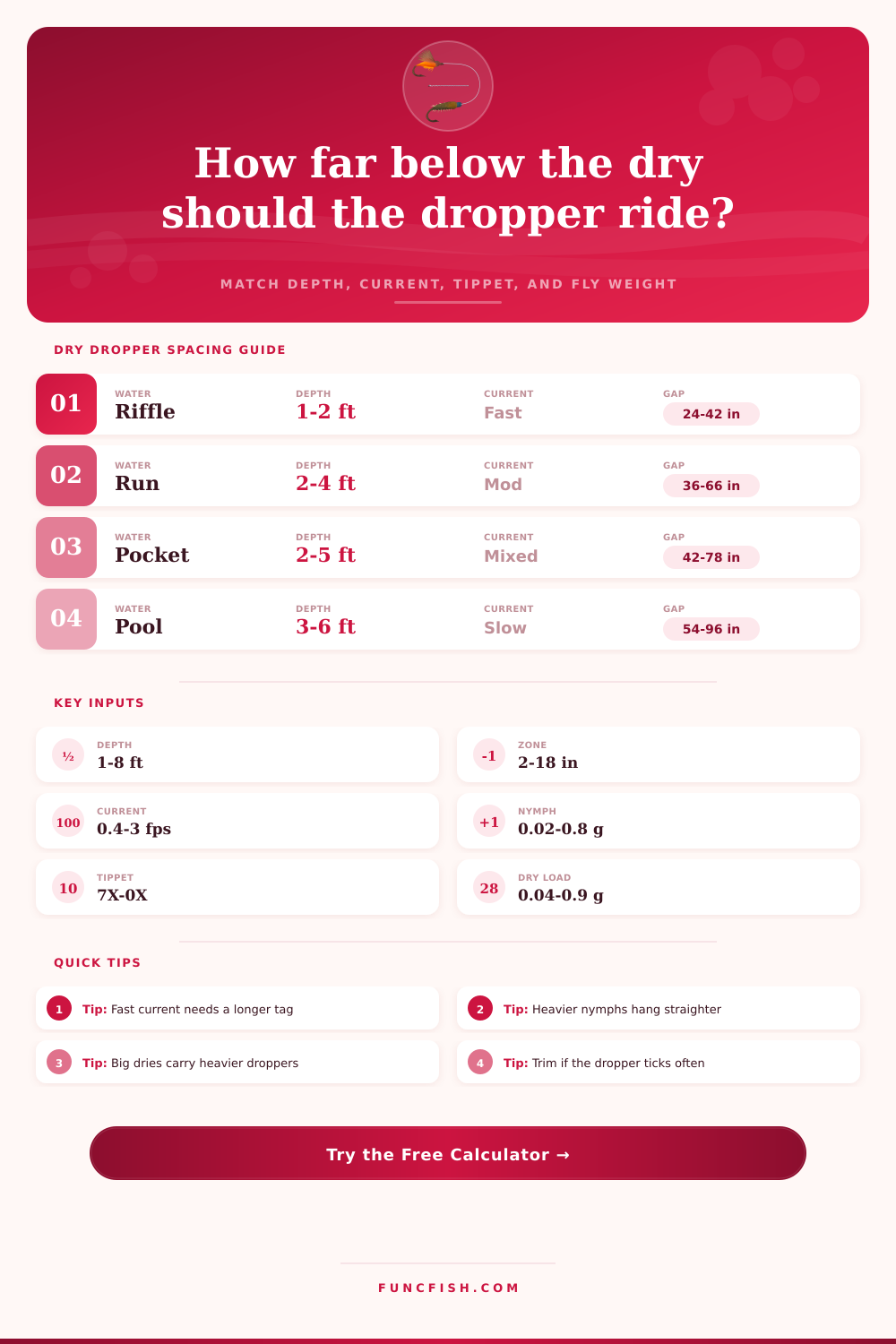
| Water type | Typical depth | Starting distance | Adjustment cue |
|---|---|---|---|
| Shallow riffle | 1-2 ft / 0.3-0.6 m | 24-42 in / 61-107 cm | Add length when fly sweeps high |
| Even run | 2-4 ft / 0.6-1.2 m | 36-66 in / 91-168 cm | Match lower-third feeding lane |
| Pocket seam | 2-5 ft / 0.6-1.5 m | 42-78 in / 107-198 cm | Use heavier nymph in churn |
| Tailout | 2-5 ft / 0.6-1.5 m | 48-84 in / 122-213 cm | Lengthen gently for slow water |
| Stillwater edge | 3-8 ft / 0.9-2.4 m | 60-120 in / 152-305 cm | Set depth below chop line |
| Dropper fly | Approx mass | Sink tendency | Dry fly match |
|---|---|---|---|
| Unweighted emerger #18 | 0.02 g | Very slow | Tiny dry or larger |
| Brassie bead #18 | 0.08 g | Slow | Parachute or caddis |
| Tungsten #18-20 | 0.12 g | Moderate | Elk hair or caddis |
| Tungsten #14-16 | 0.25 g | Fast | Stimulator or hopper |
| Tungsten #10-12 | 0.45 g | Very fast | Foam hopper or indicator dry |
| Fly plus micro shot | 0.75 g | Anchor | Indicator dry only |
| Target fish | Feeding lane | Common tippet | Spacing bias |
|---|---|---|---|
| Trout | Lower third | 5X-6X | Neutral |
| Cutthroat | Mid to lower | 4X-5X | Slight shorter |
| Grayling | Mid column | 5X-7X | Shorter |
| Panfish | Weed edge | 4X-6X | Neutral |
| Smallmouth bass | Near bottom | 2X-4X | Longer |
| Carp | Bottom skim | 3X-5X | Longer |
| Attachment | Angle effect | Tangle risk | Best use |
|---|---|---|---|
| Hook bend | Neutral | Low | Simple trout rigs |
| Dry fly eye | Slight high | Low | Small dries |
| Tag off leader | Slight low | Medium | Two-fly turnover |
| Tippet ring above dry | Neutral | Medium | Quick depth changes |
💡Rig checks
Depth check: If the dropper never touches and fish are holding low, add 6-12 inches or switch to a denser fly before rebuilding the whole leader.
Float check: If the dry dunks repeatedly on a clean drift, shorten the distance, use a lighter dropper, or choose a dry with more float capacity.
A dry dropper rig is something most anglers tie up, tie some extra tippet to and hope for the best. Take some leader material, knot it under float, heave it out there and wing it from there. Sometimes it works, usually because of luck. Intuition have nothing to do with it, and neither does how much line you cast out. The fish don’t give a flip.
They inhabit certain lanes dictated by depth, current speed, and food availability. When they feed, it’s often several feet beneath a floating fly, so you’re fishing in air if your nymph is floating three feet above where the trout are feeding. And if your fly is dragging the bottom when a soft, subtle drift is called for, you’ll be missing fish that never touch your tippet, no bite registered at all.
How to Set Up Your Dry Dropper Rig Correctly
To get it right, you must gets the distance correct. This is where the calculator figures out how much tippet to use to put that nymph in feeding lane of the target. And it doesn’t assume that the water in which you’re fishing is still. Because most of the time it isn’t.
If you consider your casting angle and speed of current, your dropper won’t hang vertically. It will pendulum back and forth, swinging downstream. If there’s any current strength, the bottom fly gets pulled sideways by the current and the dry stays high above it near surface. That means you may require a lot longer tippet than your estimated depth would show to get that nymph down there. This hydrodynamic angle is something the tool takes into consideration so you don’t end up fishing too shallow.
All variables change the equation, so choosing your inputs is important. To establish a starting point, figure out what kind of water it is and get an idea of the depth. Next, factor in surface current speed. Longer tags can offset the drag caused by a nymph moving up-current faster than it sinks, so you may want one in fast riffle situations. Conversely, a slow pool allow you to keep things tighter.
Your dropper fly’s weight is another key element of this equation. Quick-sinking tungsten beads will force your line more vertical and help counteract any drag from the tippet pulling down. Maybe you don’t have to make the rig as long to get it to the target depth as you would with an unweighted emerger that depends on nothing but gravity and drag. Also, heavier flies won’t get blown laterally as much and stay in the fish face a bit longer throughout the drift.
It’s important to note the float capacity of this system is a structural limit: the dry fly you choose is its anchor. You can’t put the same downward pull on a tiny size twenty parachute adams as you could a big stimulator pattern or an even bigger foam hopper. If you hang a heavy tungsten nymph off a dainty dry in a fast current, the weight of the nymph will pull the dry under. That messes up your drift, not to mention probably spooks any fish looking at the commotion below. The load margin check by the calculator ensures your float can bear the burden of whatever you have attached below without sinking too soon.
A large elk hair caddis paired with something heavier on the backside fares well in a more moderate run, since the buoyant dry keeps the line taut and vertical, letting the dropper get down efficienty.
The second level of nuance comes in choosing tippet material. Because fluorocarbon is denser than nylon it sinks faster which gives the nymph more time on the bottom but also increases resistance against current, whereas nylon floats better and creates less drag, which is good in shallow riffles when you need that natural drift. Conversely, nylon floats better and creates less drag then fluorocarbon, which can be beneficial in shallow riffles where you want a natural drift.
And then there’s diameter. A thicker tippet has more surface area to resist water pushing against it, which changes the angle of the line. This may have no effect on fly weight. A fine tippet slices through water with minimal resistance, while a thicker section act like a parachute. These details make sense, and help you go beyond guessing a length and refine your set up.
Failing to account for current speed and cast angle causes common errors. A mostly-upstream cast minimizes side pull on the dropper so you can use shorter tags to get them deep. Downstream casts increase side pull. More line is needed to keep it vertical. Constantly missing means many anglers are locked into one go-to length, no matter what.
To help start somewhere, there’s a set of reference tables in the tool indicating starting points by your usual depths and water type. Think of these as guidelines, not gospel. Tweak accordingly in real time depending on what the rig does out on the water.
There’s no magic formula for understanding dry dropper spacing; it’s not something you can memorize. Rather, it’s all about feeling the connection between your line, fly, and current. For instance, learning whether your nymph is dragging too much or hanging up too high requires practice. But begin with the approximations of your line length that the calculator gives you and tweak as you see fit out on the water.
The more you do it, the better you’ll get at fine tuning your distance. Knowing where to place your fly doesn’t happen overnight, but if you have a good starting point you don’t waste time spinning your wheels trying things out randomly. After some time, you know just how heavy, deep, and fast your river runs. You’ll put your fly right where it should go. That change in thought process changes your days on the river from frustrating to productive.