Elastic Stretch Ratio by Grade Calculator
Estimate fishing line elongation from line grade, material, free line length, drag load, water temperature, fatigue, and shock multiplier.
📌Scenario presets
⚙Line stretch inputs
Stretch estimate
Calculation breakdown
🧵Material stretch data
Nylon Mono
Fluorocarbon
Copolymer
Braid
📊Line grade reference
| Grade | Typical test | Grade multiplier | Common diameter | Stretch behavior |
|---|---|---|---|---|
| Ultralight | 2-6 lb / 0.9-2.7 kg | 1.16x | 0.004-0.009 in | More elastic feel; protects small hooks and thin tippet. |
| Light | 6-10 lb / 2.7-4.5 kg | 1.08x | 0.008-0.011 in | Moderate cushion for trout, panfish, finesse bass, and walleye. |
| Medium | 10-17 lb / 4.5-7.7 kg | 1.00x | 0.010-0.015 in | Baseline grade for most spinning and casting stretch estimates. |
| Medium-heavy | 17-30 lb / 7.7-13.6 kg | 0.93x | 0.014-0.022 in | Thicker line stretches a bit less at the same load ratio. |
| Heavy | 30-60 lb / 13.6-27.2 kg | 0.86x | 0.020-0.034 in | Lower elongation and more direct pressure for heavy cover. |
| Offshore | 60-130 lb / 27-59 kg | 0.78x | 0.030-0.055 in | Large diameter and splices reduce stretch ratio under steady drag. |
| Wire bite | 20-90 lb / 9-41 kg | 0.45x | 0.010-0.030 in | Almost no cushion; rod bend and drag must absorb shock. |
🐟Species and gear comparison
Trout
12-24%Light mono or nylon tippet lets small hooks stay pinned during fast shakes.
Bass
3-20%Braid is direct for frogs; mono is forgiving for crankbaits and trebles.
Walleye
7-14%Fluoro leaders balance bite feel with enough stretch for light jig hooks.
Catfish
10-18%Heavy mono cushions surges when circle hooks and bottom rigs load slowly.
Surf Species
14-22%Shock leaders need stretch for casting load and wave-driven head shakes.
Pike
1-6%Wire and braid stretch little, so drag slip and rod cushion matter.
Salmon
9-18%Float or drift rigs usually benefit from moderate mono or copolymer cushion.
Tuna
2-10%Hollow braid has low stretch; mono topshots add shock absorption offshore.
📐Material coefficient table
| Material | Model stretch at 33% load | Load curve exponent | Diameter effect | Fishing fit |
|---|---|---|---|---|
| Nylon monofilament | 18% | 1.10 | Medium | Crankbaits, live bait, surf, and treble hook cushion. |
| Hard mono shock leader | 15% | 1.06 | Medium-high | Surf casting leaders and offshore wind-on topshots. |
| Fluorocarbon leader | 9% | 1.15 | High | Jigs, bottom contact, abrasion leaders, and clear water rigs. |
| Copolymer line | 14% | 1.08 | Medium | All-round main line where mono cushion feels too soft. |
| 8-carrier braid | 2.2% | 1.20 | Low | Frogs, punching, deep jigging, and long casts needing sensitivity. |
| Hollow-core braid | 3.6% | 1.16 | Low | Offshore splices, topshots, and big-game drag pressure. |
| Nylon fly tippet | 20% | 1.12 | Medium | Light tippet protection for trout, panfish, and small-stream rigs. |
| Coated wire leader | 1.1% | 1.04 | Very low | Pike, musky, mackerel, and bite protection ahead of lures. |
🎣Drag and stretch matching table
| Technique | Useful stretch target | Usual drag load | Rod pairing | Line note |
|---|---|---|---|---|
| Trout dry fly | 14-24% | 15-25% of tippet | Soft or moderate | High stretch protects tiny hooks and tippet knots. |
| Bass crankbait | 12-20% | 22-30% of line | Moderate | Mono or copolymer slows surges on treble hooks. |
| Walleye jig | 6-12% | 20-28% of line | Fast | Fluoro leader gives contact feel without feeling rigid. |
| Frog in cover | 1-4% | 25-35% of braid | Heavy fast | Low stretch drives hooks, but margin drops on hard hooksets. |
| Surf bait | 14-22% | 25-33% of leader | Long moderate | Shock leaders need elongation during casting and wash. |
| Catfish circle hook | 10-18% | 25-33% of line | Moderate-heavy | Steady loading works well with mono cushion. |
| Pike jerkbait | 1-6% | 20-30% of line | Fast or moderate-fast | Wire leader adds bite safety but almost no stretch. |
| Tuna jigging | 2-10% | 25-40% of line | Parabolic | Braid needs rod bend, drag smoothness, or mono topshot. |
🌡Adjustment factors
| Adjustment | Stretch effect | Strength effect | Use in calculator | Fishing interpretation |
|---|---|---|---|---|
| Cold water | 0.92x | 1.00x | Temperature multiplier | Line feels crisper, especially fluorocarbon and stiff mono. |
| Warm water | 1.06x | 0.98x | Temperature multiplier | Nylon softens and recovers slower after hard stretch. |
| Abraded line | 1.03x | 0.82x | Condition multiplier | Small nicks reduce useful margin before stretch is helpful. |
| Sun-aged mono | 0.95x | 0.76x | Condition multiplier | Old mono may feel stiffer while breaking earlier. |
| Hard hookset | No direct change | 1.45x load | Shock multiplier | Instant load can exceed the steady drag estimate. |
| Parabolic rod | 0.82x demand | More cushion | Rod cushion factor | Rod bend absorbs part of the shock before line elongates. |
💡Stretch calculation tips
Use real free length: Stretch comes from the line actually outside the rod tip. A 12 ft leader tied to braid will not add much cushion if only 6 ft is under load.
Check shock load: If the margin card drops below 1.0x, lower drag, add a more elastic leader, or rely on a softer rod before pulling harder.
Bass are tucked up under thick cover. You set the hook, rip hard, and the line breaks. How many times? We approach fishing line as if it were a piece of static string instead of an elastic band. We focus on its pound test, not on how much it stretches.
Once you input your lines material and grade into the calculator (above), math gets done for you. There is no more guesswork. You won’t have to wonder if your drag setting is realy safe or just wishful thinking. Giving the line some elastic stretch are like an insurance policy on your stuff. In other words, if you get hung up or hit something hard or make a big run, the line need to take up the slack and protect your equipment from breaking. Without any stretch in your line, all that shock is transferred straight through to the first weak link in the chain. That could mean the hook eye, the knot or even drag washers themselves.
Why Line Stretch Matters When Fishing
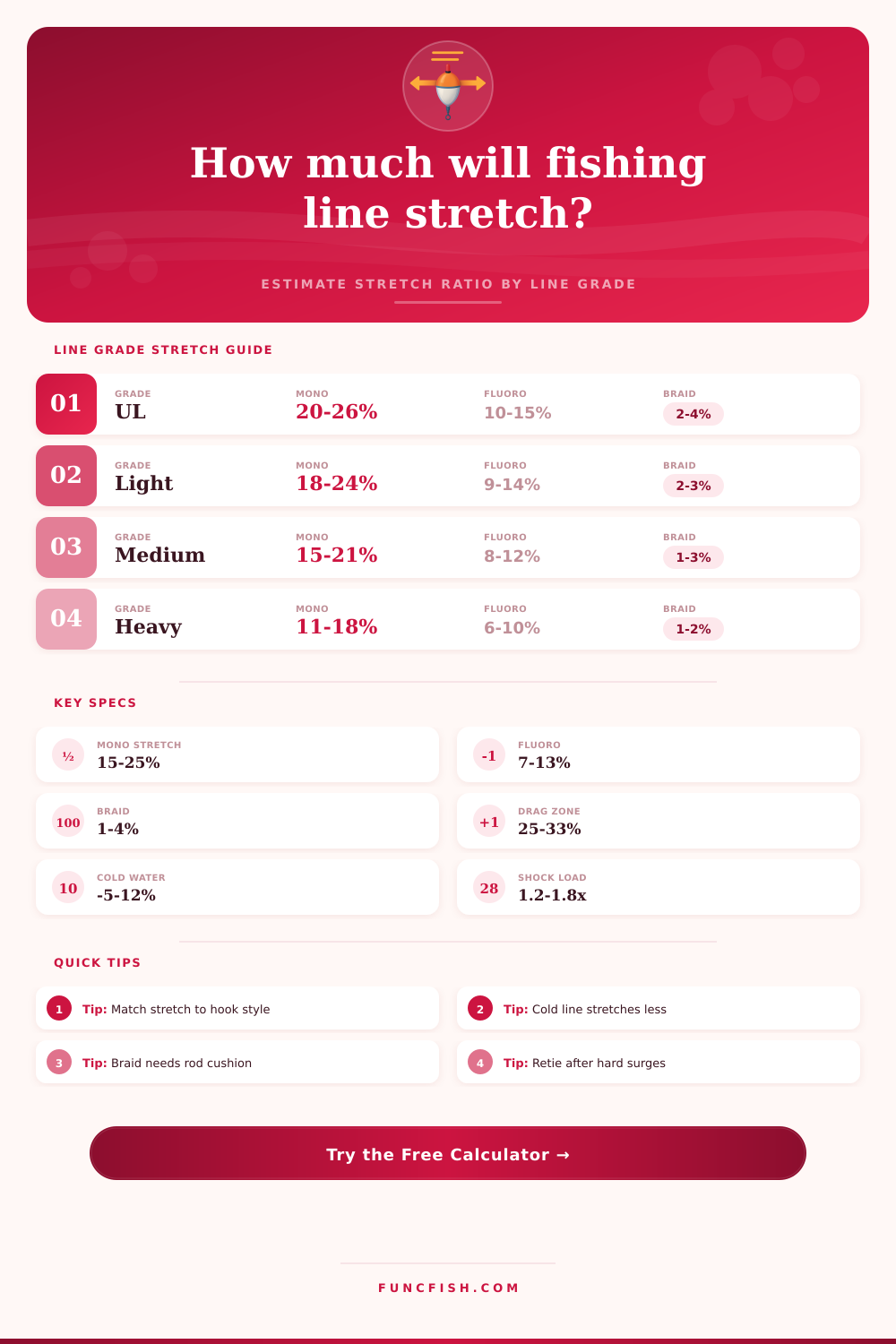
The key is not necessarily choosing the strongest pound test but matching the right stretch for the scenario. Lines also change a lot in cold water. Both fluorocarbon and monofilament gets stiffer in the cold. What felt soft on your reel in July can feel like wire in January. Molecules tighten so you don’t have as much elasticity. If you’re fishing deep cold water, you may want to back off your drag setting or change to a more elastic leader material. The tool use multipliers to account for how polymers react to thermal stress.
Braid changes the equation completely as it has almost no stretch. At normal loads, most of today’s braids has less than two percent stretch. That’s good for sensitivity. You get to feel what’s happening on the bottom with each little peck. This is bad for shock absorption with a too-stiff rod and/or overly tight drag. It’s a trade-off between cushion and straight line connection. Braid require a fluorocarbon leader that introduces some elasticity back into the setup when used with a high drag/fast-action rod. The material coefficient table show the difference between the eight-carrier braid and the hollow core version.
In the real world, the bottom line is that less stretch mean you manage shock differently. This is also where the hidden role of rod action come into play. As the name implies, parabolic and slow action rods will bend throughout their length. This creates a second level of shock absorption that counteracts lack of stretch in these lines. Because the line loads immediately, a stiff fast-action rod transfer almost all of that force straight to the line. For this reason, many heavy cover guys uses heavy mono or fluoro leaders on stiff rods so they can get the feel of braids when setting hooks but still have some stretch to absorb the force.
A reduced margin of error improves knot efficiency. No knot has 100% of the line strength it started with. A poorly tied, bulky, or rushed knot may retain just 70%. When determining how much drag you can set based off new line strength, you’re leaving yourself with far more wiggle room than needed. Inputting knot efficiency into the calculator account for that fact. It is better to err on the side of caution and lose the fish then to snap off the leader three feet before reaching the net.
Consider free line length as well. Only actual line between the fish and your rod tip can stretch. So if you’re using a ten foot mono leader with 50 feet of braid, then nearly all of your stretch occur in those ten feet. Anything beyond that will simply add drag and weight to the rig. Knowing where the stretch exists will help you create better terminal tackle setups for certain species.
This is about energy management. Fishing is all about transferring energy as the line stretches, the rod bends, the drag slips, and the fish runs. If any part of that chain break under load, the fight’s over. With tools to gauge those variables, it’s not guessing anymore, it’s strategy. No longer do you hope your knot will hold; now you know why it should of. Knowing makes for more hooked fish and less wasted leader in the trash.