Electric Reel Line Capacity Calculator
Estimate electric reel braid capacity from spool dimensions, published reel ratings, PE line diameter, packing tension, lip clearance, and deep-drop reserve so line counters and depth plans start closer.
📌Scenario presets
⚙Reel, line, and depth inputs
Electric reel capacity results
Calculation breakdown
🧵Electric reel line data
8-Carrier PE
12-Carrier PE
Hollow Braid
Coated Braid
📊Capacity planning table
| Electric reel job | Common line class | Planning reserve | Capacity concern |
|---|---|---|---|
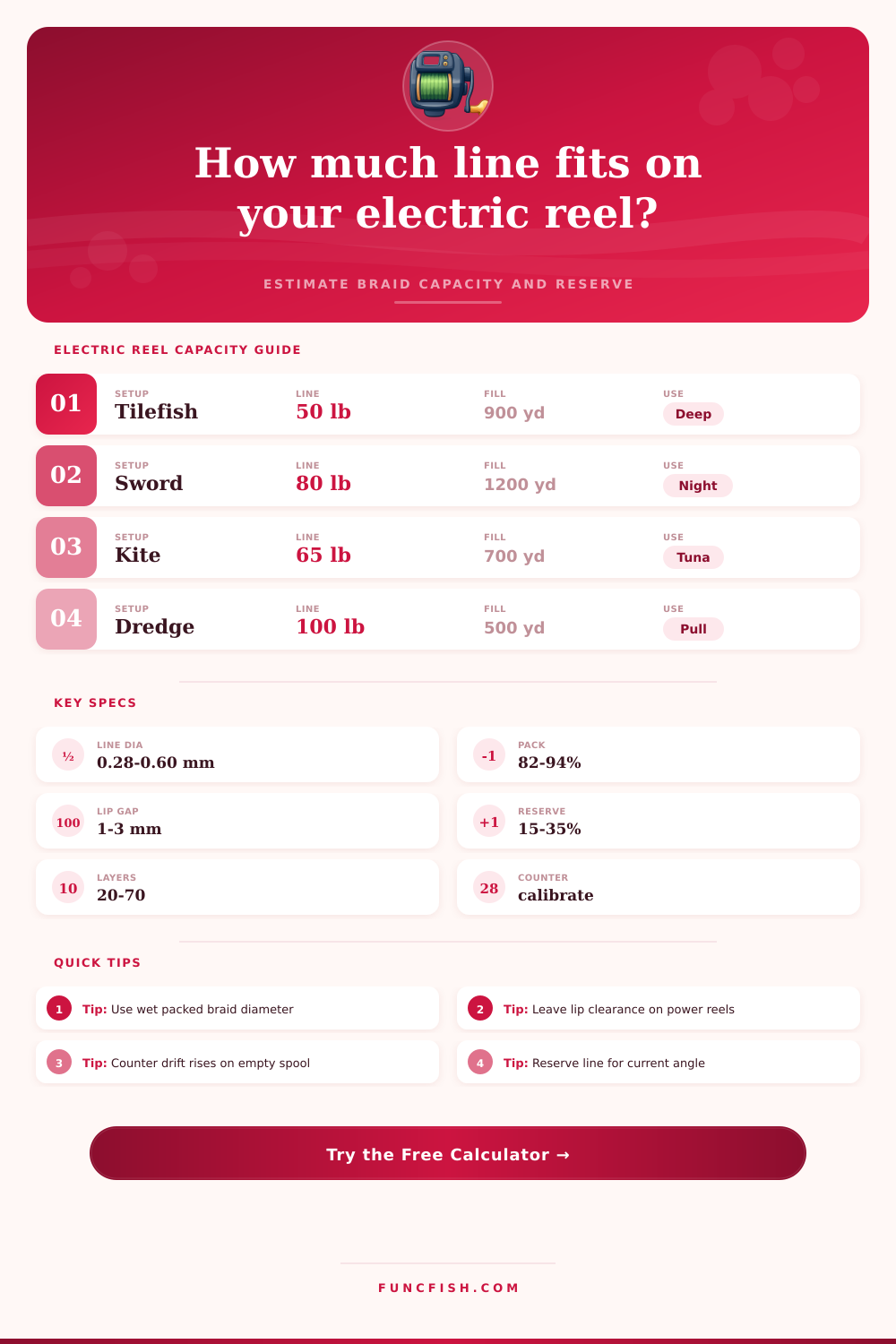
| Tilefish and deep-drop bottom | 50 to 80 lb braid, 0.36 to 0.48 mm | 25 percent after scoped depth | Long bottom contact and current belly |
| Swordfish electric assist | 65 to 100 lb braid, 0.42 to 0.60 mm | 35 percent after leader and daytime scope | Fish rise, dump, and long angle changes |
| Kite or balloon reel | 50 to 80 lb braid, 0.36 to 0.48 mm | 20 percent after clip distance | Counter repeatability and wind bow |
| Dredge and teaser reel | 80 to 150 lb braid or mono assist | 15 percent because runs are short | Spool compression under high drag |
| Cod, halibut, and wreck fishing | 40 to 80 lb braid, 0.30 to 0.48 mm | 20 to 25 percent after water depth | Reties, snags, and repeated drops |
🧮Formula reference table
| Calculation | Formula | Why it matters | Output |
|---|---|---|---|
| Spool volume | π x width x (full radius2 - arbor radius2) | Capacity is an annular volume, not a flat length | Geometry capacity |
| Line volume | π x line radius2 x length / packing factor | Small diameter changes create large capacity changes | Main-line fit |
| Printed rating scale | Printed capacity x (reference diameter / actual diameter)2 x pack correction | Uses reel maker capacity when spool dimensions are estimated | Rated capacity |
| Scoped depth | Water depth / cos(line angle) | Current increases line needed before a rig reaches bottom | Depth requirement |
| Counter drift | Calibration circumference / payout circumference | Electric reel counters change as the spool diameter changes | Counter correction |
🔎Spool class reference
Compact Power
500-750Best for squid, snapper, and lighter deep work where 300 to 600 yards is enough after topshot and reserve.
Mid Electric
800-1000Useful for tilefish, cod, kite deployment, and moderate current when braid diameter stays near PE 4 to PE 6.
Large Deep Drop
1200+Built for 800 to 1500 yard fills, swordfish scope, heavier weights, and longer current angles.
Dredge Puller
TorqueCapacity is less important than line compression, top diameter, and keeping the fill below the flange under load.
💡Capacity calculation notes
Diameter tip: If your braid lists both PE size and millimeters, use the measured millimeter diameter. Electric reel capacity changes with diameter squared, so a small coating or wet-pack difference can move the result by many yards.
Counter tip: Calibrate the reel counter with the line wet and packed at fishing tension. A counter set on a full spool can read long after several hundred yards leave the reel because each spool turn pays out less line.
Get real: Dropping a heavy sinker in deep water puts you up against reality. You may be trolling a tuna kite rig or dropping live bait to tilefish on the continental slope, but you will run out of line if you misjudge how much braid will fit on the spool. The manufacturer’s printed capacity rating isn’t a complete or accuratly representation of how much line an electric reel actualy holds. Capacity is a matter of geometry. It involves spool width, wet packing tension, and angle at which current pushes your rig off course. That mistake leads most anglers to believe the capacity chart represent a hard limit, which means they loses their rigs.
With line diameter input and spool size entered into the calculator above, it’ll spit out the answer for you. It eliminates guesswork. You will know just how many yards of line you actualy get per spool versus how much gets packed down inside those flanges or lost to improper packing. Keep in mind that formula for line capacity is an annular volume. So you’re calculating amount of space within the exterior of your spool and the arbor.
How to Calculate Your Reel’s Line Capacity
That means your braid’s actual diameter play a much larger role then its pound test. A single fraction of a millimeter off on your braid’s diameter will yield several hundred-yard differences in total capacity. Eight- and 12-carrier braids pack differently, rounding and tightening more tightly, and thus impact layer count. These packing variable are what the tool takes into account, sparing you having to guesstimate all of that yourself.
Current doesn’t follow vertical lines either, and you must consider scope too. To fish the bottom with strong current running, you’ll have to put out much more line than depth gauge indicates as it will push your leader back towards boat. That’s where angle input is important. If you’re dropping at a 35 degree angle in moderate current flow, you’ll have to go much further down to get to the bottom compared too if you were dropping nearly vertically. In that case, the calculator calculates the hypotenuse of your descent path which accounts for this. I see this all the time with deep-droppers who is fifty yards short on bottom during prime tide due to ignoring scope.
The counter also keeps track. The other secret variable are the line counter itself. An electric reel counts spool turns instead of linear yards. As line exits the spool its circumference decrease, resulting in the last hundred yards being shorter than initial hundred. If your counter was calibrated on a full spool, it will register long. The calculators includes a correction factor for that drift to help you match actual line in the water with what the digital display reads. It is a small detail but it can prevent costly errors when trying to set precise depths on a night run.
Tension matter too. Line packed on a reel under tight tension will use every available inch. There is also less “dead” space around each strand because there is less air space inside the spool. Loosely hand-pack or reload with wet line and you get fewer total yards and more chance for wind knots. Letting the reel choose how much to pack at a time based off your chosen method (hand-guide fill vs. The wet reload method keeps it filling the way you expect. And when using a powered reel spool, don’t overfill; an overrun can remove hundreds of yards in moments. You should of leave some slack as a safety buffer for snag-free retrieve.
When the fish runs and the drag screams, having confidence that you know what your reel can do is everything. Whether you’re dredging for cod on a wreck or targeting swordfish from the surface at night, it is about strategy rather then guesswork. Knowing how much your equipment can physically do means you can go further because you don’t have to worry about pushing too hard. It is simple math, but it takes time to get good at applying it. Measure your spool and pay attention to diameter. Leave some slack for the unexpected pull of the deep. Always remember to leave yourself plenty of line left to spare.