🐟 Fish Canning Jar Count Calculator
Estimate jar count, lids, packed fish weight, and batch loads from fish weight, yield, jar size, headspace, and fill density.
📌 Quick Presets
⚙ Jar Count Inputs
📦 Counting Assumption Grid
📊 Jar Format Comparison
🗂 Jar Volume Reference
| Jar Format | Nominal Volume | Typical Fish Range | Counting Note |
|---|---|---|---|
| Half-pint | 8 fl oz / 237 ml | 0.40-0.55 lb | Small portions |
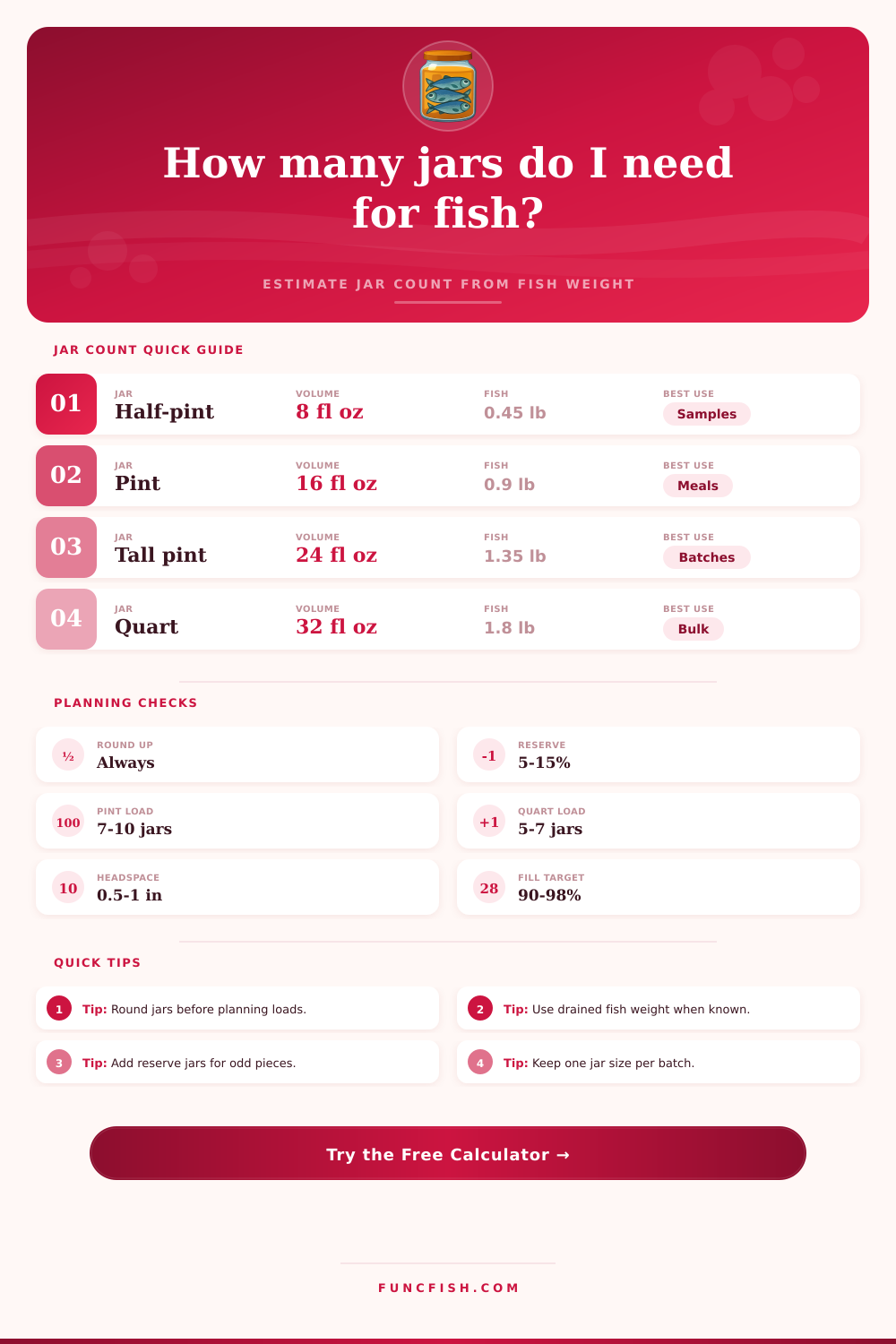
| Pint | 16 fl oz / 473 ml | 0.85-1.05 lb | Most common count unit |
| Tall pint | 24 fl oz / 710 ml | 1.25-1.55 lb | Useful for tall strips |
| Quart | 32 fl oz / 946 ml | 1.70-2.10 lb | Bulk batches |
⚖ Fish Form Yield Table
| Starting Form | Yield Factor | Use When | Calculator Meaning |
|---|---|---|---|
| Whole round fish | 45% | Ungutted weight | Converts to jar-ready estimate |
| Dressed fish | 70% | Gutted, head changes vary | Moderate trimming built in |
| Skin-on fillets | 86% | Fillets with skin | Allows small trim loss |
| Skinless fillets | 92% | Mostly trimmed fillets | High usable ratio |
| Jar-ready chunks | 100% | Already cut for jars | No form yield removed |
| Known drained weight | 100% | Measured usable fish | Uses your weight directly |
🧪 Pack Density Reference
| Pack Style | Density Factor | Space Behavior | Count Impact |
|---|---|---|---|
| Firm chunks | 0.86 oz/fl oz | Predictable blocks | Balanced jar count |
| Loose chunks | 0.78 oz/fl oz | More air gaps | More jars |
| Flaked pieces | 0.82 oz/fl oz | Settles evenly | Midrange count |
| Smoked pieces | 0.72 oz/fl oz | Drier and springy | More jars |
| Oily fish pieces | 0.88 oz/fl oz | Dense pieces | Fewer jars |
| Long strips | 0.74 oz/fl oz | Awkward shape | More spare jars |
| Mixed sizes | 0.80 oz/fl oz | Uneven spaces | Add reserve |
📝 Batch Planning Table
| Jar Count | Lids to Stage | Box Count at 12/Jar Box | Load Planning Use |
|---|---|---|---|
| 1-6 jars | Jar count + reserve | 1 box | Small catch or sampler run |
| 7-12 jars | Jar count + reserve | 1 box | One to two load plan |
| 13-24 jars | Jar count + reserve | 2 boxes | Weekend batch planning |
| 25-36 jars | Jar count + reserve | 3 boxes | Large fish harvest count |
| 37+ jars | Jar count + reserve | Round up boxes | Split into labeled groups |
You feel panic when bringing a bucketful of fish up on the dock, dumping them in a heap, and realizing you can’t count past three because you dont know how many pint jar will fit in the garage. Eight pounds of trout? Eight pints? That only works if every single chunk fit neatly into a jar. What about bones? And skin? And trim waste? And all those little spaces where there is nothing but air? And what about the lids? (The calculator takes care of that.)
Once you type in your preferred jar size(s) and starting weight, it calculate the rest. No more overbuying glass, and no more letting the better fish go bad.
Why You Need This Calculator
The yield is where things get real. Heads, scales, guts. All that stuff is dead weight when you’re talking about whole round fish. Once you’ve gutted ’em yourself, you’re probably down to maybe forty-five percent actualy edible material when you finally pack it up. Now, grab the empty carcass and see if that seems low. You betcha.
Since you might begin with whole, dressed, or trimmed-fillet fish, the tool adjust its yields accordingly. Why? Because if you underestimate how much you have, you’ll be racing to finish the last load with trembling hands, but if you overestimate, you’ll have a bunch of half-empty jars and big waste of preservatives.
The other quiet variable in jar counting is pack density. Flakes and loosely cut smokes that was a bit dehydrated don’t pack as tight as solid chunks of meat. For example: Smoking causes some dehydration, so a piece of smoked fish has more air space compared to its mass then an equivalent-sized chunk of raw oily fish (such as mackerel). That’s why you’ll end up needing a few more jars with the same amount of starting weight of smoked fish versus raw oily fish. As table on the page shows, this changes your jar count by a few either way, a small adjustment, but one that can make the difference between ending the day with a full jar vs. Losing loose ends.
The second reason most home canners don’t plan is they forget about reserve capacity! Always plan on having some extra jars, five to fifteen percent more then your estimate is ideal. That way, you have a cushion against spillage when filling, the few odd-shaped pieces of fish that won’t fit in jar neatly, or just one of those darned jars with the rim chipped and thus not passing inspection. I’ve built a reserve percentage input right into the calculator, where you can plug in your number and instantly get a concrete shopping list. Not just an anxious guess.
Another benefit is that you can batch plan more easily by grouping jars by size. For example, filling one shape of jar per load makes the process of using the pressure cooker much simpler; different sizes takes varying amounts of time to process, with slightly different headspace requirements. Mixing pint and quart jars together in the pot is a recipe for either overcooking the quarts or underprocessing the pints. It’s easier to see at-a-glance how many loads will fit into your sterilizer, so that you can work it out to take periodic breaks between loads.
And don’t forget about headspace. You want enough so that it leaves room for expansion as it heats up and forms the vacuum when cooled down. If you have too little headspace then you will get boil-overs which will destroy the seal and make a sticky mess. Not enough? Too little headspace leaves too much air in the jar, which may cause the fish to darken over time from oxidation. Use the fill target setting to find best compromise between the two given your particular fish texture and how much liquid they contain.
So all this comes back to controlling your variables before they control you. Once you’ve got that number down, packing day is less stressful. It lets you concentrate on technique and clean lines instead of frantically trying to find one more lid at the last minute. It turns what was once a mad dash into an organized assembly line. You have your ducks in a row; you know how much gas to purchase and how many jars to wash. Knowing that makes the heavy lifting seem doable.
And I’ll tell you, it’s better than any hack in the kitchen.