Fish Caught Per Hour Calculator
Convert a fishing session into catch per hour, catch per angler-hour, keeper rate, rod-hours, and a next-trip forecast using species, technique, water, and activity modifiers.
📌Scenario presets
⚙Catch rate inputs
Catch rate summary
Full breakdown
📋Technique benchmark grid
Casting lures
Float bait
Bottom bait
Trolling
Fly fishing
Surf casting
Ice jigging
Jigging
📒Catch rate references
| Species group | Slow bite | Good bite | Hot bite |
|---|---|---|---|
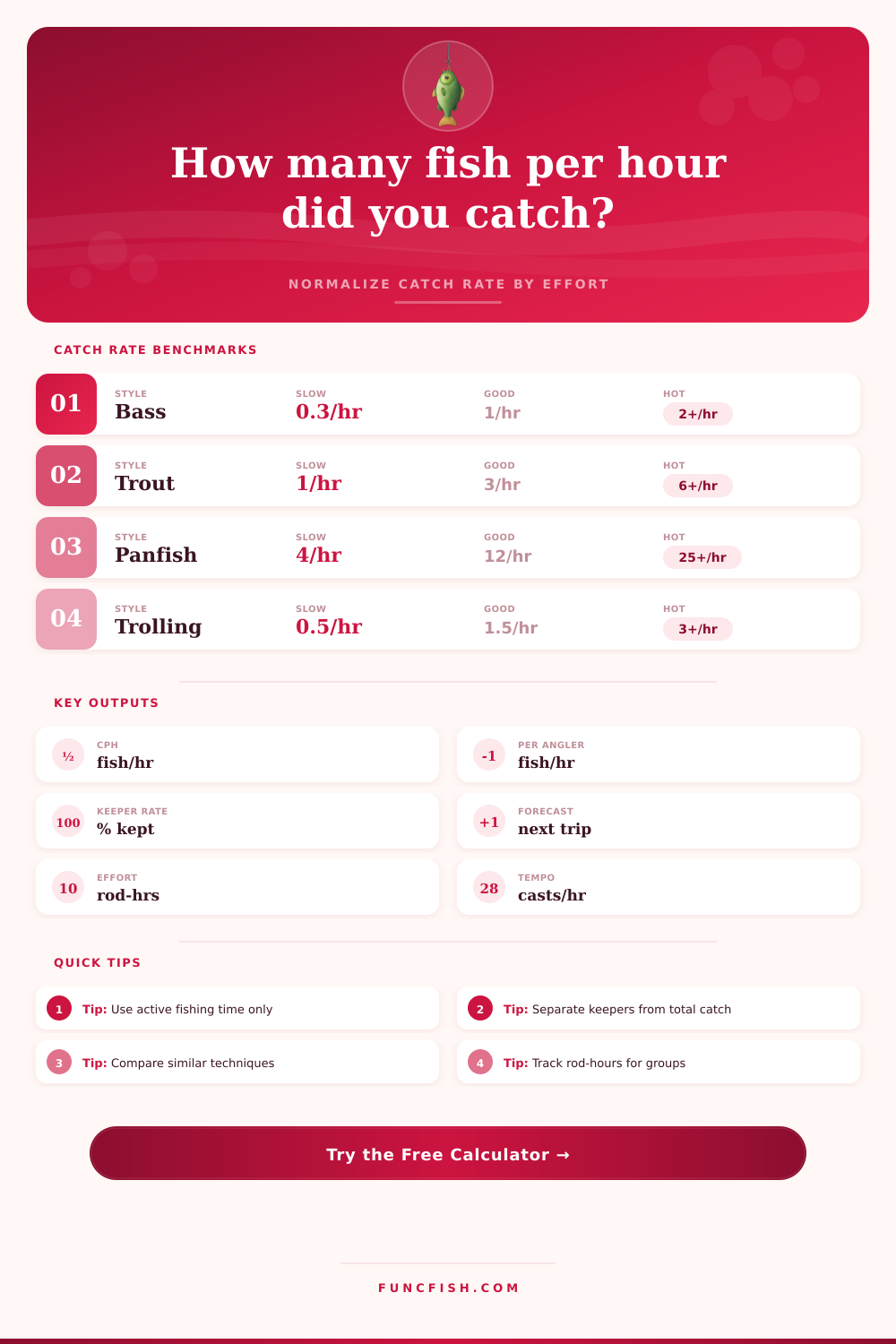
| Bass | 0.2-0.5 fish/hr | 0.8-1.5 fish/hr | 2.0+ fish/hr |
| Trout | 0.5-1.0 fish/hr | 2.0-4.0 fish/hr | 6.0+ fish/hr |
| Panfish | 3-6 fish/hr | 10-18 fish/hr | 25+ fish/hr |
| Walleye | 0.2-0.6 fish/hr | 0.8-1.6 fish/hr | 2.5+ fish/hr |
| Catfish | 0.2-0.5 fish/hr | 0.7-1.5 fish/hr | 2.0+ fish/hr |
| Inshore saltwater | 0.4-0.8 fish/hr | 1.2-2.5 fish/hr | 4.0+ fish/hr |
| Surf species | 0.3-0.8 fish/hr | 1.0-2.2 fish/hr | 3.5+ fish/hr |
| Offshore pelagics | 0.1-0.3 fish/hr | 0.5-1.2 fish/hr | 2.0+ fish/hr |
| Effort metric | Formula | Best for | Watch-out |
|---|---|---|---|
| Fish per hour | Catch / active hours | Solo trip review | Can hide crew size |
| Angler-hour CPUE | Catch / angler-hours | Comparing groups | Needs angler count |
| Rod-hour CPUE | Catch / rod-hours | Trolling or bait sets | Rods vary by law |
| Catch per 100 casts | Catch / casts x 100 | Casting tempo | Weak for soaking bait |
| Strike conversion | Catch / strikes | Hookup performance | Strikes are estimated |
| Keeper rate | Keepers / catch | Size quality | Not a legal rule |
| Technique | Tempo target | Depth range | Useful output |
|---|---|---|---|
| Casting lures | 25-45 casts/hr | 2-20 ft / 1-6 m | Catch per 100 casts |
| Vertical jigging | 18-35 drops/hr | 8-45 ft / 2-14 m | Fish per active hour |
| Bottom bait | 4-12 sets/hr | 4-35 ft / 1-11 m | Rod-hour CPUE |
| Trolling | 2-6 passes/hr | 10-80 ft / 3-24 m | Fish per spread hour |
| Fly fishing | 20-45 casts/hr | 1-8 ft / 0-2 m | Fish per angler-hour |
| Ice jigging | 15-30 drops/hr | 6-35 ft / 2-11 m | Hole productivity |
💡Practical checks
Tip: For a fair catch-rate log, subtract launching, motoring, rigging, long lunch stops, and fish-cleaning time from the active fishing hours.
Tip: Compare trips by the same species group and technique. A panfish float-bait rate and an offshore trolling rate are different effort categories.
To measure the success of fishing trip, you must use a consistent method for measuring fishing success. Many people feels that their fishing trips are similar even though they dont use a consistent method for measuring the fishing trip success. For example, if a person catches twelve bass in four hours, they may feel that they had a successful fishing trip.
However, if they only catch six trout in those same four hours, they may feel that their fishing trip was not successful. These two fishing trips are not comparable to one another due to different species of fish that are caught and the different number of hours that the fish are being caught. In order to account for different fishing trips, it is important to account for the time that it take to rig the fishing equipment and the time that it takes to drive to each fishing location.
How to Measure Your Fishing Trip Success
These times are not the same as the time that the fishing trips is actively fishing. When measuring fishing trip success, it is important to separate the actual time that the fishing trip is actively fishing from the total length of the fishing trip. The total length of the fishing trip includes times when the angler is launching their boat or other fishing vehicle to the fishing location, and when they are cleaning the fish that they have caught during the fishing trip.
Each of these actions are not part of the actual fishing time. The unit of measurement that is select for each fishing trip will depend upon the number of anglers on the fishing trip. A solo angler will use a unit of fish per hour.
However, a group of anglers will use a unit of fish per angler hour or fish per rod hour to account for the fact that there are more fishing lines in the water from a group of anglers than from a single angler. In addition to the number of fish that are caught during a specific length of time, the success of a fishing trip also includes the species of fish that are caught and the fishing techniques that were utilized during the trip. For instance, a person may find that they can easily catch twenty panfish in one hour while fishing from a dock.
However, twenty fish in one hour while trolling offshore may be considered to be an insufficient rate of catch for that fishing trip. The calculator includes factors such as the species group of the fish, the fishing technique that is used, the water type, and the activity of the fish bites to determine the baseline rate of fish that are to be caught during a fishing trip. The calculator adjusts for each of these factors so that the output of the calculator correctly reflect the expected number of fish to be caught during that fishing trip for that specific species of fish and using that specific fishing technique.
Furthermore, the angler enters the number of fish that are caught during the fishing trip into the calculator, as are the conditions that are expected for that species of fish, to provide an output that forecasts the number of fish that will be caught during the anglers next fishing trip. In addition to the factors mentioned above, it is also useful to track the percentage of the fish that are kept (as opposed to those that are released back into the water) and the strike conversion rate. The percentage of the fish that are kept is calculated by the number of legal fish sizes is divided by the total number of fish that were caught during the fishing trip.
The number of fish that are kept may vary from trip to trip. For example, on some fishing trips, a person may catch many fish that are too small to be kept, while on other fishing trips, the fish that are caught may all be of a size that is legal to keep. The strike conversion rate is a measure of the number of fish that are caught in relation to the number of times that the anglers successfully struck the fish with the fishing line.
A low strike conversion rate may indicate an issue with the hooks that are used, the rods that are used, or the way in which the anglers set their hooks into the fish when they strike the fish with the line. In addition to the factors mentioned so far, water conditions and the fishing techniques that are used will have an impact on the number of fish that are caught during a fishing trip. For instance, if the water is clear and bright sunlight is falling upon the water, the fish may move to deeper areas or areas that are shaded.
In these cases, anglers may find that fewer fish are struck with the fishing line. Muddy water may improve the chances of catching some fish species, but may make it more difficult to catch other fish species. If many people are fishing in the same body of water at the same time, the fish may become wary of anglers, and anglers will catch fewer fish during those times.
These factors are included in the calculator that is presented on this page so that the angler can have an accurate understanding of their fishing trip success compared to other fishing trips. Other factors to consider when fishing include the depth of the water that is being fished in, and the size of the fish that are caught during each fishing trip. By setting the depth to the preferred fishing zone for the species of fish that is being targeted, the catch rate of those species will usually increase.
Additionally, if the fish that are caught are all of a larger size than the typical size of the species in that area, this may be an indicator of the quality of the fish that are being caught, or of their age. By logging both the total number of fish that are caught and the average size of the fish during each fishing trip, an angler can find value in those tracking methods. After many fishing trips, with the logging of the factors described above, an angler will be able to determine when a specific fishing technique is underperforming as compared with other fishing techniques.
Furthermore, an angler may be able to determine whether one body of water contains fewer fish than another body of water. Additionally, an angler can determine whether their general fishing technique rate has declined over time. Each of the reference tables that are included on this page will help an angler to determine whether their fishing success is slow, even, or strong relative to others with similar fishing skills and experiences.
These tables can help an angler to determine whether any changes should of be made to their fishing techniques prior to their next fishing trip.