Fish Liver Oil Yield Calculator
Estimate crude and refined fish liver oil from raw liver weight, species oil content, condition losses, extraction method, refining target, density, and planning allowance.
📌Liver oil yield presets
⚙Batch inputs
Fish liver oil yield estimate
Finished oil = crude recovered x refining retention
Crude oil = available oil x extraction recovery
Yield percent = finished oil / raw liver mass
Volume uses selected finished-oil density
Calculation breakdown
🧪Species and material grid
Cod
Pollock
Halibut
Shark
Tuna
Monkfish
Skate
Mixed
📊Liver oil reference tables
| Species profile | Typical wet liver oil | Default density | Natural yield pattern | Calculator note |
|---|---|---|---|---|
| Cod | 36% to 48% | 7.72 lb/gal | Consistent medium-high oil | Good all-purpose liver oil baseline |
| Alaska pollock | 28% to 42% | 7.70 lb/gal | Variable by season and size | Use conservative recovery for mixed lots |
| Halibut | 38% to 56% | 7.74 lb/gal | High oil but sensitive handling | Condition loss matters on small batches |
| Shark or dogfish | 50% to 70% | 7.66 lb/gal | Very high liver oil fraction | Often modeled as a specialty fraction |
| Tuna or pelagic | 20% to 36% | 7.75 lb/gal | Moderate oil with higher blood trim | Watch refining and impurity limits |
| Monkfish | 22% to 38% | 7.73 lb/gal | Soft liver, gentle heat preferred | Drip and emulsion holdback can climb |
| Recovery method | Recovery range | Solids holdback | Best matched liver | Planning use |
|---|---|---|---|---|
| Low-temperature rendering | 62% to 82% | Low-medium | Fresh cod, halibut, monkfish | Good quality with modest output |
| Steam rendering | 72% to 88% | Medium | Cod, pollock, mixed whitefish | Balanced default for larger batches |
| Vacuum rendering | 78% to 92% | Low | High-oil livers | Higher recovery with gentler oxidation risk |
| Enzyme-assisted release | 70% to 90% | Medium | Soft or emulsifying liver | Useful when mechanical release is low |
| Heated centrifuge separation | 74% to 91% | Low-medium | Pelagic and mixed batches | Strong separator setting for cleaner oil |
| Mechanical press plus settling | 48% to 70% | High | Small trial lots | Conservative result for simple recovery |
| Solvent-assisted lab recovery | 86% to 96% | Low | Analytical or pilot samples | Use only as a technical recovery scenario |
| Refining target | Typical loss | Impurity target | Mass effect | Calculator role |
|---|---|---|---|---|
| Crude settled oil | 2% to 6% | 2% to 5% | Highest finished mass | Minimal polish after separation |
| Filtered oil | 5% to 10% | 1% to 3% | Small solids reduction | Good default for storage planning |
| Winterized oil | 8% to 16% | 1% to 2% | Removes waxy fraction | Reduces cold-clouding material |
| Deodorized edible oil | 12% to 22% | 0.5% to 1.5% | Moderate final reduction | Models heavier polishing loss |
| Concentrated omega oil | 20% to 38% | 0.5% to 1.5% | Largest finished mass loss | Conservative for concentration runs |
| Squalene-rich fraction | 15% to 30% | 0.5% to 2% | Specialty fraction estimate | Best paired with shark liver profile |
| Wet-liver yield band | Finished oil yield | Typical meaning | Main limiter | Check first |
|---|---|---|---|---|
| Trace | Under 10% | Lean liver or harsh losses | Oil content | Species assumption |
| Low | 10% to 20% | Small or mixed liver batch | Recovery method | Holdback and emulsion |
| Workable | 20% to 35% | Normal commercial-style estimate | Refining loss | Condition and filtration |
| Strong | 35% to 50% | High-oil liver material | Planning allowance | Density and final impurity limit |
| Very high | Over 50% | Specialty high-oil liver | Raw oil fraction | Validate with a pilot run |
💡Liver oil yield tips
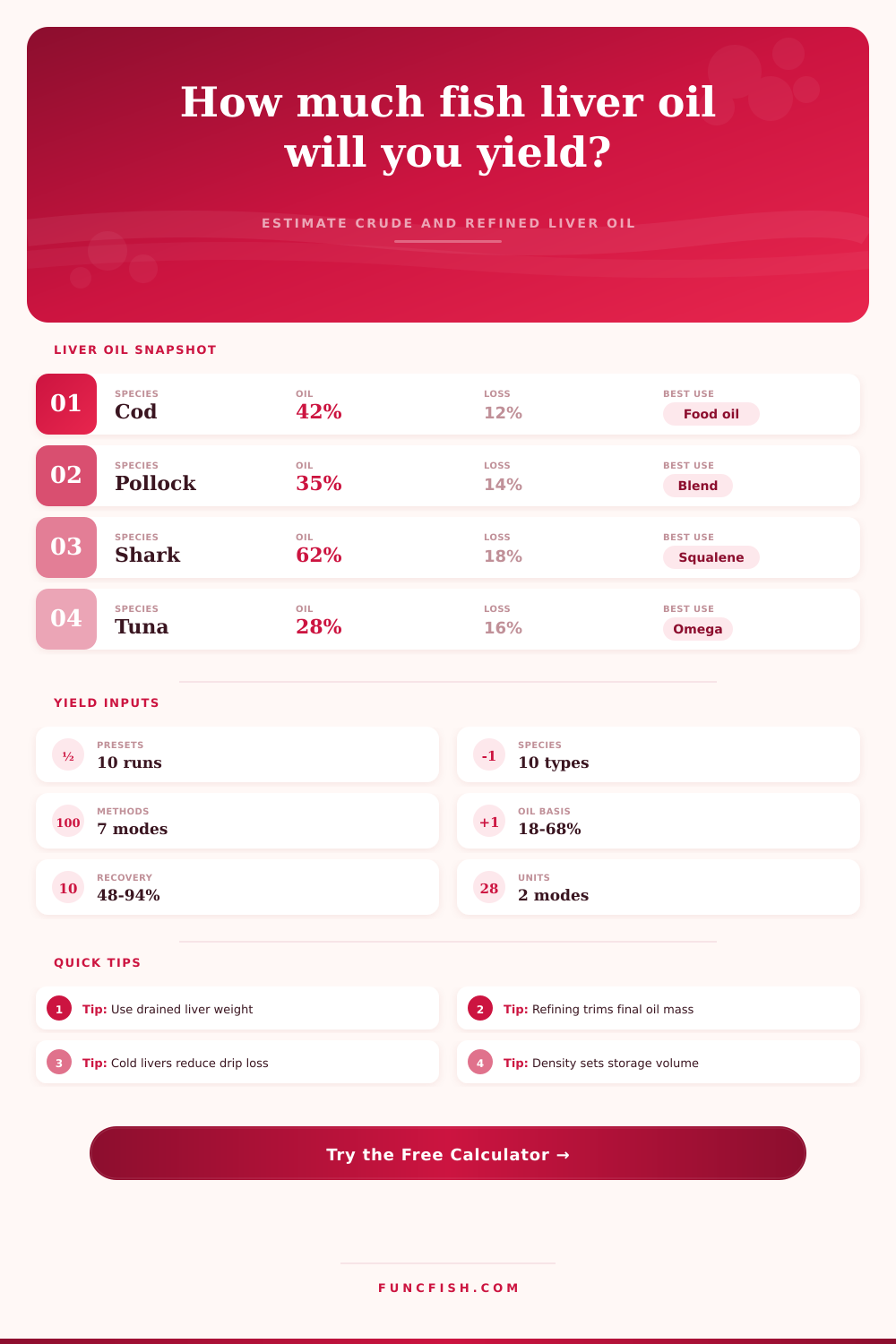
Use drained liver weight: Extra blood, rinse water, or thaw drip inflates the starting mass and makes the calculated yield look lower than the actual oil recovery.
Separate recovery from refining: Crude oil shows extraction performance. Finished oil adds filtering, winterizing, deodorizing, impurity, and allowance losses.
Knowing the starting weight of your raw liver allows you to figure out the yield in fish liver oil. That makes this a straightforward harvest process and not guesswork. Figuring out your extraction line is key for small production runs as well as processing a weekend’s worth of catch. Enter the species and weight of your liver, let the calculator do the math. No more guesswork conversions.
But know what numbers mean for your material. But biggest factor is condition of liver. A lot of folks will weigh their total mass with the rinse water and blood still on them. That increases your initial weight which decreases your yield. You want weight of liver without the rinse water. It’s a subtle difference but it affects base value of all calculations. If you are using frozen livers, be sure to adjust for any water that move in when they thawed out. That’s extra weight that won’t become oil and it can affect yield. The assumption is that more weight = more oil. Often it equals more water to shake off at some point.
How to Calculate Fish Liver Oil Yield
Next: Select your extraction technique. The tool provides modes for everything from steam processing to cold rendering. Each type yields a different degree of recovery efficiency. Cold renders maintain heat-sensitive vitamin content, yet holds more residual oil inside the protein. More aggressive techniques like steam rendering expel higher amounts of oil, but may result in a stubborn emulsification that lowers your clean yield. Think of it as trading off quality for volume, or vice versa.
Based off the mechanics used, this reference table illustrates how recoveries change. Because shark liver tend to be high-oil, maybe a gentle vacuum render will do. Pollock, being lean, may require some steam heat to make it worth your while.
Refining causes mass loss. A lot of mass gets removed in refining process. When you extract oil from the fish livers, there are impurities, solids, and water present in the crude oil. By removing those parts through deodorizing, filtering, or winterization, you get an oil that taste better with longer shelf life. However, you also end up with less weight. To model this weight-loss, use a refining loss percentage on the calculator. Even after perfect extraction, your crude settled oil will weigh more then your deodorized edible oil. Should you go for premium clarity, or maximum volume? There is no correct answer; just a tradeoff to accept.
The density of the final oil determines how it will be stored and divided into portions. Finished oil is slightly less dense than water. Specifically, a pound of fish liver oil is larger in volume then a pound of water. That’s important for planning shelf space and buying containers. And if you’re encapsulating, the tool also translates your overall weight into number of capsules at whatever size you choose. It allows you to visualize what you’ll have made. Instead of seeing abstract pounds, you begin to see separate doses. The shift is from raw process to finished product.
Extracting fish liver oil is half harvest and half management of losses. There are refining, filtration, emulsion holdback, and drainage losses. Every one of these will take something from you. But they’re not losses you should of eliminate; there’s no way to do so. Rather, it’s about understanding those losses. If you grasp what’s causing weight loss on the scale, then you can modify your approach. Perhaps you’ll rinse with less force. Perhaps you’ll strain earlier. Perhaps you’ll swap out for an extra efficient centrifuge. The mathematics remains unchanged, but your actions change.
What’s in that bottle in your hands is what you chose… And weighed, between yield and quality.