Fish Reaction Distance by Clarity Calculator
Estimate how far a fish is likely to notice a lure or bait after water clarity, turbidity, light level, target species, lure signal, and retrieve speed are combined.
🎯Scenario presets
⚙Visibility inputs
Reaction distance estimate
Calculation breakdown
📊Signal factor grid
Flash spoon
Chartreuse spinner
Natural profile
Glow or rattle
📘Clarity and visibility references
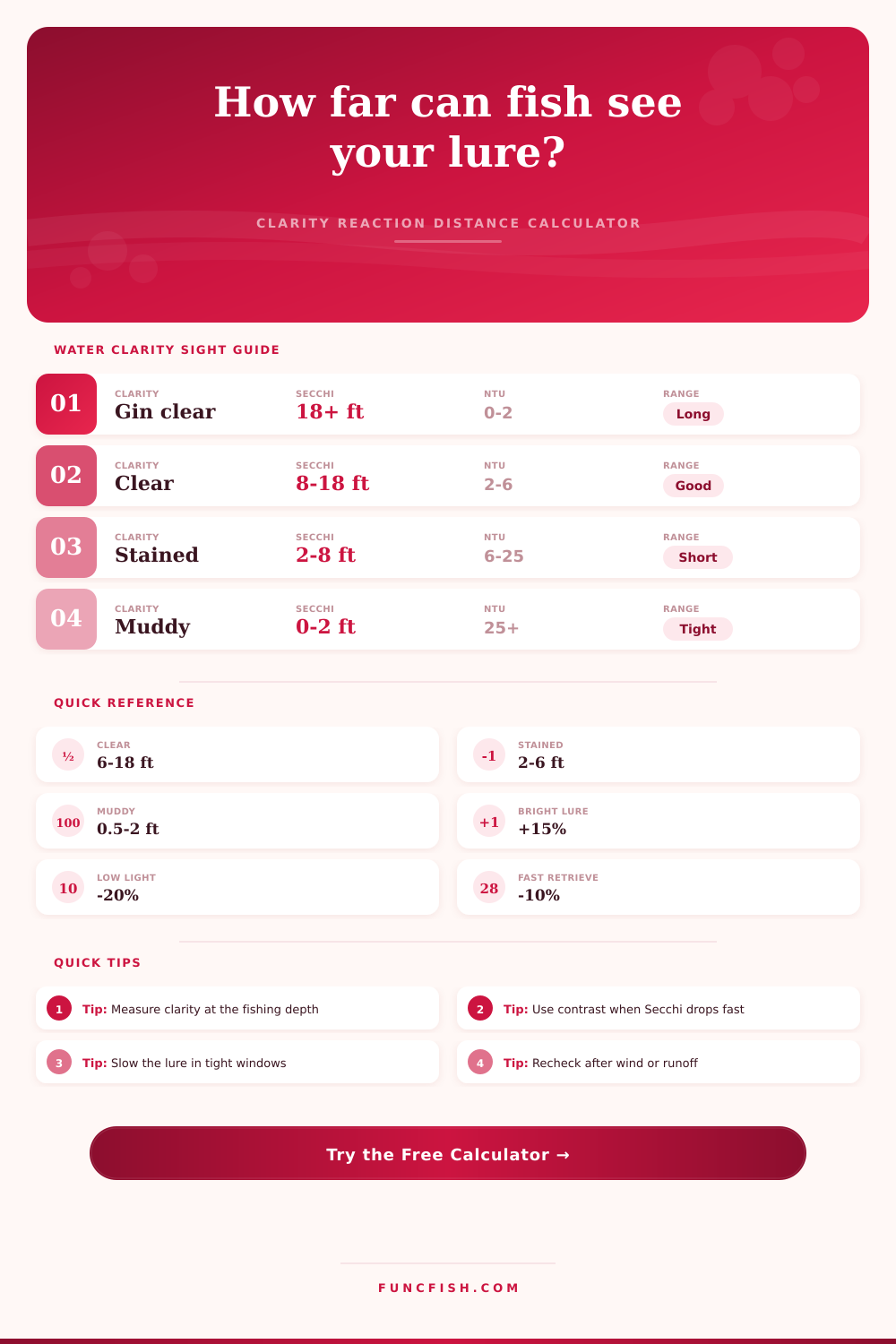
| Water clarity class | Secchi visibility | Typical NTU | Expected reaction behavior |
|---|---|---|---|
| Ultra clear | 18+ ft / 5.5+ m | 0-2 | Long look; natural color and line angle matter |
| Clear | 8-18 ft / 2.4-5.5 m | 2-6 | Good sight feeding window for most lure profiles |
| Light stain | 4-8 ft / 1.2-2.4 m | 6-15 | Contrast and vibration begin to improve detection |
| Heavy stain | 2-4 ft / 0.6-1.2 m | 15-25 | Shorter reaction window; slower retrieves help |
| Muddy | 0.5-2 ft / 0.15-0.6 m | 25-80 | Fish usually detect close, often with nonvisual cues |
| Species group | Vision multiplier | Low-light handling | Calculator interpretation |
|---|---|---|---|
| Trout | 1.18 | Moderate | Strong clear-water sight response to small targets |
| Bass | 1.08 | Good near cover | Balanced reaction in clear and stained water |
| Walleye | 1.05 | Strong | Penalty is reduced at dawn, dusk, and shade |
| Pike | 1.14 | Moderate | Large profile and ambush background lift the distance |
| Catfish | 0.72 | Good nonvisual | Visual reaction is conservative; scent may still draw fish |
| Striped bass | 1.16 | Good | Open-water movement and flash can extend the lane |
| Lure or bait signal | Signal factor | Size sensitivity | Best use inside calculator |
|---|---|---|---|
| Natural minnow profile | 1.00 | Medium | Clear water, neutral fish, pressured fish |
| Silver spoon or blade | 1.18 | High | Open water, sun breaks, active predators |
| Chartreuse spinner | 1.22 | High | Stained water where color contrast matters |
| Dark topwater silhouette | 1.08 | Medium | Surface contrast at low sun or shade |
| Rattling crankbait | 1.12 | Medium | Moderate stain with retrieve noise and displacement |
| Fly nymph or small jig | 0.86 | Low | Short, precise lanes in current or clear water |
| Field condition | Model adjustment | Reaction distance effect | Practical read |
|---|---|---|---|
| Bright sun, open water | +8% to +15% | Longer if glare does not hide the bait | Cast spacing can open up |
| Shade or canopy | -10% to -18% | Shorter visual distance but less spook risk | Work edges more deliberately |
| Foam or surf wash | -18% to -28% | Air bubbles scatter the target outline | Use closer lanes and strong profiles |
| Weeds or brush | -8% to -16% | Background clutter hides natural colors | Contrast helps more than extra speed |
| Competitive school | +12% to +22% | Fish commit from farther away | Faster passes can still work |
💡Calculation tips
Tip: Enter the visibility at the actual fishing depth when possible. A clear surface layer can overstate reaction distance if the lure is running below a stained band.
Tip: When decision time drops below one second, reduce retrieve speed or tighten cast spacing. The fish may see the lure but have too little time to turn.
Your rod loads up. Your line tightens. A ripple dissapears in front of a largemouth bass’s face. He saw your lure but he didn’t bite.
Was the water clear enough for him to see? No. That’s not even the right question. How far away could he see your tackle before noticing it and reacting?
Understanding Fish Reaction Distance
Unfortunately we tend to think that water clarity only equals one thing: visibility. We think you look down at the water and if you can see X amount then the water is clear enough to fish. Wrong. Water clarity isn’t that simple. It’s a nuanced filter. It alters shadows and direction of light. It gives a predator more or less time to determine if your lure is a threat or dinner.
This reaction distance is what the tool we offer here calculates. It’s a mix of biology and physics. It uses turbidity measurement called Secchi depth as its starting point. Then it modifies it based off the vision of the targeted species.
In clear water trout has keen eyesight and are visual specialists. As such their reaction distance is far greater then that of a walleye, who depends much more on motion and contrast in low light conditions. Those distinctions is included in the multiplier used in the calculator. The multiplier used reflect each species’ view of the world.
How much reaction distance do you have? That also matters. Glassy clear water can make a natural profile harder to see against background than you’d imagine. Stained water makes something like a chartreuse spinner pop off the water with stark contrast. Contrast lengthens the detection window.
All this math helps us get our heads around the forces at work. Yes a big lure casts further in dirty water, but it’s also just more visible. And that’s only part of why you need to throw one before the fish gets bored.
The other thing most anglers do wrong is assuming the water above them shows what the water their crankbait is operating on is like. You may see crystal clear water staring up from gunwale but there can be loads of plankton and silt suspended 10-feet below your bait. That’s where trips is missed. When measuring visibility from surface you’re overstating the reaction distance.
This is where reference tables provided with the calculator come into play. They relate turbidity units to what to expect. So if water turns from clear to a heavy stain the sight-feeding window will close quickly. In these situations, the calculator shows you how drastically your decision time reduce.
Decision time refers to amount of seconds it takes a fish to react. When you get under a second, the fish doesn’t even have enough time to process what they are seeing and react to it by the time it come past them.
That’s where speed makes such a big difference. It isn’t just for letting the fish take the bait. It’s letting their visual system figure out what they see.
The same holds true for light level. Bright sun penetrates deep, extending reaction distances and making spooked fish even more wary of lines and shadows. Sunlight penetrates far out. It expands reaction distances and also makes the fish much more sensitive to shadow and line. On the other hand, dusk shrinks your visual range. The fish don’t have time to see what’s there, so it gives you more opportunity to get in close before they go on avoidance mode.
That’s where the calculator accounts for that variable. As the light goes down, the calculated distance decreases. Again, that’s why a lot of anglers like to fish during the low-light periods. Not only are the fish more active, but you have a larger margin for error. Because the fish aren’t seeing you quite as far, you can throw bigger baits on a bigger diameter line, which creates another helpful edge based on science.
Retrieve speed This completes the puzzle. When the lure moves fast it not only vibrates and creates a wake but it also leaves the fish less time to react. So if your calculator tells you that the fish has a short reaction distance, then using a frantic retrieve will often just cause you to miss strikes.
The reason is simple, by the time the lure gets there the fish is still deciding whether or not to eat it. By slowing down the presentation, you’re giving them more time to react. In other words, you are effectively giving yourself more time for them to decide. For this reason it compensate for their limited visual range.
Bottom line: Knowing your reaction distance comes down to managing variables. Mastering the variables within your control helps you manage the ones you don’t.
There’s no way to eliminate the water following a rain storm. But there are lures that will cut through the murky waters. There’s also the ability to dial down your retrieve to meet the pace of the fish as it moves.
The goal isn’t just to catch fish; it’s to fish smarter. It’s always about fishing smarter. It is about knowing the unseen boundaries of the water. Respecting its limits makes the guess work go away while replacing it with a bit of foresight. And that change in perspective transforms a bad day on the water into a good one.