Fishing Line Breaking Strain Wet Calculator
Estimate how much line strength remains after water soak, knot choice, abrasion, age, salinity, temperature, drag, and fish surge are all in play.
📌Scenario presets
⚙Line and load settings
Wet breaking strain forecast
Full breakdown
📊Line material wet retention
Nylon Mono
Fluorocarbon
8-Carrier Braid
Wire Leader
📋Wet strength reference tables
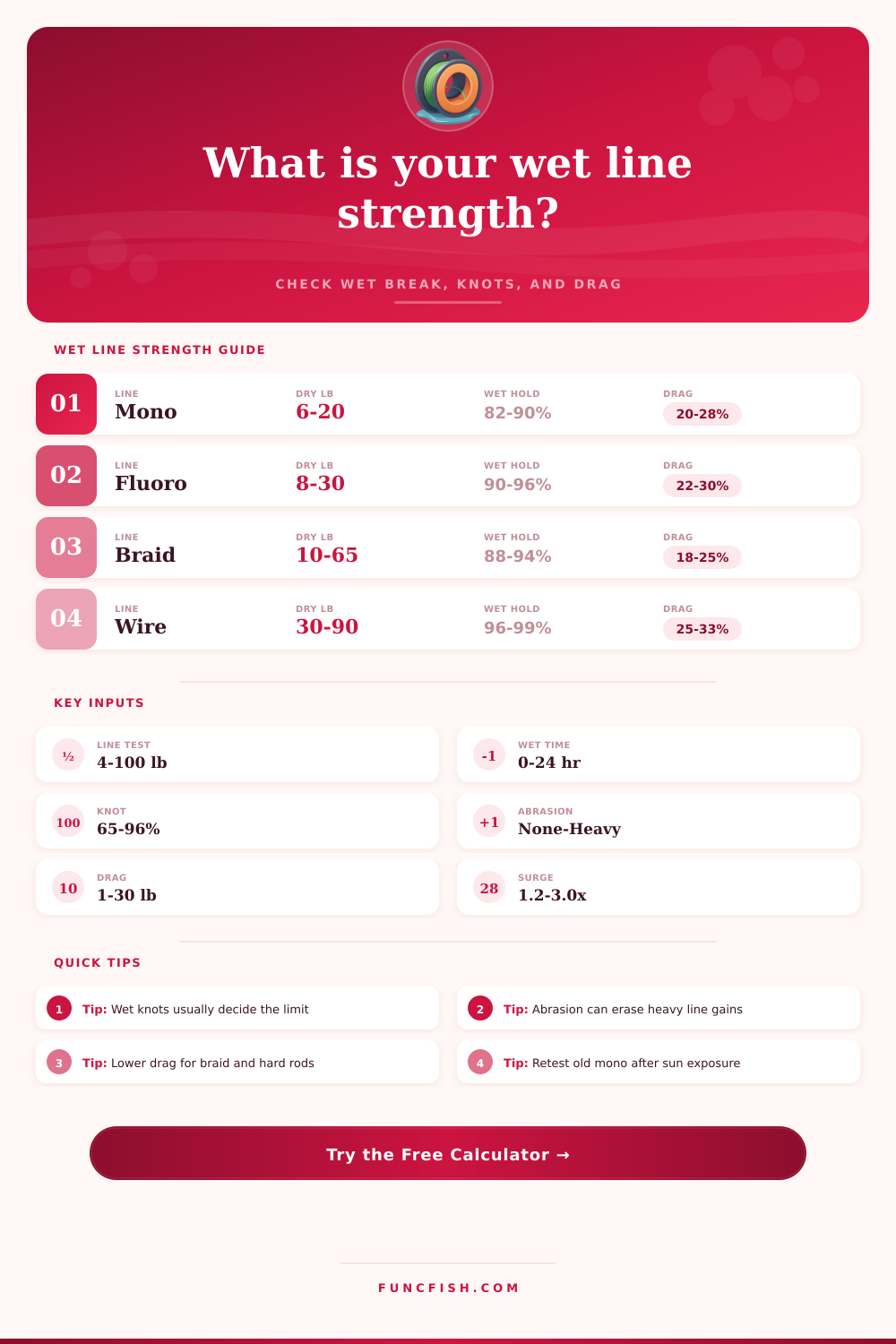
| Material | Typical wet retention | Knot-sensitive range | Practical note |
|---|---|---|---|
| Nylon monofilament | 82-90% after soak | 65-88% | Absorbs water and weakens most at knots |
| Fluorocarbon | 90-96% after soak | 68-90% | Strong wet retention, but stiff knots need care |
| Copolymer | 86-92% after soak | 66-88% | Between mono softness and fluoro density |
| 4-carrier braid | 88-93% after soak | 70-92% | Great straight pull, rougher surface under abrasion |
| 8-carrier braid | 90-94% after soak | 72-94% | Smoother and often better through knots |
| Wire leader | 96-99% after soak | 82-96% | Connection quality matters more than water |
| Scenario | Line class | Wet knot target | Starting drag range |
|---|---|---|---|
| Trout stream | 4-8 lb / 1.8-3.6 kg | 2.5-6 lb | 0.8-2 lb / 0.4-0.9 kg |
| Bass spinning | 8-15 lb / 3.6-6.8 kg | 5-12 lb | 1.5-4 lb / 0.7-1.8 kg |
| Catfish bottom | 20-50 lb / 9-23 kg | 14-38 lb | 4-12 lb / 1.8-5.4 kg |
| Surf casting | 20-60 lb / 9-27 kg | 14-48 lb | 5-15 lb / 2.3-6.8 kg |
| Pike leader | 30-90 lb / 14-41 kg | 25-82 lb | 7-22 lb / 3.2-10 kg |
| Offshore trolling | 50-100 lb / 23-45 kg | 38-90 lb | 12-30 lb / 5.4-13.6 kg |
| Knot or connection | Base efficiency | Best material match | Wet-use caution |
|---|---|---|---|
| Palomar | 82-92% | Braid, mono, fluoro | Avoid crossed strands at the eye |
| Improved clinch | 65-82% | Mono and light fluoro | Loses more if cinched dry |
| Uni knot | 75-88% | Mono, fluoro, braid | Needs enough wraps for slick braid |
| FG knot | 82-92% | Braid to leader | Fails early if wraps are loose |
| Snell knot | 78-90% | Mono and fluoro hooks | Strong with straight pull alignment |
| Crimp sleeve | 88-96% | Heavy mono, fluoro, wire | Over-crimping cuts the leader |
💡Practical checks
Tip: Treat this as a field estimate, then pull-test the actual knot when a new spool, new leader, or high-drag setup matters. Wet the knot before cinching and test it after it has been soaked.
Tip: If the shock margin is low, reducing drag usually helps more than stepping up one line size, especially with braid, stiff rods, short leaders, and close-range fish surges.
The fish takes off deep and your drag is screaming, then it’s silent. Your reel just keeps spinning with zero tension and tip of your rod remains buried. You likely broke off, but the number on the spool’s label didn’t match the one in your hand.
When you tested that breaking strength out on tackle shop floor it never had to face water, which dramatically alters how a fishing line perform. But nylon absorbs water like a sponge and loses seven to ten percent of its strength in just a few hours underwater. Age, abrasion and knot choice also affect nylon’s strength. Fluorocarbon doesn’t take up quite as much but gets stiff and brittle from age or cold temperatures. And braid is impervious to wet…unless we consider the knot, which has a smoother surface and makes it the weak link, not the fiber itself.
Why Your Fishing Line Breaks
Understanding those material properties in relation to what you’re using helps make the tool more meaningful. You choose your line type and how long it’s been in the water. Next you add in the knot you tied and whether there are any rub marks from structure or rock abrasions. The result tell you what your real wet breaking strain is, plus a safe drag target based off that diminished strength.
“Knowing what the inputs are helps change your approach to fishing. Drag at 25% of line rating is a common rule of thumb. That’s great when using new mono in slack water. It is not so good with sun-bleached line after two years or line left soaking in saltwater for four hours. Nothing tears down nylon like UV exposure; line that was once strong turns into brittle string before you see any other signs of damage.
A low drag number (meaning shock margin) means a tuna in open water or a bass on cover produces a burst you cannot control with your knot. Lowering your drag just enough can save the fish. Using a heavier line instead kills your spookiness and presentation sensitivity.
The other silent killer is abrasion; something reference tables detail nicely yet we tend to overlook in real life. A few light rub marks may look harmless, but they become a point where stress concentrates when under maximum loads. Abrasion from river rock or oyster shell against a mono leader will result in exponential loss of strength, not linear. While you’re thinking there’s still five-pounds of buffer strength remaining, those nicks can reduce your buffer to nearly nothing in a heartbeat.
Therefore, careful knot tying with subsequent wetting prior to cinching is a no-brainer. Heat generated by dry knots weakens polymer strands prior to casting. If tied properly, a Palomar might retain 90 percent of its strength, while the calculator shows that an improved clinch drops much lower. It’s all about controlling the variables that you can’t.
You won’t be able to keep your line from scraping against sharp objects and you won’t be able to keep the fish from running. But by adjusting to your surroundings, you’re able to adjust your expectations. Test your knots while they are still loaded prior to departure, check your equipment for UV exposure, and reduce your drag if your line is old or wet.
The key isn’t to never break off; that just won’t happen. The key is to know why you broke off so you don’t repeat the same mistake twice. Use printed line ratings as your starting point but not necessarily your guarantee. Let nature tell you how much slack to put between yourself and your quarry.