Fishing Line Drift Bow Angle Calculator
Estimate line bow angle, side sweep, down-current set-back, and bottom-contact control from drift speed, current, wind, line diameter, depth, scope, and sinker weight.
📌Drift scenario presets
⚙Line bow inputs
Line bow and drift forecast
Full breakdown
📋Line material comparison grid
Thin 8-strand braid
Standard braid
Monofilament
Fluorocarbon
Lead-core
Stainless wire
Hollow-core braid
Float mono
📐Reference tables
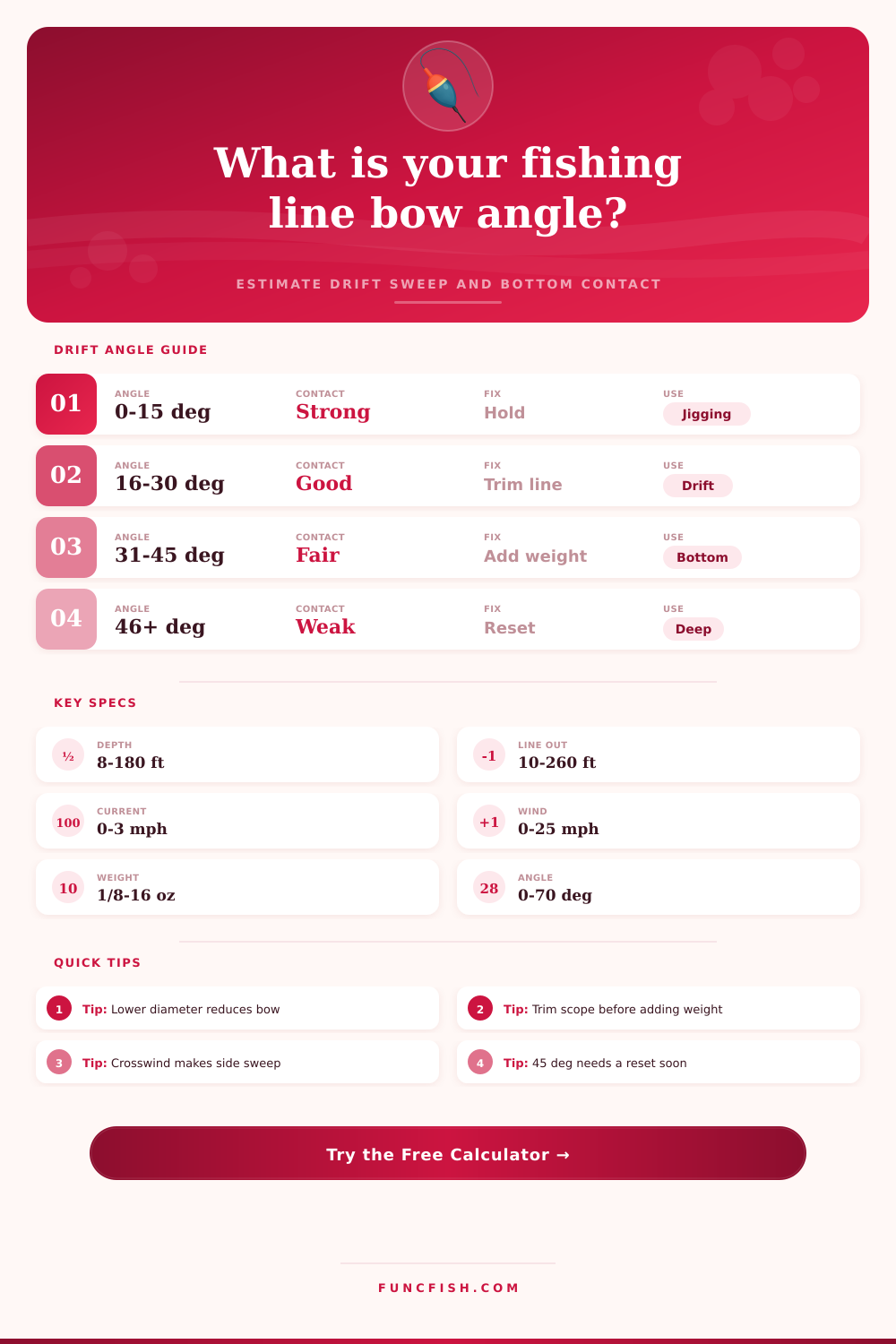
| Bow angle band | Bottom contact | Line response | Best adjustment |
|---|---|---|---|
| 0-15° | Strong vertical feel | Jig snaps stay crisp | Hold weight and shorten lifts |
| 16-30° | Good drift control | Light bow but bites show | Trim extra scope first |
| 31-45° | Fair and delayed | Slack grows between hops | Add weight or slow the boat |
| 46-60° | Weak contact | Sweeps past the strike zone | Reset up-drift or change line |
| 61°+ | Poor bottom feedback | Drag dominates the rig | Reposition before fishing deeper |
| Species or technique | Useful angle range | Typical depth | Line and weight note |
|---|---|---|---|
| Walleye vertical jig | 5-20° | 12-45 ft / 4-14 m | Thin braid, 1/4-3/4 oz jigs |
| Bass drop shot | 10-30° | 15-60 ft / 5-18 m | Braid to fluoro, 1/8-1/2 oz |
| Steelhead side drift | 20-40° | 3-12 ft / 1-4 m | Mono helps mend the bow |
| Fluke three-way | 20-35° | 20-90 ft / 6-27 m | Braid with 2-8 oz sinker |
| Catfish bottom rig | 15-35° | 8-50 ft / 2-15 m | Mono or braid, heavy no-roll |
| Cod bank drift | 15-30° | 80-220 ft / 24-67 m | Thin braid and 8-16 oz sinker |
| Surf pompano sweep | 25-45° | 4-18 ft / 1-5 m | Long scope and pyramid weight |
| Crappie slow troll | 10-25° | 6-25 ft / 2-8 m | Light mono, slow boat speed |
| Condition change | Angle effect | Set-back effect | Practical correction |
|---|---|---|---|
| Line out rises 20% | +4 to +10° | Longer arc | Feed line only when needed |
| Diameter doubles | +6 to +14° | More sweep | Drop to thinner braid |
| Weight doubles | -5 to -12° | Shorter arc | Use when contact fades |
| Crosswind increases | Small vertical change | Much more side sweep | Cast upwind or deploy drift sock |
| Boat outruns current | +3 to +15° | Lure drags behind | Throttle back or jog upstream |
| Current outruns boat | +3 to +15° | Lure pulls downstream | Shorten scope and add weight |
| Line profile | Sample diameter | Drag factor | When it helps |
|---|---|---|---|
| Thin 8-strand braid | 0.004-0.008 in / 0.10-0.20 mm | 0.72 | Deep vertical presentations |
| Standard braid | 0.006-0.012 in / 0.15-0.30 mm | 0.90 | Balanced sensitivity and strength |
| Monofilament | 0.008-0.020 in / 0.20-0.51 mm | 1.22 | Float mends and forgiving drifts |
| Fluorocarbon | 0.007-0.018 in / 0.18-0.46 mm | 1.10 | Clear-water leader-heavy rigs |
| Lead-core | 0.020-0.030 in / 0.51-0.76 mm | 1.35 | Trolling where sink rate matters |
| Wire line | 0.012-0.024 in / 0.30-0.61 mm | 0.82 | Deep strong-current control |
💡Drift control notes
Tip: If the calculator shows a steep bow angle but the sinker still ticks bottom, shorten line first. Extra weight fixes drag, but excess scope is often the real source of the bow.
Tip: Side sweep matters most when the wind is near 90° to the drift track. Cast slightly upwind or point the rod lower to keep the rig in the same lane.
It’s just another one of those days when you get on a good ridge and start drifting down and your lure loses contact with the bottom. You hop it a few times and notice that your rod tip isn’t twitching at each hop and the slack in your line is getting looser. So what gives? It wasn’t the fish, and it sure as heck wasn’t a broken fishing pole. It was physics. Your line has taken on a curve and put your bait 20-feet behind where you believe it to be.
So what happened? That disconnect happen to us all, but knowing why makes this unknown factor something we can control. You don’t have to remember hydrodynamics because it calculates complicated drag equations for you. You provide details of your set-up (line diameter, sinker size, boat drift rate, current speed) and it will calculate how much that bow is distorting your presentation.
Why Your Fishing Line Drifts Away
Most anglers focus on getting their bait as close to structure as possible but they forget about the angle of the line connecting them. And that’s what often explains missing bites when fishing in heavy current. First think about line material. Braids cut through water without much friction and keep a tighter line to lure. Mono, particularly heavy mono, act like a sail in the water. The bigger the profile, the harder the current fight it, creating slack between you and the bite before it gets to your hands. Braid may vibrate all the way up your arm; mono smoothes it out.
The calculator takes those drag coefficients into account when you choose your line. It will illustrate the difference a light braided line makes versus traditional nylon under equal force. The other key factor that counters this drag is weight. The more weight you have, the more it will pull the line down and get it back on angle, increasing the sensitivity. But again, you can only go so far with adding weight. You don’t want to have so much sinker weight that it dives into the mud or penetrates some type of structure rather than hovering in strike zone. It’s all about having enough weight to overcome water resistance but not so much that it ruins the natural fall of the lure.
That balance changes depending off how deep you’re fishing. It is even trickier because wind causes a sideways drift. While vertical bow changes with a following wind or headwind, crosswinds will cause your bait to move off to the side. This can take your bait away from the cover you’re trying to target and into more open water where fish hides less often. When you miss strikes in windy weather, many guys chalk it up to bad luck, but they probably just let the bait drift out of strike zone. Paying attention to direction of the wind allows you to change casting points to counteract the push.
Current also factors into depth. More current over more line = longer line in the current. In shallow water, no matter what line you’re using, you have a short distance from your bait to the boat. Drag is minimal and your connection is tight. In deep water, there’s a long arc between the bottom and your rod tip. Drag piles up exponentially as this distance increase. A five-degree angle at ten feet is negligible, but that same angle at sixty feet means your bait is trailing significantly behind the boat.
The tool comes with a set of reference tables breaking down the bands. You’ll see when contact drops to a point where you can’t trust your tactile feedback anymore. These angles can be learned over time and will translate to more consistent success in any style of drift fishing: side drifting for steelhead, vertical jigging for walleye; they’re the same principle.
It’s not the lure that causes your line to move, but the water. Before you cast, you figure out what kind of bow to expect on the line, then you trim your scope, add weight, or slow down as necessary to get control. You no longer have to guess where the bait is. You know how it sits near whatever structure it’s near, which makes it a proactive tactic instead of a reactive one. When that tick finally comes through, you’re set up to set.