Fishing Line Knot Weakness Percentage Calculator
Estimate how much strength a fishing knot removes after line type, knot choice, tying quality, abrasion, shock load, and drag pressure are considered.
📌Scenario presets
⚙Knot strength inputs
Knot weakness forecast
Full breakdown
🧵Line material reference grid
Mono
Fluoro
Braid
Wire
📋Knot efficiency reference
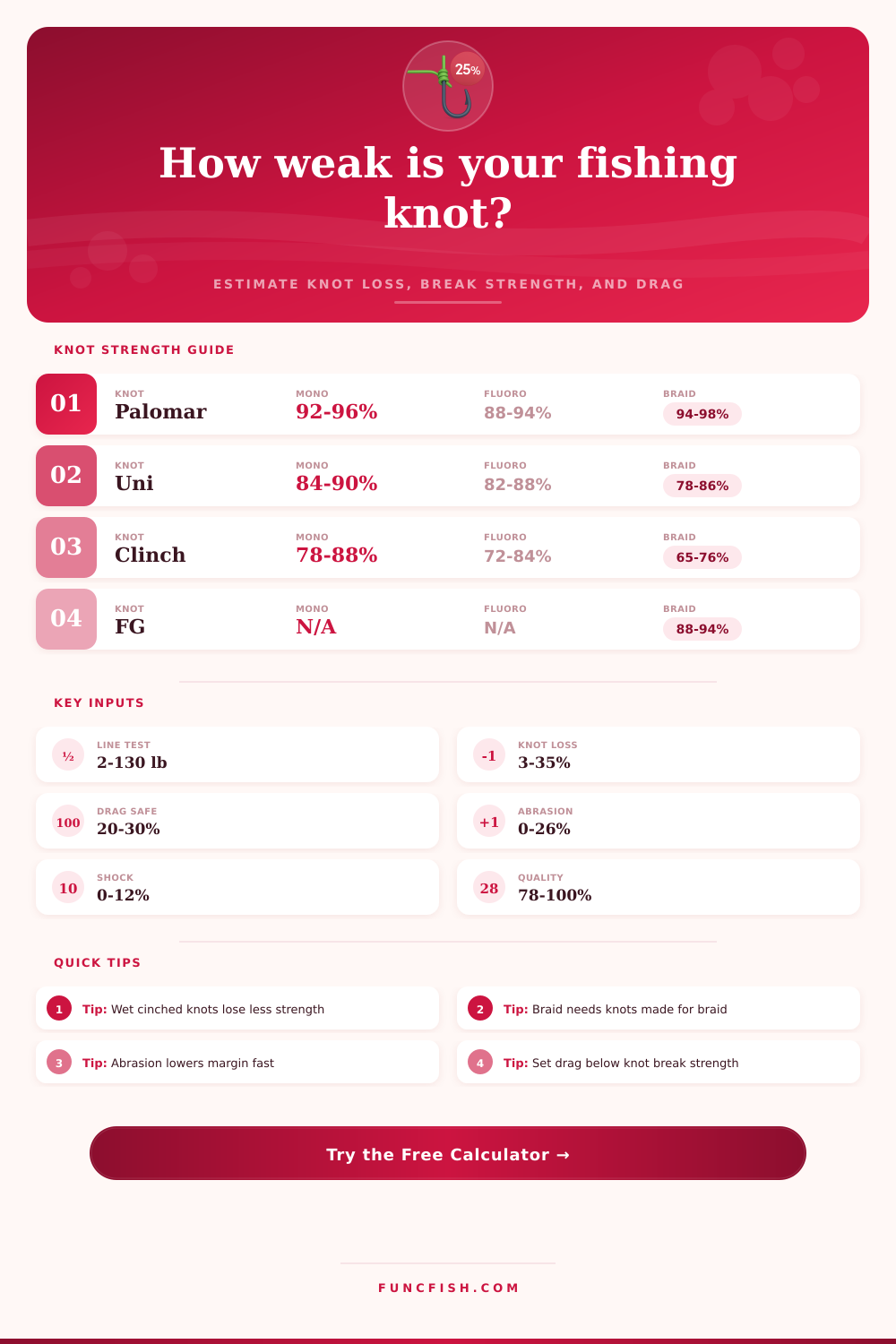
| Knot | Typical line match | Base efficiency | Weakness range | Notes for calculator |
|---|---|---|---|---|
| Palomar | Mono, braid, fluoro | 88-97% | 3-12% | Strong when doubled line seats cleanly |
| Improved clinch | Mono and light fluoro | 72-88% | 12-28% | Can slip or burn on slick braid |
| Uni knot | Mono, fluoro, braid | 78-90% | 10-22% | Reliable general knot with enough wraps |
| Double uni | Line-to-line joins | 72-86% | 14-28% | Best when diameters are close |
| FG knot | Braid to leader | 86-94% | 6-14% | High strength but tie quality matters |
| Alberto | Braid to leader | 80-88% | 12-20% | Compact connection, sensitive to wraps |
| Loop knot | Lures and live bait | 76-88% | 12-24% | Action improves, strength often drops |
| Haywire twist | Single strand wire | 86-94% | 6-14% | Twist count replaces knot compression |
🎣Species and drag reference
| Scenario | Common line test | Drag window | Shock profile | Suggested margin |
|---|---|---|---|---|
| Panfish ultralight | 2-6 lb / 0.9-2.7 kg | 0.5-1.5 lb | Light steady | 3.0x or more |
| Trout stream | 4-8 lb / 1.8-3.6 kg | 0.8-2.0 lb | Short runs | 2.8x or more |
| Bass casting | 10-20 lb / 4.5-9.1 kg | 3-6 lb | Hookset pulses | 2.3x or more |
| Walleye jigging | 6-12 lb / 2.7-5.4 kg | 1.5-3 lb | Jigging lift | 2.5x or more |
| Catfish bottom rig | 15-40 lb / 6.8-18.1 kg | 4-10 lb | Heavy steady | 2.0x or more |
| Inshore saltwater | 10-30 lb / 4.5-13.6 kg | 3-8 lb | Runs and cover | 2.2x or more |
| Surf casting | 15-50 lb / 6.8-22.7 kg | 4-12 lb | Cast shock | 2.5x or more |
| Offshore trolling | 30-130 lb / 13.6-59 kg | 8-35 lb | Strike surge | 2.0x or more |
| Adjustment | Excellent | Normal | Risky | Calculator effect |
|---|---|---|---|---|
| Tie quality | Clean seated | Good wraps | Crossed wraps | 0-22% loss factor |
| Cinch heat | Wet and slow | Unknown | Dry cinch | 0-10% loss factor |
| Abrasion | Fresh line | Light scuffs | Heavy scuffs | 0-26% loss factor |
| Shock load | Smooth drag | Jigging | Trolling hit | 0-12% loss factor |
| Line age | Fresh spool | Season-used | Old line | 0-12% loss factor |
💡Practical checks
Tip: Recheck the knot if the calculated weakness climbs above 25%. The result usually means the knot, line type, or line condition is doing too much damage.
Tip: Compare planned drag with the estimated knot break, not only the printed line test. Knots fail at the weakest loaded section.
Then it happens. The tension on the reel handle stop abruptly. Not the gradual resistance as a fish exhausts its energy to fight again; no, this is the quick empty snap as you realize you’ve just let go of a hard-earned bass due to an ill-fitting knot. Most anglers chalk it up to some sort of bad luck or a toothy predator. In reality, it’s much more ordinary than that. You tied the wrong knot which was not strong enough for those fishing conditions that day. Also, your drag setting is based off what the label says your line can handle, not what it will actualy pull if it is worn down, warmed, and rubbed by friction.
Use the calculator at the top of this story to do the math for you and turn fuzzy thinking about knots into cold hard facts. You’ll have to fill in the blanks on stuff most folks don’t even think about, how much abrasion the line has been subjected to since being spooled, whether you wet the knot prior to cinching it, etc. All those factors changes the actual nature of the fiber itself.
Why You Lose Fish and How to Fix It
When you pull tightly on nylon, it heats up from all that friction, and unless that heat are reduced with either water or saliva, the softened polymer melts together, forming a brittle point of failure directly next to hook eye. Fluorocarbon resists melting and retains structure better than nylon, however it’s more unforgiving to sloppy tie jobs. And braid has virtually no stretch whatsoever, which might sound good, but remember: Any flaw in your connection gets transmitted directly to your main line with nothing to absorb the blow.
But that’s where folks mess up. “All fishing line is just nylon string of varying colors and prices,” they say. Nope. As the table on the page spells out, monofilament loses less strength in a Palomar knot while braid demand precision to maintain its efficiency. The tool takes these basic differences into account when it’s determining what to set your drag to based on the line material and knot you choose.
It also considers the quality of your tie. All of us have been forced to tie a knot under duress at some point, perhaps sticking our hands in muddy water or standing on the slick boat deck. Because the knot was imperfect, the calculator reduce the estimated break strength. That is so you don’t set your drag too tight for a perfect situation that won’t happen in the real world.
Silent Killer, Abrasion: A scuffed spot right next to a knot can be dangerous because sudden shock loads from a lunging fish can exceed your line’s static strength by 20% or more. When you’re pulling baits along oyster bars and launching crankbaits into rock shorelines, that means a big drop in your line rating. The tool lets you enter this wear level so it will redo your drag margin for safety. That’s important because when that fish surges on you, you don’t want your drag to fail if it’s just inches from breaking the knot.
Fish doesn’t pull in a straight-forward manner. They surge and lunge, exceeding steady strength in as little than one-fifth of a second. Remember, we’re not tying the best knot in theory. We’re figuring out our safety buffer. When the calculator shows you have just ten percent slack between the estimated break strength of your knot and your drag setting, you’re on the edge. Retie with an even more efficient loop or tighten up the drag. This isn’t a big adjustment, but it will make all the difference between keeping a fish versus losing one due to gear failure.
Age of line also play a part in this. New spool material retains its integrity much better than old line exposed to water and sun. Accounting for these factors keeps our expectations realistic. In the end, it all boils down to self-confidence. There’s nothing you can do about the behavior of a fish; except be certain that your gear is ready for anything. When your knot becomes the “weakest link” instead of an afterthought, you put yourself into position to win more.
The next time you feel that unexpected slack on the reel handle, what used to be bad luck will become an “avoidable mistake.” You’ll tie better knots, drag smarter, and keep ‘em longer.