Fishing Line Yardage Remaining Calculator
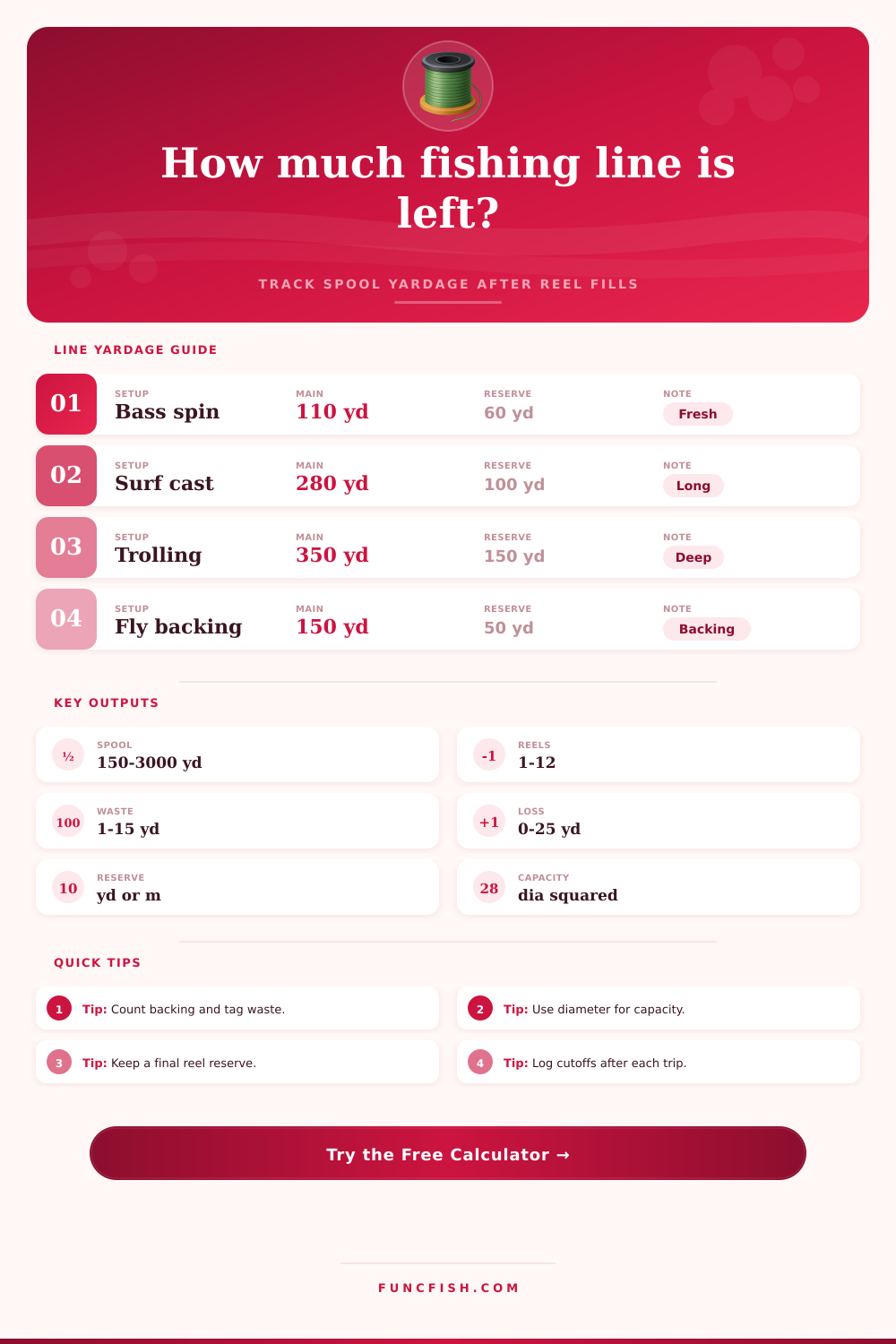
Estimate how many yards or meters remain on a line spool after reel fills, backing, leader tags, knot waste, trip cutoffs, diameter-adjusted reel capacity, and a final reserve.
📌 Yardage presets
⚙ Spool and reel inputs
Yardage remaining results
Calculation breakdown
🧵 Line profile grid
High capacity profile for finesse spinning and long casts.
Common reference diameter printed on many medium spinning reels.
General baitcaster and inshore profile with lower spool capacity.
Thick trolling line; verify reel capacity before long fills.
📊 Current setup comparison
Estimated from label length multiplied by the reference-to-actual diameter ratio squared.
Mainline, backing from this spool, tag waste, and bedding allowance for one reel.
Remaining line after the keep-back reserve and selected strictness adjustment.
Compares your planned mainline plus same-spool backing against adjusted reel capacity.
📘 Reference tables
| Line profile | Typical diameter | Capacity effect | Best yardage use |
|---|---|---|---|
| Thin braid, 10 lb | 0.006 in / 0.15 mm | About 3.4x 8 lb mono label | Finesse, inshore, backing-friendly fills |
| Standard braid, 20 lb | 0.009 in / 0.23 mm | About 1.5x 8 lb mono label | Bass casting, kayak, pier, light surf |
| Mono, 8 lb | 0.011 in / 0.28 mm | Near many reel label references | General spinning and trout reels |
| Fluorocarbon, 10 lb | 0.012 in / 0.30 mm | About 84% of 8 lb mono label | Clear-water leaders and full fluoro fills |
| Heavy braid, 50 lb | 0.014 in / 0.36 mm | About 62% of 8 lb mono label | Frogging, pike, catfish, light offshore |
| Setup | Typical mainline | Keep-back reserve | Planning note |
|---|---|---|---|
| Ultralight panfish | 60-90 yd / 55-82 m | 30-50 yd / 27-46 m | Small reels waste less but need frequent fresh tops. |
| Bass spinning | 90-140 yd / 82-128 m | 50-80 yd / 46-73 m | Track leader reties when braid is the source spool. |
| Baitcaster | 80-120 yd / 73-110 m | 50-100 yd / 46-91 m | Backlashes can consume more line than normal reties. |
| Surf casting | 220-330 yd / 201-302 m | 100-180 yd / 91-165 m | Long casts and shock leaders call for a larger reserve. |
| Trolling reel | 250-500 yd / 229-457 m | 150-300 yd / 137-274 m | Use diameter-adjusted capacity before committing a bulk spool. |
| Logged loss source | Typical amount | When to increase | Calculator field |
|---|---|---|---|
| Knot and tag trimming | 1-3 yd per reel | Double uni, FG, or heavy leader changes | Waste per reel |
| Spool bedding error | 1-5% of fill | Loose braid packing or hand-measured yardage | Allowance percent |
| Abrasion cutbacks | 2-10 yd per outing | Rock, shell, docks, toothy fish, surf wash | Cutoff loss |
| Backlash or wind knot | 5-30 yd event | Baitcasters, braid wind knots, night fishing | Already used |
| Leader building | 3-20 yd session | Many rigs made from the main spool | Already used |
| Capacity formula | Use when | Strength | Limit |
|---|---|---|---|
| Label length x (reference diameter / actual diameter)2 | Changing line diameter on the same reel | Fast capacity estimate | Spool shape and line lay can shift real fill |
| Mainline + backing + waste | Counting line consumed from one source spool | Prevents hidden losses | Only include backing if it comes from this spool |
| Cutoff loss x outings | Updating a partly used spool after trips | Matches real angling wear | Average loss needs periodic correction |
| Remaining - reserve | Deciding whether another reel is possible | Keeps a repair cushion | Reserve should match the fishing setup |
💡 Yardage planning tips
Capacity and remaining-yardage estimates are planning values. Final fill still depends on line lay, spool lip clearance, tension while spooling, and how much old line remains underneath.
You have just spent twenty minutes threading guides and tying a knot only to realize your spool is running dangerously low. Knowing how much line you has left is crucial, until you don’t have any. Most folks purchase a 1,000-yard spool figuring it will be good for six reel. Knot trimming, waste, diameter changes and mistakes made while filling it up is all overlooked factors.
After you enter your set-up information into the calculator, it will do math for you. You won’t have to guess with conversions and coefficients. It makes you consider invisible losses that reduces your supply prior to making a cast. For instance, have you ever thought about tag waste? Every time you cut a tag end on a leader, or cut line off of your reel, you’re throwing away three or four yards of line. Doesn’t seem like much until you fill several reel over the course of a few trips; then it adds up in a hurry. By allowing you to input an average cutoff loss per outing, the tool take this into account. So when you see your remaining estimation, what you’re seeing is actual situation after fishing, not some ideal scenario based off manufacturer’s specs.
Why Use a Fishing Line Calculator
Reels are also a bit tricky and can throws people off if they don’t read fine print, which mostly comes down to line diameter. They’ll say their spinning reel holds 140 yards of eight-pound mono, but drop it down to heavy fluorocarbon or super-thin braid and all of a sudden its a different story. And it doesn’t take long to see why in the reference table above; notice how capacity increase at a rate matching diameter squared. So, for example, if you have a line that’s twice as thick, it will take about four times as much room (and conversely, if it’s half as thick, it will only take about a quarter of space). That’s what makes the difference between being able to load two reels with bulk spool or having to run right out and grab another.
But the number isn’t the only strategy (there’s one on the reserve side as well). Having excessive line in reserve seems wasteful, but having none when you really need it can be more expensive then an extra spool of line (in both money and frustration). So the calculator allows you to choose between a Lean Reserve and Strict Reserve line. It will force you to make that choice and applys it to your own fishing style. Do I want my reserves huge because I’m going to troll offshore where deep runs demand massive capacity? Or do I fish shallow water where I might get 10 bites in an hour requiring frequent reties as opposed to long fights where I’d have less line usage? That single answer completely alters the calculation.
Spool tension changes and packing density don’t align perfectly with package claims in real world applications. The tighter you wind line under consistent pressure, the less space it will take up. Loosely laid line require more space. Therefore, even if you track yardage spot-on, your initial reel-fill could of been greater than anticipated, simply because of the way the line bedded down onto the arbor. That’s where a modest bedding allowance help bridge the gap between theory and practice. Giving yourself a little wiggle-room cushions any surprise shortfalls without having to purchase additional line-just-in-case.
It sounds boring, but logging each trip’s loss will turn the guessing game into numbers. By recording what happened to all that line (abrasion, snags, backlashes), you’ll create an individual timeline of consumption. This, in turn, will teach you things you’d never see otherwise. You might find that your baitcaster setup lose more line due to wind knots than you realized. Or maybe your surf casting rigs require longer shock leaders then anticipated. Knowing these habits will help you buy supplies and run your sessions with more confidence.
Control is all about knowing what you’ve got It avoids overbuying and wasting line. It prevents the panic of running out of line And it allows you to understand the relationship between diameter, reserve margin, waste and all those things so you can manage your equipment as a pro instead of hoping it will be there when you need it.
The next time you grab that big ole’ spool in the back of your truck, you’ll instantly know if it’s been eaten up by unseen losses or if it still has plenty of line left to last you throughout the season. You may not catch ’em all, but you certainly won’t lose one due to running out of line.