Fishing Rod First Guide Distance Calculator
Estimate the first guide mark from the reel, the butt-end layout mark, choke or reduction span, and a starting ring size before taping guides for a static test.
📌Rod layout presets
⚙Rod, reel, and guide train
Recommended starting layout
Calculation breakdown
🔧Guide train data used
Spinning
Baitcasting
Fly
Boat / Troll
📊Reference spacing tables
| Rod style | Typical blank length | First guide from reel | Starting ring size | Layout note |
|---|---|---|---|---|
| Ultralight spinning | 5 ft 0 in to 6 ft 6 in / 1.52 to 1.98 m | 16 to 20 in / 41 to 51 cm | 16 to 20 mm | Keep reduction train light and short. |
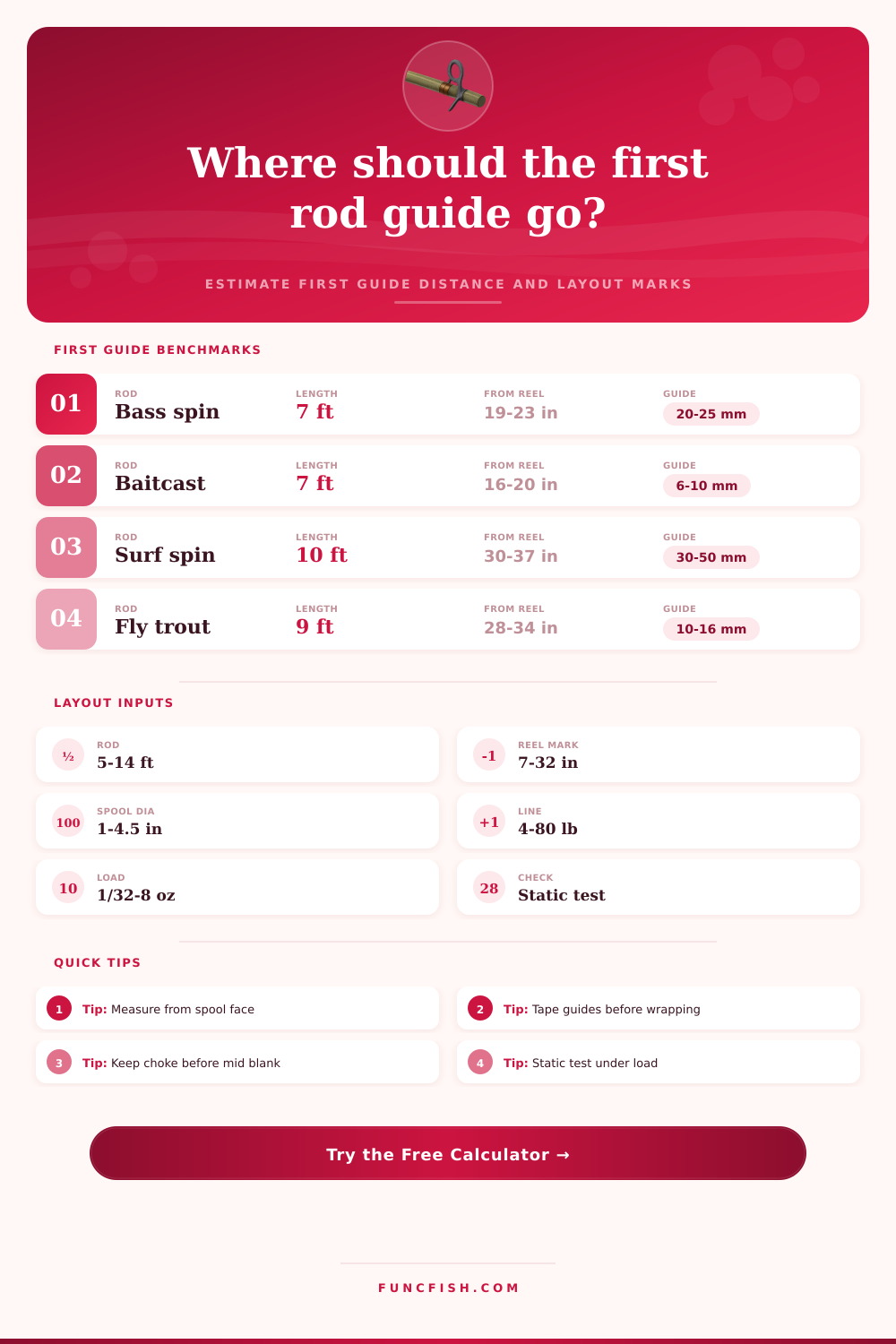
| Bass spinning | 6 ft 6 in to 7 ft 6 in / 1.98 to 2.29 m | 19 to 24 in / 48 to 61 cm | 20 to 25 mm | Match ring height to spool height. |
| Surf spinning | 9 ft to 12 ft / 2.74 to 3.66 m | 30 to 40 in / 76 to 102 cm | 30 to 50 mm | Shock knots need extra ring clearance. |
| Baitcasting bass | 6 ft 6 in to 7 ft 6 in / 1.98 to 2.29 m | 16 to 21 in / 41 to 53 cm | 6 to 10 mm | Line comes off a low, controlled spool. |
| Conventional boat | 5 ft 6 in to 8 ft / 1.68 to 2.44 m | 18 to 26 in / 46 to 66 cm | 10 to 20 mm | Protect the blank under heavy bend. |
| Fly rod | 7 ft 6 in to 10 ft / 2.29 to 3.05 m | 28 to 36 in / 71 to 91 cm | 10 to 16 mm | Stripper guide must clear line hand travel. |
| Guide train choice | Distance adjustment | Ring size effect | Best match | Static test focus |
|---|---|---|---|---|
| Cone of flight | Baseline | Medium to large stripper | General spinning and surf | Line cone narrows smoothly. |
| KR / rapid reduction | Move 6% closer | Smaller high-frame stripper | Braid and finesse spinning | Choke reached quickly without slap. |
| Micro running train | Move 4% closer | Small first guide after reduction | Baitcasting and light braid | No sharp angle under load. |
| Traditional spacing | Move 4% farther | Conservative larger ring | Mono, beginners, mixed reels | Even blank support before wrapping. |
| Fly stripping train | Use hand-clearance range | 10 to 16 mm stripper | Fly rods and shooting line | Line hand does not strike guide. |
| Roller / heavy boat | Move 5% farther | Roller or heavy double-foot | Trolling and stand-up rods | Line stays off blank at full bend. |
| Line setup | Diameter behavior | First guide adjustment | Ring clearance | Builder check |
|---|---|---|---|---|
| Thin braid | Limp, small coils | Can run closer | Moderate ring height | Listen for blank slap on hard cast. |
| Braid to leader knot | Knot passes guides | Slightly farther | Upsize if knot ticks | Pull wet knot through first guide. |
| Light mono | Memory coils | Baseline | Medium ring | Watch coil decay from spool face. |
| Heavy mono | Large coils | Farther | Larger ring | Use smooth, taller reduction frames. |
| Fly line | Thick coating | Hand clearance first | Large stripping ring | Strip line through taped guide. |
| Wire or lead-core | Stiff and abrasive | Farther | Heavy frame or roller | Check line angle under drag load. |
🐟Species and technique starting points
| Scenario | Rod style | Line range | Load range | First guide emphasis |
|---|---|---|---|---|
| Bass spinning | 6 ft 10 in to 7 ft 3 in medium | 8 to 15 lb / 4 to 7 kg | 1/8 to 3/4 oz / 4 to 21 g | Quiet braid coils and fast choke. |
| Trout stream | 5 ft 6 in to 7 ft light | 2 to 6 lb / 1 to 3 kg | 1/32 to 1/4 oz / 1 to 7 g | Light guide weight and soft bend. |
| Surf casting | 9 ft to 12 ft heavy spinning | 15 to 50 lb / 7 to 23 kg | 1 to 6 oz / 28 to 170 g | Large first guide and knot clearance. |
| Catfish bottom | 7 ft 6 in to 9 ft casting | 20 to 65 lb / 9 to 29 kg | 2 to 8 oz / 57 to 227 g | Load path under sinker and drag. |
| Walleye jigging | 6 ft 3 in to 7 ft medium light | 6 to 12 lb / 3 to 5 kg | 1/8 to 5/8 oz / 4 to 18 g | Sensitivity and close first guide. |
| Fly trout | 8 ft 6 in to 9 ft 6 in | 4 to 6 wt fly line | Weighted fly or split shot | Stripper guide hand clearance. |
Layout check: The calculated mark is a starting point for tape-up. Flex the blank with a working load and move the guide until the line path is smooth, the blank is supported, and the line never touches the rod.
Measurement check: For spinning rods, measure from the spool face or spool lip toward the tip. For casting, conventional, trolling, and fly rods, use the reel center or line exit as the practical reference point.
The placement of the first guide on a fishing rod is a critical task. The placement of the first guide on the fishing rod will determine the way the fishing line travel along the fishing rod blank. Should the angler place the first guide in a wrong position along the fishing rod blank, the fishing line will slap against the fishing rod when the angler casts the line.
Additionally, the blank of the fishing rod will not flex in an even manner when the fish pull at the fishing line. The goal in placing the first guide is to ensure the fishing line leave the reel smoothly, and the rod blank is supported when the fish apply pressure on the rod blank. The rod builders determine the placement of the first guide by analyzing the geometry of the reel.
How to Place the First Guide on a Fishing Rod
Several factor affects the placement of the first guide, including the diameter of the spool on which the fishing line is cast, the height of the fishing line on the reel, and the length of the fishing rod. For spinning fishing rods, the line is released in a wide cone, so the first guide has to be placed in such a way that it will catch the fishing line before it comes into contact with the rod blank. For baitcasting fishing rods, however, the reel maintains the fishing line in a lower position, so the first guide is more closer to the fishing reel than spinning rods.
The same rod blank can be used but with a different distance between the first guide and the fishing reel. Another factor that determines the distance of the first guide from the reel is the type of fishing line that will be used. For rods that use thin braided fishing lines, the first guide can be placed closer to the fishing reel.
For heavy monofilament lines, however, there will be more space require before the line reaches the first guide. For anglers who use fly lines that are thick in nature, the first guide must also clear the hand of the angler when stripping the line. In this case, the first guide must be further away from the fishing reel.
A calculator can help determine these distances given the length of the rod, the position of the reel, the diameter of the spool, the strength of the fishing line, and the weight that will be cast. The calculator will provide three specific marks for the rod builder. The first mark will show the distance from the reel seat at which the rod builder should tape the first fishing guide to the rod.
The second mark, called the butt mark, will show the distance of the first guide from the end of the rod. This marking allow the rod maker to measure the distance from the grips of the fishing rod. The last mark is the choke mark.
This mark will indicate where the fishing line should be under control before the fishing line reaches the middle of the fishing rod blank. These three marks will ensure that the remaining guides are not force the fishing line into sharp angles. Depending on the weight of the fishing lure and the action of the fishing rod, the rod will behave in different ways.
For example, a seven-foot medium spinning fishing rod may behave differently when using a three-ounce fishing lure compared to a half-ounce fishing lure. The heavier the fishing lure, the more the rod will bend. This will change the path of the line, so the first guide may need to be moved.
If the rod blank has an extra-fast action, the rod will bend less, so the first guide can be closer to the fishing reel. If the blank bends more, it is better to move the first guide away from the fishing reel. Many fishing rod makers will tape the first guide in place and perform a static test of the rod with the specific weight of the fishing lure that will be used.
When the fishing line clears the fishing rod blank and there is no line slap against the rod, and the blank feels evenly loaded with the weight of the fishing lure, then the position of the first guide is set. If the fishing line does not clear the fishing rod blank, or if the blank is not evenly loaded, move the first guide by half an inch. Repeat the test with the fishing lure until you achieve the outcome described above.
Thus, the mathematical calculation from the fishing rod guide line calculator is only an estimation of the distance of the first guide. The actual behavior of the fishing rod blank when loaded with fishing bait determine the final placement of the first guide. It’s important to realize that you’re should of checked the rod’s length too.
The actual behavior of the fishing rod blank when loaded with fishing bait determine the final placement of the first guide.