Fishing Rod Stripper Guide Size Calculator
Estimate the first guide ring size, frame height class, reel-to-stripper distance, choke point, and leader knot clearance for spinning, casting, fly, surf, and trolling rod layouts.
📌Rod layout presets
⚙Reel, line, and blank inputs
For baitcasting and conventional reels, use spool width if it is larger than visible diameter.
Recommended stripper guide layout
Calculation breakdown
🧰Guide train data
Spinning
Casting
Fly
Trolling
📊Reference sizing tables
| Rod layout | Typical stripper size | Reel-to-stripper start | Best used when |
|---|---|---|---|
| Light spinning | 16 to 20 mm | 16 to 21 in / 41 to 53 cm | Small 1000 to 2500 reels, thin line, short casts. |
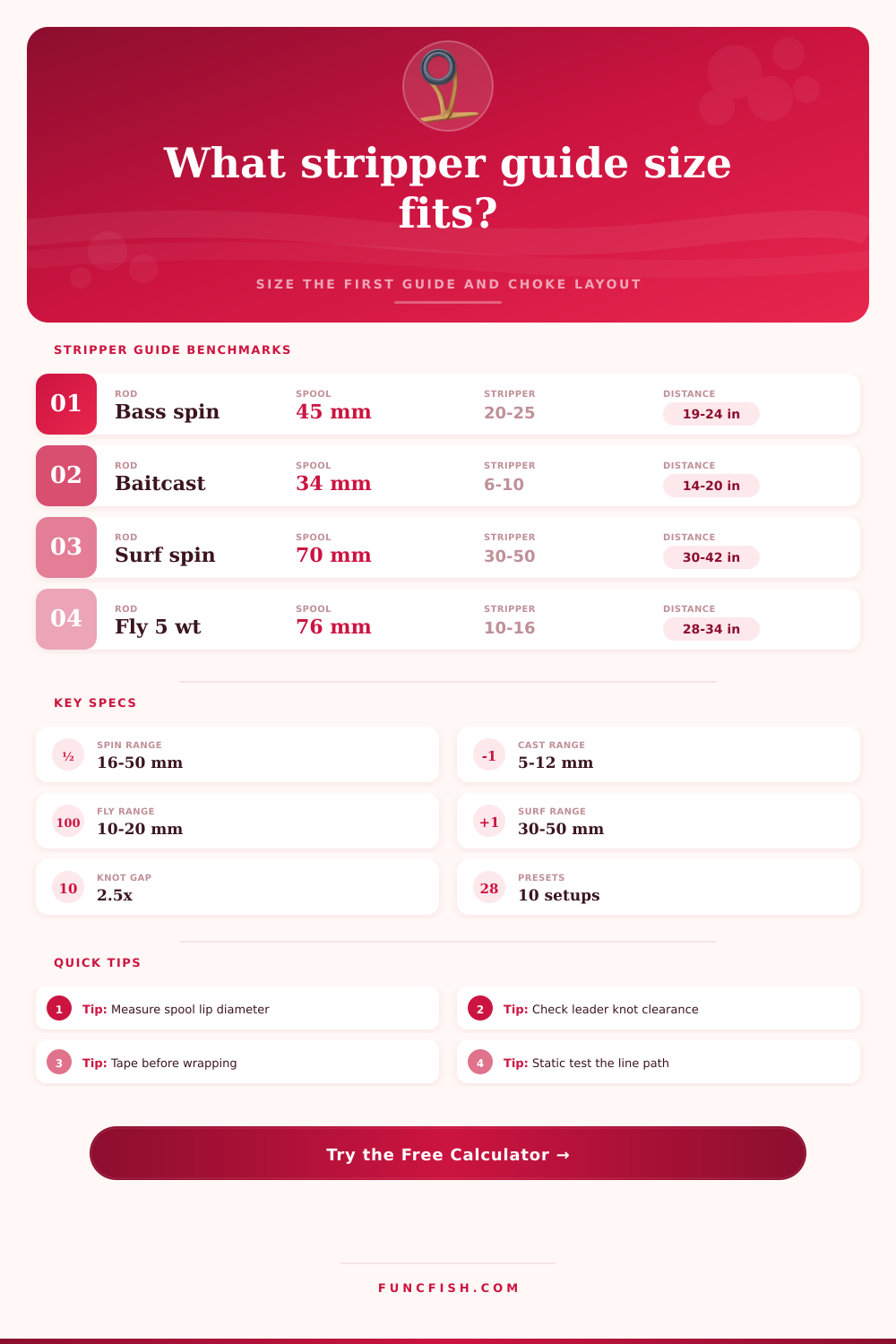
| Bass spinning | 20 to 25 mm | 19 to 24 in / 48 to 61 cm | 2500 to 3000 reels, braid to leader, all-around use. |
| Heavy spinning | 25 to 30 mm | 22 to 30 in / 56 to 76 cm | Large spools, heavier leaders, inshore and pike rods. |
| Surf spinning | 30 to 50 mm | 30 to 42 in / 76 to 107 cm | Large spool reels, shock leaders, long cast rigs. |
| Baitcasting | 6 to 10 mm | 14 to 21 in / 36 to 53 cm | Low-profile reels with controlled line exit. |
| Boat or trolling | 12 to 30 mm | 18 to 31 in / 46 to 79 cm | Heavy mono, braid, wire, or roller guide layouts. |
| Fly rods | 10 to 20 mm | 26 to 36 in / 66 to 91 cm | Line handling clearance and shooting line control. |
| Line path | Clearance multiplier | Size effect | Layout note |
|---|---|---|---|
| Thin braid | 2.0x knot diameter | Can size down | Watch line slap on spinning rods. |
| Braid to leader | 2.5x knot diameter | Add 1 to 3 mm | Useful when knots pass through on cast. |
| Shock leader | 3.0x knot diameter | Add 4 to 8 mm | Often drives surf stripper sizing. |
| Fly line | 1.8x line loop | Moderate ring | Keep enough hand-strip clearance. |
| Wire or lead core | 2.2x line diameter | Use tough frames | Friction and frame durability matter. |
🐟Species and build references
| Target use | Rod length | Line range | Starting stripper plan |
|---|---|---|---|
| Panfish and trout | 5 ft to 7 ft / 1.5 to 2.1 m | 2 to 6 lb / 1 to 3 kg | Small spinning stripper, short transition train. |
| Bass and walleye | 6 ft 6 in to 7 ft 6 in / 2.0 to 2.3 m | 6 to 20 lb / 3 to 9 kg | 20 to 25 mm spinning or 6 to 10 mm casting. |
| Pike and musky | 7 ft to 8 ft 6 in / 2.1 to 2.6 m | 30 to 80 lb / 14 to 36 kg | Upsize for leader knot and hard cast loads. |
| Surf species | 9 ft to 13 ft / 2.7 to 4.0 m | 15 to 65 lb / 7 to 29 kg | Large first guide with longer choke distance. |
| Offshore trolling | 5 ft 6 in to 7 ft / 1.7 to 2.1 m | 50 to 130 lb / 23 to 59 kg | Heavy double-foot or roller stripper sizing. |
| Fly trout | 8 ft 6 in to 9 ft 6 in / 2.6 to 2.9 m | 4 to 6 wt fly line | 10 to 16 mm stripper with hand clearance. |
Layout check: The result is a starting guide size and mark. Tape the guide on the blank, run line through the train, flex the rod, and confirm the line clears the blank under load.
Measurement check: For spinning layouts, the spool lip diameter and spool height drive the ring size. For casting, conventional, fly, and trolling rods, line exit height and knot clearance usually matter more.
The stripper guide is a first guide on a rod to feature the line. The position of the stripper guide relative to the reel, as well as the sizes of the stripper guide itself, will have an impact upon the performance of the rod when fishing with it. If the stripper guide is positioned too close to the reel, too far from the reel, or of an incorrect size, there will be various problems in relation to the casting and retrieving of the fishing line.
These issues include line slap, knot hangups, and uneven loading of the line onto the reel, all of which are the result of an incorrectly positioned or sized stripper guide. Thus, the caster must first obtain measurements of the rods spool and the knots that will attach the fishing line to the rod before the size of the stripper guide can be selected. The calculator that is provided in the article include mathematical results based off the measurements that the caster of the rod provides.
How to Size and Place the Stripper Guide
The length of the rod, the position of the reel, the dimensions of the spool, and the details of the fishing line must all be entered into the calculator. These inputs by the caster result in the calculator providing recommendations of the size of the ring that will be used, the distance between the reel and the stripper guide, and the choke point of the rod. The diameter of the spool lip is important in that it will indicate the width of the line as it leaves the rod.
The height of the spool above the rod blank indicate the angle of the line before it reaches the first guide ring. These two measurements are the baseline for the size of the ring that will be established before considering the size of the knots and the style of the frame of the rod. The number of leader knots that will be attached to the line will have an impact upon the size of the ring that is used for the stripper guide.
More specificaly, the number of leader knots will require the line to have extra room to travel through the guide. If the inclusion of shock leaders or heavy braided fishing line increase the number of knots, the calculator will increase the size of the ring to ensure that the knot does not catch upon the stripped fishing line. The same logic apply to fly lines and the stripping hand of the fisherman.
The action of the rod and the fishing style that is to be used will impact the distance between the stripper guide and the reel. Fast actions are utilized for rapid loading and unloading of the fishing line, and, therefore, require the stripper guide to be closer to the reel. Conversely, moderate and slow actions will allow for increased flexing of the rod, and, thus, require the stripper guide to be positioned further from the reel.
The calculator will account for both these variables; however, the rod should of still be tested on a workbench to ensure that the line will clear the rod blank when flexed. To test the stripper guide, the stripper guide can be taped into place into the rod, the fishing line can be passed through the rod, and the rod can be flexed to ensure that the line does not slap against the rod blank. It is common for individuals to make mistakes in the positioning and sizing of the stripper guide.
For instance, many individuals may decide upon the size of the stripper guide based upon the look that it creates for the rod, or they may use the size that was used for another rod build. In both instances, the line may hang upon the knot due to the inconsistencies between those dimensions and those of the rod itself. It is essential, therefore, to measure these dimensions prior to the wrapping of the stripper guide to ensure that the individual does not develop frustrations in the building of the rod.
The tables that are provided as examples of the required dimensions for the different types of fishing rods and lines can provide benchmarks for the caster. For instance, surf rods will require larger guide rings and distances between the stripper guide and the reel due to the size of the spools and leaders for these types of rods. Baitcaster fishing rods will have smaller rings due to the way that the line is cast onto the baitcaster.
Additionally, the dimensions of the guide and the stripping point for fly rods will be different than straight fishing rods due to the need for the fisherman’s stripping hand to strip the line. These tables can help to confirm the stripper guide sizing decisions that the caster makes intuitively, but the calculator will provide the exact measurements that are required for the fishing rod that will be built. Because the stripper guide is the first guide of a rod, the positioning of the two components, the stripper guide and the rod blank, is crucial for the performance of the rod.
If the stripper guide is positioned correctly relative to the rod blank, the balance and function of the fishing rod will be correct. However, if that positioning is incorrect, the fishing rod will have issues throughout its build and construction.