Fishing Spot Rotation Schedule Calculator
Build a practical spot loop from your available time, run distance, soak or cast time, confidence weighting, tide and wind window, fishing pressure, and return interval.
📌Spot rotation presets
⚙Schedule inputs
Rotation schedule forecast
Full breakdown
📊Gear and species comparison grid
Bass Points
Redfish Marsh
Surf Cuts
Trout Pools
Walleye Reefs
Catfish Holes
Brush Panfish
Offshore Lines
📋Rotation reference tables
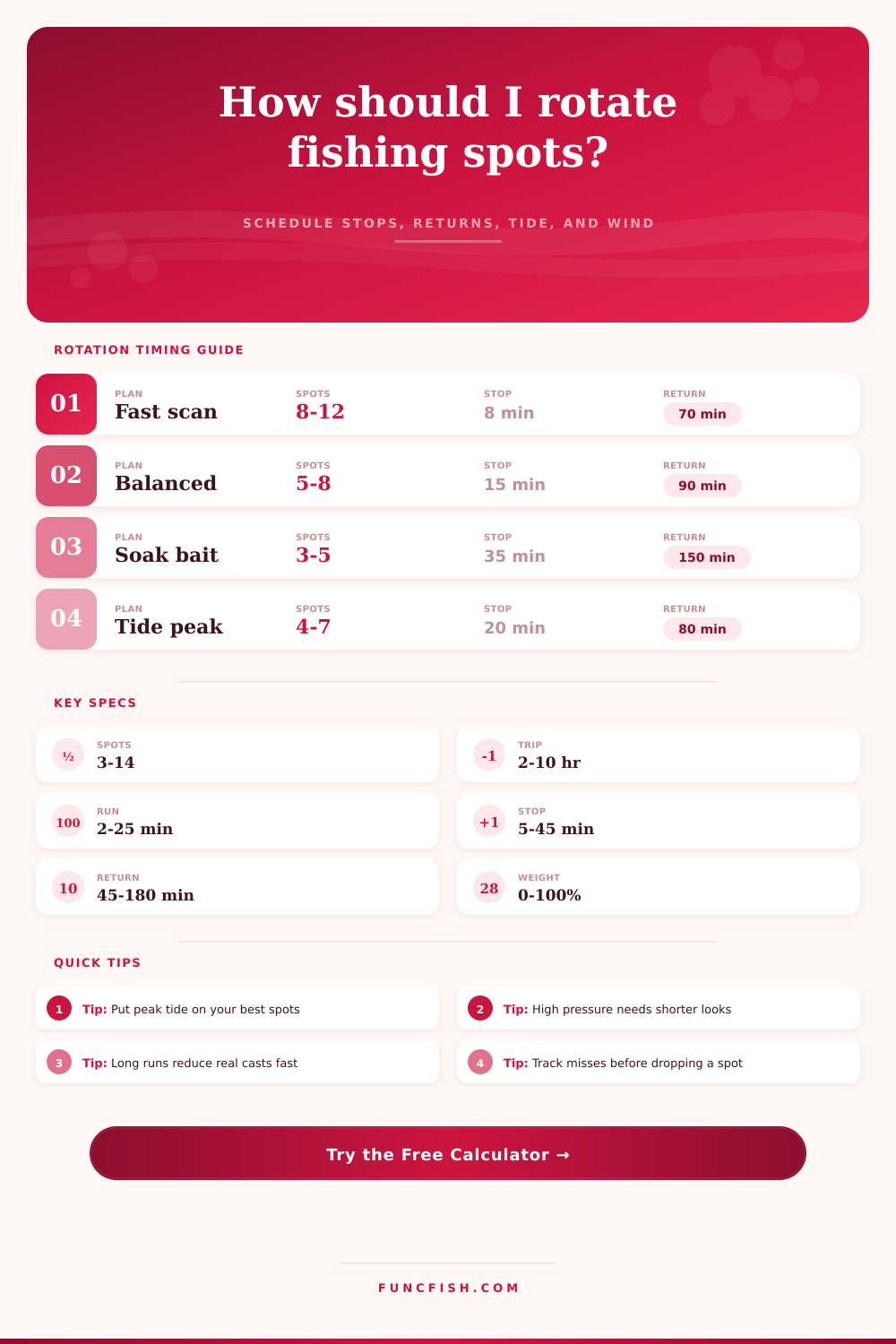
| Rotation type | Best spot count | Stop length | Use when |
|---|---|---|---|
| Fast reaction search | 8-14 spots | 5-12 min | Fish are moving or visible signs are scattered |
| Balanced scouting loop | 5-9 spots | 12-22 min | You need return shots without rushing each stop |
| Prime-window priority loop | 4-7 spots | 15-28 min | Tide, current, or wind will peak during the trip |
| Long soak bait loop | 3-5 spots | 30-60 min | Bait needs time to draw fish from cover or depth |
| Low-pressure quiet loop | 4-8 spots | 18-35 min | Stealth matters and extra movement hurts the bite |
| Tide and wind window | Fishing multiplier | Prime share | Schedule effect |
|---|---|---|---|
| Poor alignment | 0.82 | 25% | Trim weak stops and keep scanning |
| Fair alignment | 0.95 | 40% | Hold the planned loop unless a spot is dead |
| Good alignment | 1.12 | 58% | Return to top confidence spots sooner |
| Peak alignment | 1.28 | 72% | Spend the strongest window on the best spots |
| Fishing pressure | Stop adjustment | Spot adjustment | Rotation note |
|---|---|---|---|
| Low pressure | +12% | -1 spot | Stay longer when fish are not being disturbed |
| Normal pressure | 0% | 0 spots | Use the planned soak or cast time |
| Busy water | -10% | +1 spot | Shorten looks and avoid crowding one area |
| Heavy pressure | -18% | +2 spots | Move before the spot goes stale |
| Return interval target | Best use | Typical loop | Warning sign |
|---|---|---|---|
| 40-60 min | Small water, active fish | 3-5 short stops | Fish spook after each return |
| 70-100 min | Balanced casting route | 5-8 mixed stops | Only one spot gets the prime window |
| 110-160 min | Pressure or bait soak | 4-6 longer stops | Too much time lost running |
| 180+ min | Big water or heavy bait | 2-4 anchor stops | Few checks before conditions change |
💡Timing checks
Tip: If the calculated pass is shorter than your return interval, keep the weakest spot in reserve instead of forcing another immediate visit.
Tip: When wind or tide is strongest for a short window, move the two highest-confidence spots into the middle of the schedule.
How long do you think you’ll stay at any given spot? That’s something you don’t realy plan much. Knowing where the fish are go into planning what you’re going to do that day, but planning out your time and using the area before the bite fizzle is a whole different ballgame. With eight potential holes and six hours of daylight, you’d better not guess, especially if tide is only moving in your favor for two of them. While you fight current, trying to do the math in your head are close to impossible.
The tool above will take care of that for you, it figures all this scheduling stuff out so you can concentrate on throwing things around. And this is where you begin: with the real-world constraints of your actual trip, rather than the idealized one you dream up while sitting around at home.
How to Plan Your Fishing Trip
How many place do you actualy want to visit? What’s your total time available? Next, enter friction costs. These are thing like the average travel time between locations. How much time do you need to spend retying a lure, anchoring, etc? Many folks neglect the latter but it add up quick. Lose four minutes at each of ten stop and suddenly you’ve just lost forty minutes of fishing time.
Then you adjust for the conditions. The calculator will ask you about fishing pressure. That’s how many other boat are fishing the same underwater structure. If it’s heavy pressure, that change the game. If three other boats worked a spot first, it doesn’t give you time to soak a spot for 40 minutes. So the system crank up the number of spots and shortens amount of time you’re supposed to be on each spot, forcing you into a faster reaction pattern. With low pressure, the fish haven’t been bumped off and you have the chance to soak a spot longer because they might be a bit more shy or picky.
Also important is how the wind and tide line up. This is where chart on the page clearly shows it for you. That multiplier on your fishing time increase a lot when the wind create a big disturbance on the water’s surface. It also increases when the tide come in or going out at its peak. This is the prime window. Match your best spots with that peak energy. So if you pull up at your third-best spot and the tide goes off the hook then, you’ve wasted the best moment of the day. The calculator will weight your schedule accordingly and tell you to hit those prime spots when the optimal window hits them. It doesn’t assume all minutes of daylight is created equally.
Then there’s the slider for weighing your confidence. It quantifies your gut feel. You’re eighty percent confident that a particular piece of grass line holds fish; you slide it up. That makes the schedule favor returning to that area. Spend less time fishing those speculative holes. There is less chance of making the all too common mistake of wasting an hour on a maybe spot just to come up dry, you have no time left to use the sure thing. It is a small tweak, but it saves the trip.
The result? It provides you with a return interval. How long should you wait until fishing that same place again? Shorter intervals are good for aggressive species (panfish, trout) which will return shortly. Longer gaps work for wary predator and bottom feeder species which require some time for the area to recover. If the interval is too short, you run the risk of spooking other fish in the area. Too long and you miss the boat. The tool tries to balance those two factors based off your inputs.
So all in all, a rotation schedule is nothing more than a theory. It’s never going to tell you what the water is going to do. But it does give you something to react to instead of floating along with whatever the day bring you. You have an idea as to why you’re on that spot and how much time you need to be there. You should of fished the day, not the hole.