Fishing Trip Packing List Calculator
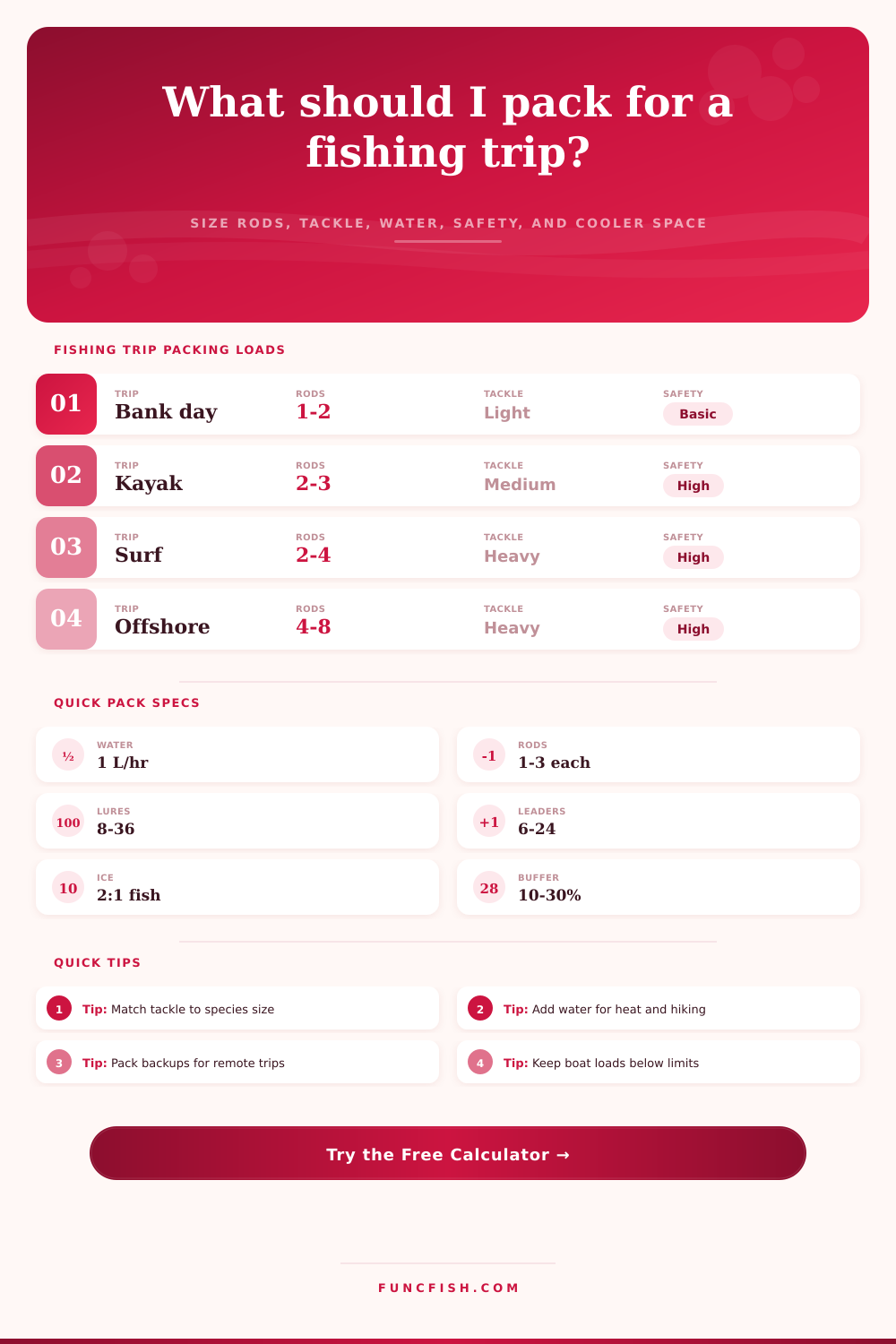
Build a trip-specific packing list from anglers, duration, target species, fishing style, access distance, weather exposure, tackle redundancy, food, water, safety gear, and cooler needs.
📍Trip presets
⚙Packing list inputs
Calculated fishing trip packing list
Calculation breakdown
🧰Gear and species packing grid
Bass
Trout
Catfish
Offshore
Surf
Kayak
Walleye
Pike
📊Packing reference tables
| Trip style | Base kit weight | Base volume | Core storage | Safety add-on |
|---|---|---|---|---|
| Bank fishing day trip | 9 lb / 4.1 kg | 18 qt / 17 L | Shoulder bag or small crate | First aid, pliers, rain shell |
| Wade stream hike | 12 lb / 5.4 kg | 24 qt / 23 L | Vest, chest pack, or waterproof sling | Wading staff, dry layer, repair kit |
| Boat lake or reservoir | 18 lb / 8.2 kg | 42 qt / 40 L | Boat bag and utility trays | Throwable, light, tool roll |
| Kayak inshore flat | 20 lb / 9.1 kg | 38 qt / 36 L | Milk crate, dry bag, deck box | PFD, leash, compact anchor |
| Surf or pier session | 25 lb / 11.3 kg | 54 qt / 51 L | Sand spike bag or pier cart | Headlamp, gloves, leader roll |
| Offshore boat trip | 44 lb / 20 kg | 96 qt / 91 L | Large deck bin and fish box | VHF, seasick kit, heavy tools |
| Ice fishing shelter | 38 lb / 17.2 kg | 80 qt / 76 L | Sled, bucket, and shelter bag | Ice picks, heater check, cleats |
| Overnight bank session | 34 lb / 15.4 kg | 86 qt / 81 L | Cart, cooler, and dry duffel | Lights, power, extra layers |
| Species group | Rods each | Lure or rig count | Leader count | Tool priority |
|---|---|---|---|---|
| Bass | 1.5-3 | 12-28 soft baits, jigs, cranks | 6-12 leaders or snaps | Pliers, scale, line cutters |
| Trout | 1-2 | 8-20 flies, spinners, spoons | 6-14 tippet or leaders | Forceps, nippers, thermometer |
| Walleye | 2-3 | 16-36 jigs, rigs, crankbaits | 10-18 leaders or harnesses | Net, pliers, depth notes |
| Catfish | 2-4 | 10-24 sinker rigs and hooks | 8-18 leaders | Gloves, spreader, hook remover |
| Panfish | 1-2 | 12-30 jigs, floats, tiny hooks | 4-10 light leaders | Small pliers, bucket, towel |
| Surf species | 2-4 | 12-30 rigs, spoons, sinkers | 12-24 shock or bite leaders | Sand spikes, gloves, light |
| Inshore redfish | 2-3 | 10-26 paddletails, spoons, topwaters | 8-18 fluorocarbon leaders | Fish grips, pliers, measuring board |
| Offshore tuna | 4-8 | 18-48 skirts, jigs, plugs | 12-30 heavy leaders | Harness, crimpers, gloves |
| Gear system | Rod weight each | Tackle box weight | Volume factor | Typical spare ratio |
|---|---|---|---|---|
| Light spinning kit | 1.1 lb / 0.5 kg | 3.5 lb / 1.6 kg | 0.7 qt per item | 10% spare terminal |
| Medium spinning kit | 1.4 lb / 0.6 kg | 5 lb / 2.3 kg | 0.9 qt per item | 15% spare terminal |
| Baitcasting kit | 1.6 lb / 0.7 kg | 6 lb / 2.7 kg | 1.0 qt per item | 20% spare terminal |
| Fly fishing pack | 1.2 lb / 0.5 kg | 3 lb / 1.4 kg | 0.45 qt per item | 25% tippet and flies |
| Heavy surf kit | 2.6 lb / 1.2 kg | 10 lb / 4.5 kg | 1.35 qt per item | 25% rigs and sinkers |
| Trolling spread | 3.4 lb / 1.5 kg | 18 lb / 8.2 kg | 1.6 qt per item | 30% leaders and hardware |
| Bottom rig kit | 2.3 lb / 1.0 kg | 9 lb / 4.1 kg | 1.15 qt per item | 25% hooks and weights |
| Ice combo kit | 1.9 lb / 0.9 kg | 7 lb / 3.2 kg | 1.05 qt per item | 20% jigs and line |
| Condition | Water multiplier | Safety weight | Volume add | Calculation note |
|---|---|---|---|---|
| Mild stable weather | 1.00 | 1.5 lb / 0.7 kg | 3 qt / 3 L | Baseline first aid and rain cover |
| Hot sun or warm water | 1.35 | 2 lb / 0.9 kg | 5 qt / 5 L | Extra water and fish cooling margin |
| Cold wind or rain | 1.10 | 4 lb / 1.8 kg | 10 qt / 9 L | Dry layers and hand protection |
| Storm chance or rough water | 1.20 | 5 lb / 2.3 kg | 12 qt / 11 L | Navigation, shelter, and waterproofing |
| Night session visibility | 1.10 | 3.5 lb / 1.6 kg | 8 qt / 8 L | Lights, spare power, reflective markers |
| Remote or off-grid | 1.25 | 6 lb / 2.7 kg | 14 qt / 13 L | Repair, communications, and backup warmth |
💡Packing calculation tips
Water and distance: Treat the water result as a carried-load minimum when no resupply is available. Heat, long walks, and surf or offshore exposure raise the multiplier because dehydration risk climbs faster than tackle weight.
Storage fit: If storage use is above 90%, reduce duplicate lure colors first, then spare rods, then cooler space only when you are releasing fish or have reliable ice access nearby.
The worst moment in fishing is not when you lose a fish. It is when you realize you forgot the leaders, ran out of ice, or packed a net that’s too small for what you caught. Not losing one fish. But then you remember you didn’t pack ice, forgot your leaders, or that your net won’t hold what you caught.
Should you bring your whole kitchen to water’s edge? Unless you know what utensil goes where, it’s just an exercise in weight and aggravation. Too much stuff weigh you down. Not enough gets you into trouble and costs money. Finding a happy medium between being ready and being weighed down is key.
How to Pack the Right Gear for Fishing
Once you enter in your trip parameters, the calculator do all of the math for you. You won’t have to guess about conversions or coefficients anymore. How long will you be gone? How many angler are traveling? What kind of fishing do you plan to do? Based off those answers, you receive the base load.
An offshore trolling trip for tuna is very different then a bank day for bass. Choosing your species also matter. You’re not taking as much tackle if you’re heading out for tuna versus a few bass guys carrying light lines and a handful of confidence baits. Those selections drive rod numbers and number of lures needed.
Your tackle list is then tailored to suit the trip. You have sufficient lures for pattern fishing without dragging around dead weight.
Most folks goof on food and water. When it comes to food, you don’t pack based off hunger, but on distance, heat and time. With water, you don’t pack based off thirst; instead, you plan for distance and timing. The tool has a base level, then multiplies by conditions. Hotter weather? More water needed. Warmer water? A lot more! Longer miles to that lonely stream without resupply? That water weighs a lot too. Better to have a spare liter than to ration it out sip-by-sip your mind drifting off course.
On coolers: How much do you want to keep, and how cold should it be? Release all of them? Save your back by skipping that heavy chest. Fish? You’ll need some ice and some volume. Even on a short trip, don’t scrimp on safety gear. The calculator includes modules for light, a rain shell, and first aid. They might sound unimportant, but when you need one, you really do.
A good rain shell helps you feel vibrations in your fishing line and keeps your hands dry. A simple first aid kit lets you pop a blister or at least clean up any hook cuts. On long trips, it adds buffer weight for redundancy. And there’s no fixing a lost lure or broken rod if you didn’t had a spare. That’s the difference between saving a day and ruining it.
The fit output for storage tells you whether your pack will fit in your boat or vehicle. If it’s over ninety percent, you’re going to have to trim. Cut duplicate colors first. Then drop spare rods. Duplicate color second. Don’t touch hydration or safety first.
Packing comes with its own flow. You figure out that soft plastics takes up less space than hard baits. Fluorocarbon leaders are bulkier than mono. Your cooler can only hold so much ice and your kayak deck holds only so much gear. With the page’s reference tables, they lay this out in general terms based off style. For example, a hike into a wade stream carries a baseline weight, while a surf session carries more weight. That sand exposure and those heavy rigs. Add ice fishing with weight for shelter and warmth.
Those baselines gives you something to test your own thinking against. Double the baseline on your number and chances are you’re overthinking it. You should of checked that first. You’re not trying to travel light, you’re trying to travel right. Your goal is to show up on the water with everything you need and nothing you don’t.
Use the calculator as a starting point and let experience fill in the blanks. Understand what kind of weather you’ll be fishing in. Understand what kind of species you’ll be facing. Understand your limitations. Load up, go, and hopefully, the fish will be biting.
The last thing you want to think about while you cast is did I forget to bring …