Fishing Trip Water Needs Calculator
Estimate potable drinking water, reserve water, live-bait support water, rinse water, and container count for boat, bank, kayak, wading, surf, pier, and offshore fishing trips.
📌Fishing trip presets
⚙Water planning inputs
Fishing trip water plan
Calculation breakdown
🎣Gear and species water grid
Bass Casting
Trout Wading
Kayak Inshore
Surf Casting
Walleye Boat
Catfish Night
Salmon River
Offshore Crew
📊Reference tables
| Temperature band | Base drinking pace | Best fit | Water planning note |
|---|---|---|---|
| Under 55°F / 13°C | 12 oz/hr / 355 mL/hr | Ice shelter, cold stream | Cold reduces thirst cues; still schedule drinks. |
| 55-70°F / 13-21°C | 16 oz/hr / 475 mL/hr | Cool morning trips | Good baseline for low-effort fishing. |
| 70-80°F / 21-27°C | 20 oz/hr / 590 mL/hr | Typical daylight fishing | Add more if walking, wading, or casting hard. |
| 80-90°F / 27-32°C | 24 oz/hr / 710 mL/hr | Summer bank or boat | Use shade and split water into reachable bottles. |
| 90-100°F / 32-38°C | 30 oz/hr / 890 mL/hr | Hot shore, kayak, flats | Electrolyte fluid becomes a bigger share. |
| Over 100°F / 38°C | 36 oz/hr / 1065 mL/hr | Heat alert trips | Shorten the session or carry a large reserve. |
| Trip style | Exposure factor | Typical reserve | Planning cue |
|---|---|---|---|
| Bank near vehicle | 1.00 | 10-15% | Stage backup in the vehicle, not only in a tackle bag. |
| Boat lake or reservoir | 1.06 | 15-25% | Wind and delayed return make a cooler jug useful. |
| Kayak or canoe | 1.18 | 25-35% | Use reachable water plus a stowed backup bottle. |
| Wading stream or flats | 1.12 | 20-30% | Weight matters, so split between pack and vehicle. |
| Surf casting beach | 1.20 | 25-35% | Sand, glare, and wind increase unnoticed losses. |
| Offshore boat trip | 1.28 | 35-45% | Carry a return-delay reserve independent of ice melt. |
| Live bait setup | Starting water | Refresh rate | Use case |
|---|---|---|---|
| No live bait water | 0 gal / 0 L | 0 gal/hr / 0 L/hr | Lures, cut bait, worms, or packaged bait. |
| Small minnow bucket | 1 gal / 3.8 L | 0.15 gal/hr / 0.6 L/hr | Panfish, crappie, trout minnows. |
| Large shiners or suckers | 3 gal / 11.4 L | 0.30 gal/hr / 1.1 L/hr | Bass, pike, muskie, catfish bait. |
| Live shrimp bucket | 2 gal / 7.6 L | 0.25 gal/hr / 0.9 L/hr | Inshore saltwater and pier trips. |
| Herring or bunker well | 6 gal / 22.7 L | 0.50 gal/hr / 1.9 L/hr | Striped bass, bluefish, nearshore trolling. |
| Tournament livewell add | 5 gal / 18.9 L | 0.40 gal/hr / 1.5 L/hr | Top-off water kept separate from drinking water. |
| Water carrier | Nominal capacity | Usable planning fill | Best match |
|---|---|---|---|
| 32 oz insulated bottle | 0.25 gal / 0.95 L | 0.24 gal / 0.91 L | Short bank sessions and backup bottle slots. |
| Two 1 L bottles | 0.53 gal / 2.0 L | 0.50 gal / 1.9 L | Wading pack or shore walk without a large jug. |
| 2 L hydration pack | 0.53 gal / 2.0 L | 0.48 gal / 1.8 L | Kayak, stream, and trail casting where sipping matters. |
| 1 gal soft jug | 1.0 gal / 3.8 L | 0.95 gal / 3.6 L | Solo day trip or refill point at camp. |
| 2 gal hard jug | 2.0 gal / 7.6 L | 1.90 gal / 7.2 L | Small boat crew or family pier trip. |
| 5 gal boat cooler | 5.0 gal / 18.9 L | 4.50 gal / 17.0 L | Offshore and full-day boat staging. |
💡Water planning tips
Separate potable water: Keep drinking water, bait water, and rinse water in different containers so a spill or bait dip does not reduce the crew's safe drinking supply.
Stage by access: Put the first-drink bottle within reach, then store the reserve where it cannot roll, leak, or get confused with livewell top-off water.
That’s right: There’s a moment on every fishing trip where you’re dry. Typically it’s hour five, The water’s flat calm. The sun is beating down. You reach for your water bottle, and it’s empty. Next thing you do is reach for the cooler. Only to find it filled with half dead minnows and melted ice. The bait water has combined with the drinking water. And now there’s nothing to drink except a slushy concoction you can’t stomach.
That’s how most anglers approach water, as an afterthought. But planning your hydration doesn’t end with getting enough liquid. It also mean ensuring that liquid stays separate, protected and easily accessible amid all the other stuff in your equipment.
Plan Your Water for a Safe Trip
Use the calculator above to let it do the math for you, but knowing the variables is what truly keeps your trip afloat. Heat is the first variable to respect. Heat’s not one number. It’s not a seventy-five degree day; it’s a seventy-five degree day when I’m soaking wet inside my kayak and it’s a seventy-five degree day when I’m sitting in the shade of a canopy. And that make a difference. Your sweat output will be higher then your thirst cues suggest. The calculator takes all that into consideration, accounting for both humidity and sun exposure.
Does that mean you lose more water from a wade fishing trip down a creek where your eyes have reflected glare all day long? Or does it mean less water lost if you’re sitting in the cool shade of a boat? That’s what folks miss. They know the air temp but don’t account for the radiant heat that bounces off of the water. Your sweat rate will rise if you pick full sun. The calculator ups your hour needs based on that increased sweat rate while accounting for your decreased thirst cues.
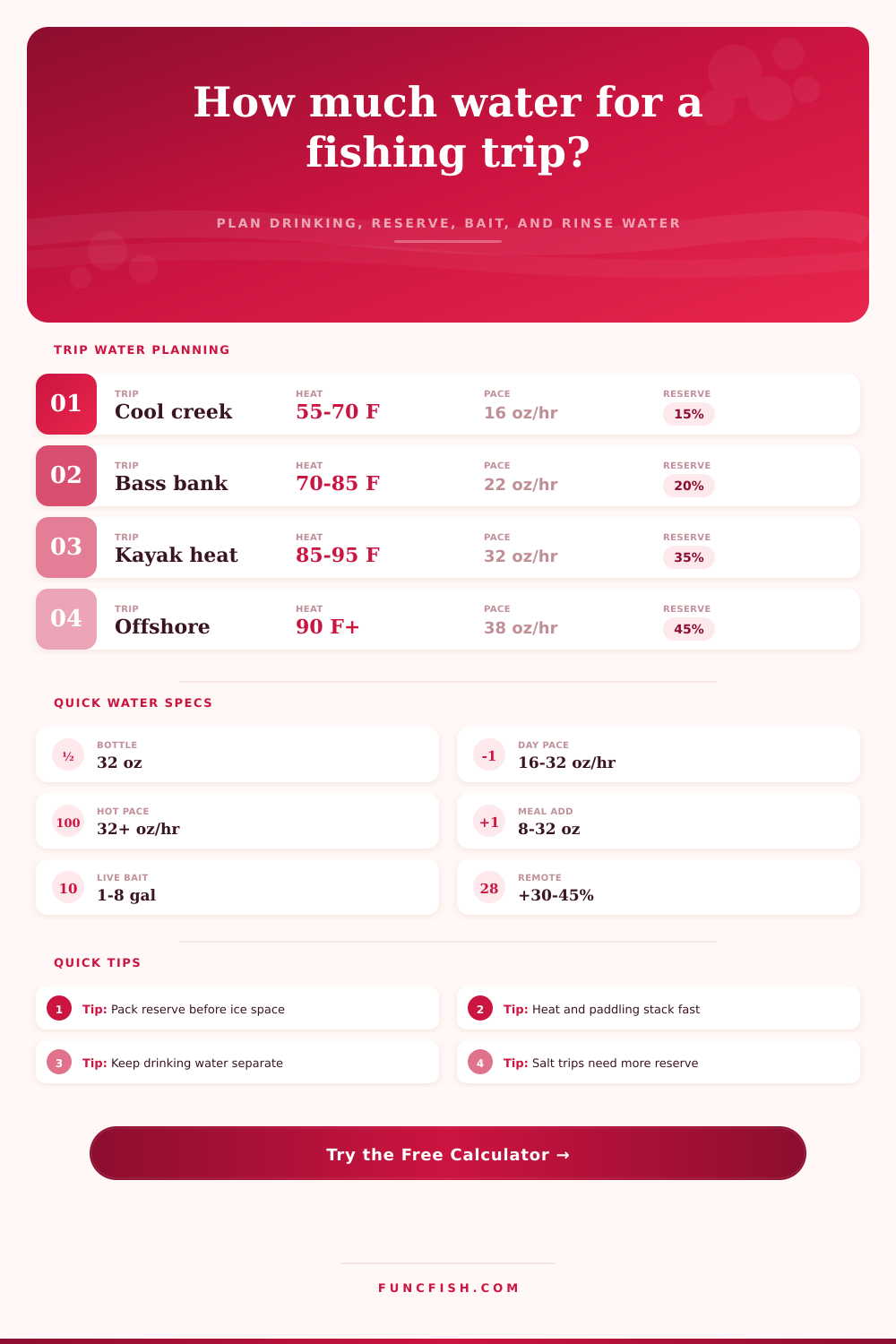
The other part that works is the recognition that effort is a factor as well as temperature. Six hours casting a heavy lure are a workout. Paddling a kayak all day is an aerobic exercise. Hiking a trail with a fishing rod? That’s hiking. All those thing make you sweat. They also burn some calories. That’s what the tool does: adjust your base rate of drinking depending on effort. A tournament angler making jumps from spot to spot has a higher pace than a guy sitting down on the bank. And the reference table on page spells it out nicely. The pace increases from 16 ounces per hour in a cool, low effort situation up to more than 30 ounce per hour in a hot high effort one. It is a small detail, but it matters. Dehydration comes about by ignoring effort, thinking “I’m just sitting here” when in fact I am moving around constantly.
And then there’s the matter of reserves. Spills happen. Leaks occur. Long battles with fish causes us to forget our drinks. Depending on where you operate, the calculator provides a safety margin for that. Can you quickly top it back off? Are you close to the truck? Are you offshore, way down river, or at a remote boat? Then you need more. And since operating in salty water increase water loss through exposure, saltwater trips needs yet another layer of reserve, for wind and spray. The calculator accounts for that as well by asking how much reserve percentage I want to add. Is it pessimism? Nope, it’s common sense insurance. Nobody wants to be the guy that has to ration the final quart on the run back to town.
Last, think about the separation of duties. Never combine drink and rinse water. Don’t mix your bait water with your rinse water, either. Live bait also requires gallons of water to keep them in, which is asked for separately on the calculator. That’s support water if you’re using shrimp or shiners. Use a different container. Use a different jug. If you have a cooler leak, do you really want to know if it’s only ruining your bait, or also your drinks? The tool totals up all the gallons of water needed, including rinse water for gear and hands. This lets you plan out your loadout correctly. You’ll know how many gallons to pack for support versus how many for drinking. Sounds easy, but will keep you from making the rookie mistake of washing a slimy catfish down with your final liter of drinking water. Keeping the water clean and the crew wet means good planning. You should of do the math but conclude with a plan.