Flat Line Distance Calculator
Estimate line out, horizontal setback, lure running depth, and turn clearance for trolling flat lines behind the boat, kayak, transom, or stern corner rod.
📌Flat line presets
⚙Flat line inputs
Flat line calculation results
Formula breakdown
🧰Gear and species comparison grid
📊Flat line distance reference tables
| Flat line use | Typical line out | Target depth | Speed range | Spread note |
|---|---|---|---|---|
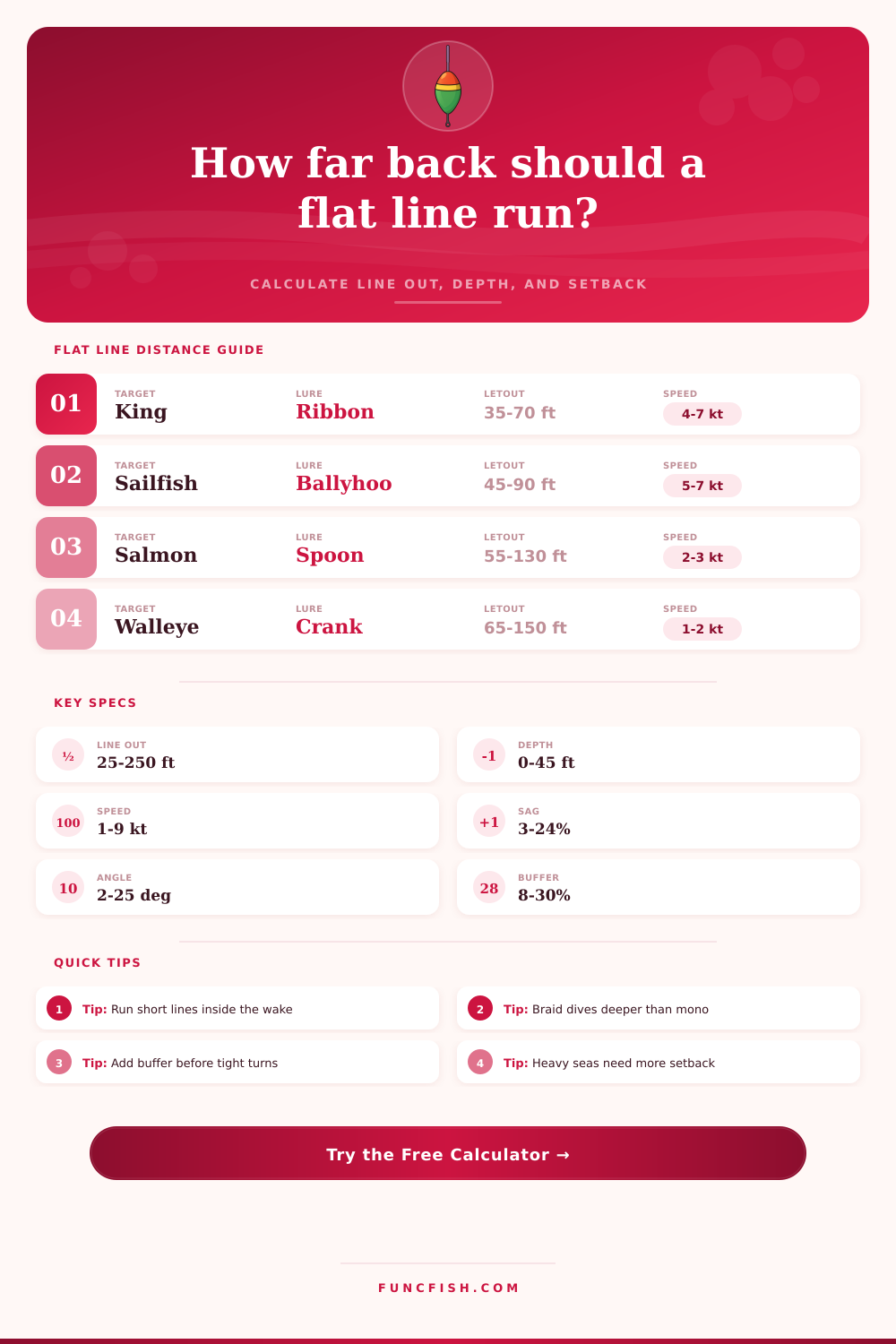
| King mackerel ribbon or live bait | 35-70 ft / 10.7-21.3 m | Surface to 8 ft / 0-2.4 m | 4-7 kt | Keep one bait just outside prop wash. |
| Sailfish ballyhoo flat | 45-90 ft / 13.7-27.4 m | Surface to 6 ft / 0-1.8 m | 5-7 kt | Short flat runs inside rigger baits. |
| Striped bass tube or bunker spoon | 60-140 ft / 18.3-42.7 m | 4-18 ft / 1.2-5.5 m | 2-4 kt | Allow extra belly in current. |
| Salmon spoon or plug flat | 55-130 ft / 16.8-39.6 m | 5-25 ft / 1.5-7.6 m | 2-3 kt | Use a clean lane outside turbulence. |
| Walleye crankbait flat line | 65-150 ft / 19.8-45.7 m | 6-24 ft / 1.8-7.3 m | 1.2-2.4 kt | Thin braid or light mono changes depth. |
| Mahi feather or cedar plug | 45-110 ft / 13.7-33.5 m | Surface to 5 ft / 0-1.5 m | 6-8 kt | Run in clean water behind the wake face. |
| Lure or device | Base dive per 100 ft | Metric per 30 m | Best flat-line role | Drag load |
|---|---|---|---|---|
| Surface bait or feather | 1 ft | 0.3 m | Wake, prop wash, tuna, mahi | Low |
| Ballyhoo or cigar minnow | 3 ft | 0.9 m | Sailfish, dolphin, kingfish | Low-medium |
| Trolling spoon | 8 ft | 2.4 m | Mackerel, salmon, lake trout | Medium |
| Diving crankbait | 12 ft | 3.7 m | Walleye, pike, striped bass | Medium |
| Tube or eel rig | 5 ft | 1.5 m | Striped bass and nearshore trolling | Medium |
| Small planer or diver | 22 ft | 6.7 m | Deep flat lane without downrigger | High |
| Species | Common flat-line distance | Strike drag guide | Suggested leader range | Setback behavior |
|---|---|---|---|---|
| King mackerel | 35-75 ft / 10.7-22.9 m | 5-9 lb / 2.3-4.1 kg | 30-60 lb / 14-27 kg | Short bait often draws fish from prop wash. |
| Sailfish | 45-90 ft / 13.7-27.4 m | 4-8 lb / 1.8-3.6 kg | 60-100 lb / 27-45 kg | Flat baits sit inside long rigger baits. |
| Walleye | 65-150 ft / 19.8-45.7 m | 2-5 lb / 0.9-2.3 kg | 8-15 lb / 4-7 kg | Depth changes sharply with line diameter. |
| Salmon | 55-130 ft / 16.8-39.6 m | 4-9 lb / 1.8-4.1 kg | 12-30 lb / 5-14 kg | Clean water lane matters more than wake. |
| Striped bass | 60-140 ft / 18.3-42.7 m | 5-12 lb / 2.3-5.4 kg | 30-60 lb / 14-27 kg | Current can add belly and reduce depth. |
| Tuna school fish | 60-120 ft / 18.3-36.6 m | 10-25 lb / 4.5-11.3 kg | 80-150 lb / 36-68 kg | Cedar plugs and feathers stay shallow. |
| Condition | Sag allowance | Depth effect | Distance adjustment | Turn buffer |
|---|---|---|---|---|
| Calm or protected | 3-8% | Most predictable | Use charted line out | 8-14% |
| Light chop | 8-13% | Slight lure lift | Add 5-10 ft / 1.5-3 m | 12-18% |
| Moderate chop | 13-19% | More speed variation | Add 10-20 ft / 3-6 m | 18-24% |
| Cross current | 15-24% | Line sweeps sideways | Widen lane spacing | 20-30% |
| Following sea | 10-18% | Lure surges forward | Shorten if lure fouls | 16-24% |
💡Flat line calculation tips
Geometry tip: A shallow flat line is not equal to the tape-measure setback. Rod height, lure depth, and sag all add line length before the lure reaches the same point behind the boat.
Spread tip: Keep the shortest flat line inside the spread and add turn buffer when a diver, spoon, or crankbait can sweep below a longer lure during a tight turn.
The calculator estimates flat-line geometry and lure behavior from common trolling rules. Confirm final placement by watching lure action, rod tip load, sonar marks, and whether the lure stays in clean water.
The space between perception and reality can be a frustration. You drop out 50 feet of line, see it enter wake and believe bait is way back there in the depths. Then either a fish grabs it or nothing happens, and we are left wondering what occured.
That’s what the flat line distance calculator does. It perform the geometry for you. It converts all that slack in your rod to actual separation, depth and setback numbers.
What the Flat Line Calculator Does for You
Line length is a linear measurement for most anglers, but thats where they loses strikes and lures. A flat line isn’t really flat. It sags in the water and has a curve to it. With drag, it drops; with speed, it lifts. Fifty feet of nylon mono thrown off the stern may only have thirty-five feet of horizontal distance behind boat. Why? Twelve percent of that line length is lost in the water due to belly and vertical drop.
Braid turns that equation inside out. It’s a thinner line, creating less drag. It dive deeper, slipping further with less line out. The tool figures all that into difference automatically. If you’re cranking a walleye crankbait and select braid for instance, the depth factor adjust based on that difference. You won’t run your bait over fish on a shallow ledge because that thin line cut through water instead of fighting against it.
Then there are variables like speed that change equation. Two knots on a deep running spoon may have it screaming to surface at four knots. Drag scales to the square of speed so your desired operating speed is considered in calculator. It’s not simply dragging something through the water; you are pushing air and creating turbulence behind the hull. The water gets chaotic between boat and spread, while it is cleaner further away. Laying a long line out into open water versus working in prop wash makes a difference. Less distance is needed for an inside short line where it doesn’t need to be clear of boat noise. But that line will swing more further out when turning.
The final thing you overlook when rigging out a spread is turn clearance. You might be fishing at perfect depth and at perfect line out, but if you are too close on a hard turn, your lines gets tangled. On this, the calculator asks how much of a buffer should of been left so that inside line doesn’t swing under outside line on a pivot of boat. The bigger the number, the greater distance between rods, which is critical when pulling hard with big spoon or running in rough water. Because if two lures meet, they’ll wrap around one another and end your day early.
And then there’s addition of water conditions that further complicates things. A line with a belly in choppy seas will be lifted higher off the water. Side currents will shift line to one side or the other, which affects setback. By adding a sag allowance to the tool you can make those adjustments for them. You can rely on the charts in calm water but in moderate chop add some line to reach the same depth since wave action lift your bait. That’s just physics, it ain’t magic.
The calculator take all the math out of your head and lets you concentrate on feeling the bite and watching rod tip. More important than knowing how much line you’ve thrown out is knowing where that lure is sitting in relation to it. Each bait has its own lane, working a different area without crossing paths or tangling with adjacent baits. That precise spacing help catch more fish.
The math comes second nature once you get a handle on the relationship between speed, line material and water conditions. Rather than wondering why the bait doesn’t dive, you make an adjustment based off what’s occurring beneath the surface. That clarity makes all the difference.