Flipping Weight by Depth Calculator
Estimate a flipping, pitching, or punching weight from water depth, target fall time, cover density, mat thickness, bait profile, line drag, and current or wind.
📌Flipping weight presets
⚙Depth, cover, line, and bait inputs
Clean targets usually need control more than raw punch power.
Use zero for open water, wood, docks, reeds, and grass edges.
Flipping weight recommendation
Formula breakdown
📊Flipping weight material comparison
Tungsten
Lead
Brass
Steel or Tin
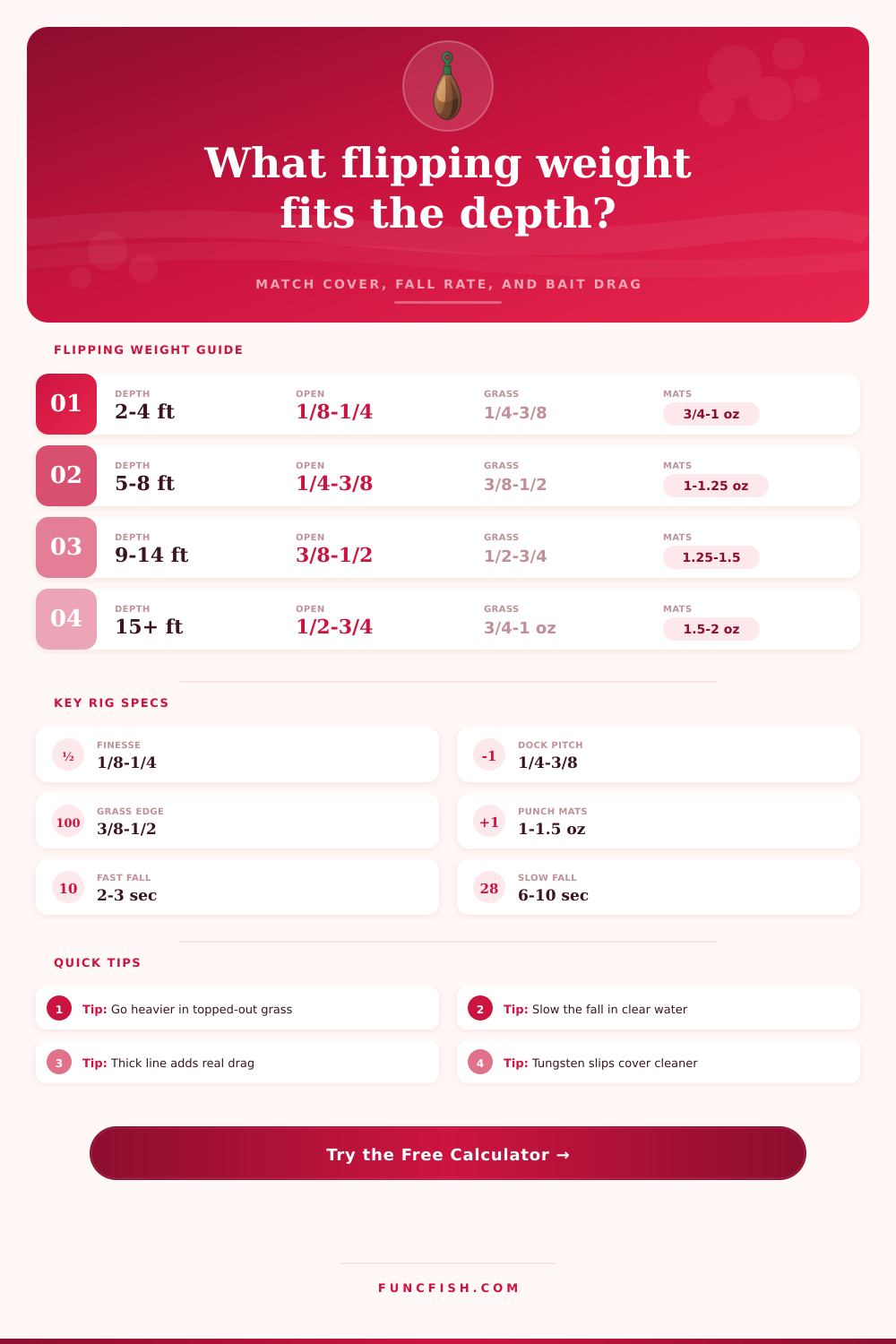
📏Starter weight by depth and cover
| Depth range | Open targets | Wood or docks | Grass edge | Mats and punching |
|---|---|---|---|---|
| 2-4 ft / 0.6-1.2 m | 1/8-1/4 oz | 1/4 oz | 1/4-3/8 oz | 3/4-1 oz |
| 5-8 ft / 1.5-2.4 m | 1/4-3/8 oz | 3/8 oz | 3/8-1/2 oz | 1-1 1/4 oz |
| 9-14 ft / 2.7-4.3 m | 3/8-1/2 oz | 1/2 oz | 1/2-3/4 oz | 1 1/4-1 1/2 oz |
| 15-22 ft / 4.6-6.7 m | 1/2-3/4 oz | 5/8-3/4 oz | 3/4-1 oz | 1 1/2-2 oz |
| 23+ ft / 7+ m | 3/4-1 oz | 1 oz | 1-1 1/4 oz | 2 oz plus only when needed |
🌱Cover and bait drag data
| Factor | Low drag example | Medium drag example | High drag example | Calculator effect |
|---|---|---|---|---|
| Cover | Clean dock shade | Submerged grass | Hyacinth mat | 0.85x to 1.80x |
| Bait profile | Straight worm | Compact craw | Skirted punch rig | 0.95x to 1.65x |
| Line drag | Thin braid | Fluorocarbon | Heavy braid | 0.96x to 1.18x |
| Water movement | Calm pocket | Wind bow | River seam | 1.00x to 1.24x |
| Mat thickness | Open top | 3 in canopy | 8 in mat | 0.00 to +0.55 oz |
🎯Species and flipping setup reference
| Scenario | Typical target | Common line | Weight band | Target fall style |
|---|---|---|---|---|
| Dock shade | Largemouth, spotted bass | 15-20 lb fluorocarbon | 1/4-3/8 oz | Controlled glide |
| Grass edge | Largemouth bass | 40-50 lb braid | 3/8-3/4 oz | Clean vertical fall |
| Wood cover | Bass, bowfin bycatch | 17-25 lb fluoro or braid | 3/8-5/8 oz | Contact without wedging |
| Heavy mat | Largemouth in canopy | 50-65 lb braid | 1-1 1/2 oz | Penetrate first, then fall |
| Deep hydrilla | Offshore bass | 50 lb braid or 20 lb fluoro | 1/2-1 oz | Bottom feel at depth |
⚖Preset comparison grid
| Preset | Depth | Cover | Bait profile | Expected band |
|---|---|---|---|---|
| Shallow Dock Pitch | 4 ft / 1.2 m | Docks | Compact craw | 1/4-3/8 oz |
| Milfoil Edge Bass | 7 ft / 2.1 m | Sparse grass | Beaver bait | 3/8-1/2 oz |
| Hydrilla Mat Punch | 5 ft / 1.5 m | Matted grass | Punch bait | 1-1 1/4 oz |
| Deep Grass Line | 14 ft / 4.3 m | Submerged grass | Creature bait | 3/4-1 oz |
| Matted Hyacinth | 4 ft / 1.2 m | Floating mat | Skirted rig | 1 1/4-1 1/2 oz |
💡Calculation notes
Depth check: If the bait never reaches bottom on semi-slack line, raise the size one common step before changing the bait.
Cover check: If the rig hangs on the canopy, use a smaller-profile material or add weight before speeding up the fall target.
Flipping weight is one of those things most anglers consider a set-in-stone decision. You grab a three-eighth-ounce bullet, stuff it into your tackle box, let it gather dust for several years and fish with it until the lead deforms or you finaly send it to the bottom of a sunken stump.
There’s no problem with this mentality, until you pull up to a bank and the bass is in six feet of clear water under scattered lily pads. Or perhaps they are ten feet beneath an overhead canopy of lush, green hydrilla that resembles more of a ceiling than a carpet of vegetation. What once was effective on shallow dock posts will likely hang you up within seconds if you fail to adapt to conditions below the surface.
How to Choose the Right Weight for Flipping
While depth certainly play a role, gravity must overcome drag and buoyancy across a greater distance, the true variable affecting everything are the density of the surrounding cover. Plug in the details for your bait, line thickness, cover type, and target depth. This calculator does the math (above) to show you exactly how much extra weight you need to reach the mats without spooking the fish.
The key is more than just heaving something heavy down there. You’re trying to achieve a certain fall rate that triggers a bite while still having enough contact with the bottom to feel those subtle bites. So when flipping around a clean piece of wood or into open water, there’s very little drag. You can use a lighter weight to let the bait fall naturaly. This maintains its action and helps you get a better feel from the line.
However, throw that same light rig into a mat of thick grass and it’s hanging up on top of the mat like a cork. Something they won’t bite. In these instances, adding mass become a “must do” instead of a strategy.
The other big variable here is what kind of line you’re using. Anglers tend to believe that line is only important for its breaking strength. While that’s true, diameter also make a huge amount of drag throughout the fall. When your line are thicker, it will catch water just like a parachute. A thinner, slicker line like fluorocarbon or an eight-carrier line have much less drag. That doesn’t matter much in two feet of open water, but try and get a bait 15 feet down through submerged grass and it becomes critical.
The tool considers line type and size. It explains how you may need a heavier weight even if your target depth remain the same. It makes you think about more than just the sinker; about the whole system, from reel to hook.
The other thing that’s easily forgotten is material density. For a given size, tungsten is significantly heavier and smaller than brass or lead. That make it easier to slide into those narrow openings without snagging as much. The smaller size also means you can use a half-ounce of tungsten where you would of needed a three-quarters ounce of lead to achieve the same pushing power in heavy cover situations. That’s why when looking at the table on the page you’ll frequently notice that tungsten is listed with lower ounces than lead. Less material give you greater penetration due to decreased surface area contacting the water.
You should also consider the bait profile. While a small, compact punch bait or beaver rig slices through the water cleanly, something like a skirted jig or a bulky crawdad imitator with flapping claws are going to put up quite a bit of resistance. Switching baits while leaving your weight alone drastically alters your fall rate. In certain conditions, a slow dragging fall can appear wounded and tempting, whereas in other situations such as around wary bass or clear water, it’s often the same as danger.
You want control over presentation of the bait. Flipping is as much about presentation and accuracy as it is brute force. You want to bring your bait through the cover quickly enough to punch through but gently enough that you don’t hang yourself up and spook the fish.
When you begin to consider your weight as a balancing act between sensitivity, drag and depth, you move from reactive habits to being conditioned by current conditions. That mental leap is what transforms a solid flipper into a consistently good one. The best choice isn’t the heaviest weight you can throw, but rather the right weight to get the look you want at whatever depth and cover you’re fishing. When you get that dialed in, everything else fall into place.