Float Tube Buoyancy Calculator
Estimate safe fishing payload, reserve lift, hull submersion, and load status for round tubes, U-boats, V-boats, and pontoon-style float tubes.
📌Float tube presets
⚙Buoyancy inputs
Float tube buoyancy result
Formula breakdown
📊Buoyancy data grid
Each displaced cubic foot of freshwater supports about this much total weight.
Saltwater gives slightly more lift, but wind and swell still demand reserve.
Float tubes should retain visible chamber volume above the loaded waterline.
Open-front, pontoon, and V styles use inflated volume more efficiently than pack tubes.
🎣Gear and species comparison grid
Fly rod, fins, net, vest pack, pump, small anchor, rain layer, and a light catch allowance.
Two rods, tackle tray, soft plastics, landing net, hand anchor, water, and heavier PFD layers.
Compact sonar, lithium battery, rod holders, panfish box, net, drink pack, and stringer weight.
Large lures, jaw tools, long net, wire leader kit, spare layers, and extra stability allowance.
📖Reference tables
| Float tube style | Typical rating | Shape factor | Best fishing use |
|---|---|---|---|
| Classic round belly tube | 180-250 lb / 82-113 kg | 0.58 | Calm ponds, small trout lakes, light tackle |
| Open-front U-boat tube | 220-300 lb / 100-136 kg | 0.66 | General bass, trout, and panfish work |
| High buoyancy V-tube | 275-350 lb / 125-159 kg | 0.70 | Longer kicks, wind lanes, and heavier clothing |
| Hybrid pontoon float tube | 300-400 lb / 136-181 kg | 0.74 | Electronics, anchors, and big-water stillwater loads |
| Packable ultralight tube | 160-230 lb / 73-104 kg | 0.48 | Alpine hike-in lakes with compact gear |
| Foam-seat fishing tube | 250-325 lb / 113-147 kg | 0.64 | Comfort seating with moderate tackle weight |
| Water condition | Density used | Exposure factor | Reserve advice |
|---|---|---|---|
| Freshwater calm pond | 62.4 lb/ft³ / 999 kg/m³ | 0.96 | 20-25% reserve is usually a planning minimum |
| Freshwater light ripple | 62.4 lb/ft³ / 999 kg/m³ | 0.90 | Use 25-30% reserve for casting and fin movement |
| Freshwater wind chop | 62.4 lb/ft³ / 999 kg/m³ | 0.82 | Use 30-35% reserve before crossing open water |
| Cold open water | 62.4 lb/ft³ / 999 kg/m³ | 0.76 | Use 35-40% reserve for clothing and reduced mobility |
| Slow current or inlet | 62.4 lb/ft³ / 999 kg/m³ | 0.78 | Use conservative reserve and avoid overloaded anchors |
| Protected saltwater | 64.0 lb/ft³ / 1025 kg/m³ | 0.88 | Salt gives lift, but wind requires practical margin |
| Species setup | Common extra load | Tube fit | Buoyancy concern |
|---|---|---|---|
| Trout fly stillwater | 18-35 lb / 8-16 kg | Round, U-boat, or packable tube | Cold layers can weigh more than tackle |
| Bass pond casting | 35-65 lb / 16-29 kg | U-boat or foam-seat tube | Repeated casting favors side-to-side stability |
| Crappie with sonar | 40-80 lb / 18-36 kg | V-tube or pontoon hybrid | Battery and screen should sit low and centered |
| Pike lure casting | 55-95 lb / 25-43 kg | V-tube or big-water tube | Large net and lure boxes raise trim risk |
| Catfish anchored pond | 60-110 lb / 27-50 kg | Pontoon hybrid only for heavier loads | Anchor, bait, and retained fish add fast |
| Protected salt lagoon | 35-75 lb / 16-34 kg | Salt-ready or big-water tube | Wind drift reduces practical usable reserve |
| Result range | Reserve margin | Submersion estimate | Planning interpretation |
|---|---|---|---|
| Green | 20% or more payload left | Under 65% of chamber diameter | Load is within the selected reserve plan |
| Watch | 10-20% payload left | 65-75% of chamber diameter | Reduce nonessential gear before wind or cold water |
| Tight | 0-10% payload left | 75-85% of chamber diameter | Use calm water only and remove heavy gear |
| Overload | Below zero margin | Above 85% of chamber diameter | Load exceeds the calculator's safe recommendation |
💡Buoyancy planning tips
It’s spring, and this time you inflate your float tube for the first time, and the air hisses into the chambers as the fabric tightens. It seems like it’ll hold everything. You cram the cooler in there, then the tackle box, and the rods. You might even add a little sonar unit since you can. Slide in and notice the sides is touching water. That’s when you get that sinking feeling as physics closes in on your margin of error.
You enter your exact dimensions and gear weight into the float tube buoyancy calculator; then let the math handle the displacement for you. Stop winging it to see if the tube will hold everything you need for a long day of fishing. Don’t wonder why you’re swimming before you even make a cast. It calculates how much weight you can carry, how much reserve lift is available and how deep your float will sit in the water. It does this using real-world water density and shape factors. And no, you don’t have to remember what Archimedes’ principle says. Just tell the truth about what you’ll carry.
Why You Need a Float Tube Calculator
When you plug those numbers in, most folks don’t count their clothes. A wet wader weigh something. So does a soaked-in fleece jacket. That’s dead weight on your body. It says angler weight plus clothing you’re wearing. Where folks get cheap here is by weighing themselves on their dry bathroom scale and not factoring in the 50 pound load out they’ll be taking with them in the water. That leads to what was a comfortable ride turning into a borderline safety issue.
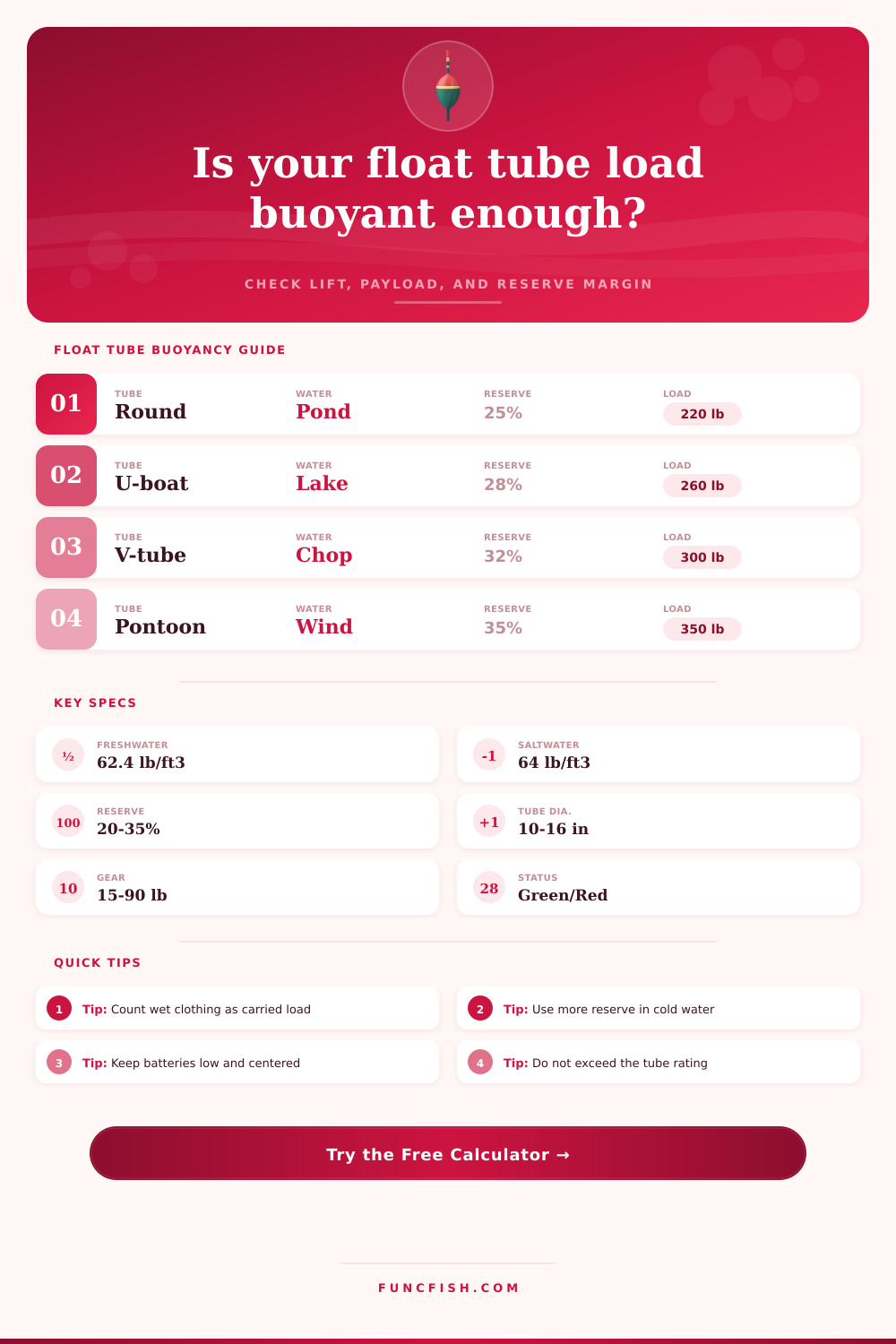
The safety factor come into play if something goes wrong. That is reserve lift, which is buoyancy you do not use. A common reserve target (settable on the calculator) would of 20-40% depending on conditions. For instance, you might need less reserve in calm freshwater conditions. Cold water or wind chop require more headroom. When your estimation of how far the chamber will be submerged exceeds 85% of the diameter, you’re in trouble. There’s nothing left for the unexpected splash or wave or sudden movement.
The reference tables on the page break this out by exposure and water type. Density alters lift just a little bit, but wind increases reserve needs dramaticly. Volume is important but so is shape That’s also where shape comes into play. A V-tube will behave different than a hybrid pontoon, which behaves differently than a classic round tube. Shape factors takes that into consideration. The open front design allows for more efficient use of inflated volume, and that volume displaces water to support weight more effectively than flat packable tubes do. This explains why you can load up a big-water bladder tube and get away with heavy electronics loads when a lightweight pack tube gets pinched by the same equipment.
So it’s not simply a matter of filling the tube with air. It’s a matter off the air pushing out to counteract gravity. The way you put your gear in the boat also affects its ability to carry more weight. For instance, your total weight might be within the safety zone. However, sitting in high boots with a battery box on your lap will change your center of balance and be very risky. While the calculator will produce a number for you regarding your safe payload, it won’t take into account where you place the load. Center heavy stuff as close to the seat as possible and keep it low. Don’t hang batteries, anchors, tackle trays etc., on the side or prop them up on cushioned high seats. This small tweak increase stability without increasing lift at all.
Now put your findings up against the manufacturer’s max load rating and there’s where the rubber meets the road. Even if the physics of it tells you there is space, the dang tool isn’t going to tell you to go beyond what the factory rated her at. They rate safety based off failure points and material stress that the movement math doesn’t take into account. Listen to the little guy in your gut if he tells you to ease off a bit because you’re feeling the tube getting close to dipping with your weight shift. Go with the lower number if the calculator says green.
Float tube fishing comes down to balance. Balance comfort with capacity, balance load with lift, balance ambition with reality. Before setting foot on the water, the tool shows that balance for you. It translates the intuitive into quantifiable. Plan your load, know the reserve and maintain those chambers high enough to be dry if the wind ever blows. Those few extra inches of freeboard are what separates a perfect day on the lake from walking wetly back to shore.