Fly Leader Taper Length Calculator
Estimate finished butt, taper, transition, and tippet lengths for fly leaders using rod weight, fly size, material stiffness, wind, water clarity, and presentation style.
📌Leader taper presets
⚙Taper length inputs
Use hook size for trout flies. For bass or salt flies, use 2 for size 2, 1 for size 1, and 0 for 1/0 or larger.
Recommended leader layout
Calculation breakdown
🎣Material comparison grid
Supple Nylon
Fluorocarbon
Hard Mono
Micro Mono
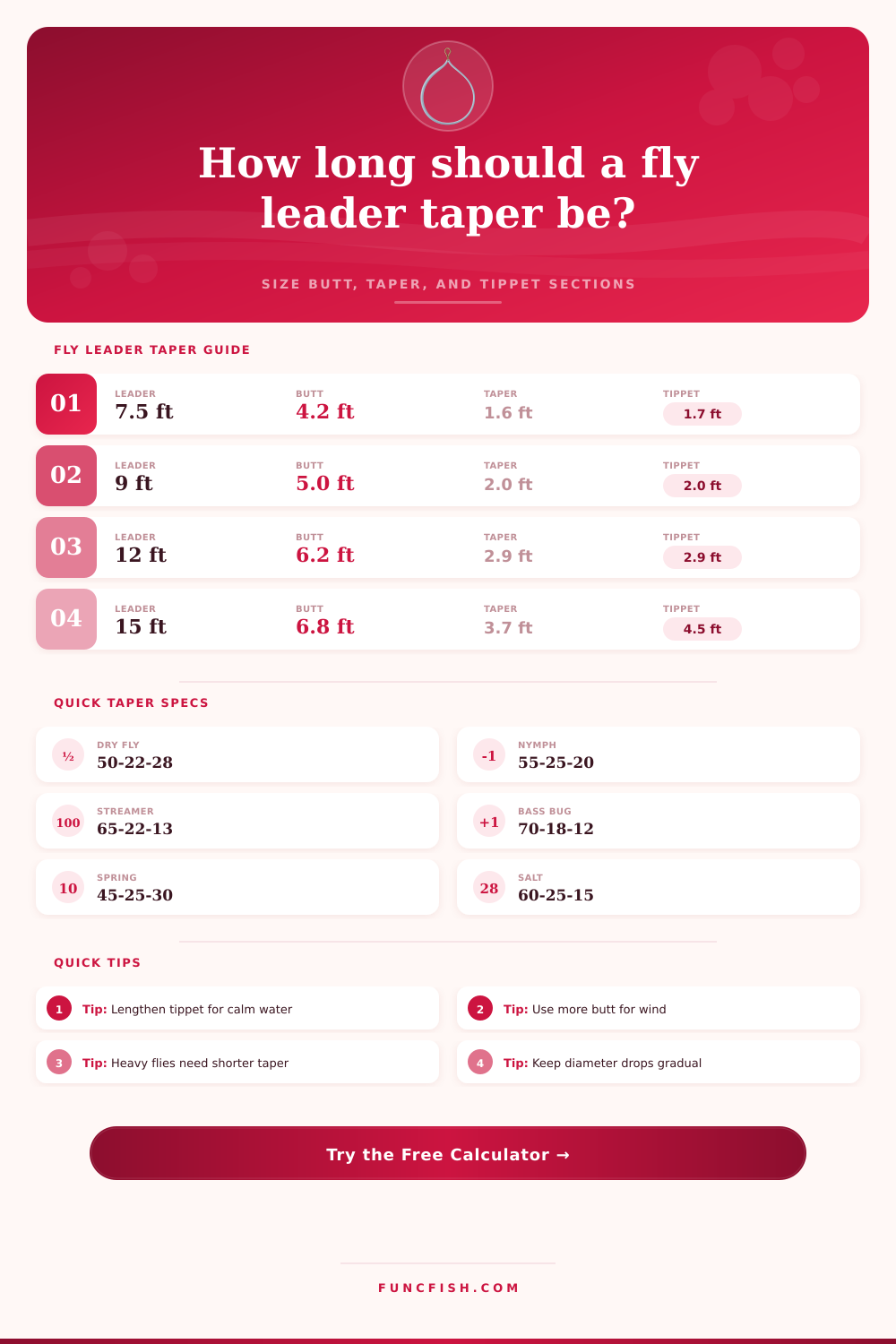
📏Fly leader taper ratios
| Presentation | Starting Ratio | Typical Length | Best Use | Adjustment Cue |
|---|---|---|---|---|
| Standard dry fly | 55% butt / 22% taper / 23% tippet | 8.5-10 ft | General trout dries | Add tippet for calmer water |
| Delicate dry | 47% butt / 24% taper / 29% tippet | 10-13 ft | Small dries and emergers | Reduce butt in no wind |
| Indicator nymph | 58% butt / 25% taper / 17% tippet | 9-11 ft | Weighted rigs and indicators | Add butt for split shot |
| Euro nymph | 38% butt / 22% taper / 40% tippet | 13-20 ft | Contact nymphing | Long tippet improves depth |
| Streamer | 66% butt / 22% taper / 12% tippet | 6-8.5 ft | Sinking lines and big flies | Shorten for wind and bulk |
| Bass bug | 70% butt / 18% taper / 12% tippet | 6.5-8 ft | Poppers and deer hair | Use stiff butt material |
| Salt flats | 60% butt / 25% taper / 15% tippet | 9-12 ft | Bonefish and redfish | Preserve class tippet length |
📊Tippet diameter and taper targets
| Tippet | Diameter | Typical Strength | Fly Size Range | Taper Note |
|---|---|---|---|---|
| 7X | 0.004 in / 0.10 mm | 2-3 lb | 20-26 | Needs long fine taper |
| 6X | 0.005 in / 0.13 mm | 3-4 lb | 18-24 | Good spring creek tippet |
| 5X | 0.006 in / 0.15 mm | 4-5 lb | 14-20 | Balanced trout standard |
| 4X | 0.007 in / 0.18 mm | 5-7 lb | 10-16 | Dry-dropper friendly |
| 3X | 0.008 in / 0.20 mm | 7-9 lb | 6-12 | Indicator and hopper size |
| 2X | 0.009 in / 0.23 mm | 9-11 lb | 4-8 | Streamer transition size |
| 0X | 0.011 in / 0.28 mm | 12-15 lb | 1/0-4 | Short powerful taper |
🌊Species and water reference
| Scenario | Leader Length | Butt Diameter | Tippet | Preferred Taper |
|---|---|---|---|---|
| Small stream trout | 6.5-7.5 ft | 0.017-0.020 in | 4X-5X | Compact dry-dropper |
| Technical tailwater | 10-13 ft | 0.018-0.021 in | 5X-7X | Long delicate front |
| Indicator trout | 9-11 ft | 0.020-0.024 in | 3X-5X | Strong butt, short tippet |
| Bass popper | 6.5-8 ft | 0.024-0.030 in | 0X-2X | Short power taper |
| Steelhead wet fly | 9-11 ft | 0.024-0.028 in | 0X-2X | Turnover with shock room |
| Bonefish flats | 9-12 ft | 0.026-0.032 in | 12-16 lb | Class tippet layout |
⚖Taper comparison table
| Change | What It Does | Best For | Watch For |
|---|---|---|---|
| Longer butt | More energy transfer from fly line | Wind, weighted flies, bass bugs | Can slap clear water |
| Longer taper | Smoother diameter drop | Fine tippet and dry flies | May collapse with bulky flies |
| Longer tippet | More drift and stealth | Calm water, spooky trout | Less positive turnover |
| Stiffer material | Turns over shorter sections | Salt, streamers, bass | Less delicate presentation |
| Tippet ring | Protects taper from trimming | Nymph rigs and dry-dropper | Adds hinge weight |
💡Practical taper tips
Tip: If the leader lands in a pile, shorten the tippet or increase butt share before changing every section. If the fly slaps down, lengthen the taper or soften the material.
Tip: Cut each hand-tied section slightly long. Knots, testing, and trimming usually consume 1-3 inches across a trout leader and more on heavy saltwater mono.
Your rod technique isn’t often what makes your cast land cleanly versus all tangled up. It’s almost always the leader. Most anglers see leaders as nothing more than basic accessories that you buy at store, tie on, and forget about until they breaks or snap off. This kind of attitude works with casual fishing, but not when you’re trying to delicately drift an emerger to a spooky trout in a technical tailwater. Because weight is distributed incorrectly along your leader, the fly line slaps down a good ten feet from where you want it to go.
The issue isn’t just that the leader are long; it’s the way it distribute the weight. There is three specific functions for a leader. The butt section transmit power from your heavy fly line into the remainder of the rig. Then there’s the taper, which gets thinner so the tippet can turns over easy without being slowed down by air resistance. And finally, the tippet deliver the fly invisibly. Any one of these components improperly tuned will mean a failure of the entire system.
Why Your Leader Matters More Than Your Rod
You could of had a smoothly delivered cast and a balanced rod. However, a taper that is simply too short for material you’re using will create a shockwave that crumples your line in mid-air. Or maybe your tippet are too long for the wind and the thin material drags your cast out of position before reaching water. The problem with this kind of estimating based off sight is that you’re balancing several factors at the same time.
For example, how stiff the material are affects its ability to absorbs the energy needed to roll the leader over. A given size of fluorocarbon is stiffer then an equivalent size of nylon, therefore able to handle a shorter taper without collapsing. Conversely, nylon’s flexibility require more gradual tapering to dissipate the energy pulse applied by the butt. By plugging in wind conditions and material choice, the calculator do all the math for you. No need to remember any complicated hydrodynamic formulas; just let it run through physics of the cast.
“A lot of it is about inputs. It depends on how you are trying to present. For instance, if you pick a fly and go with a nymphing approach or a dry fly turnover approach, you have selected an energy profile. That profile determine how you build the system. In other words, for dry flies, you don’t want too much material from the butt down because you’re trying to deliver them delicately. A streamer is all brute force to try to penetrate water resistance and the wind. For that, you want big bulk in your butt section with no taper at all, which call for a totally different leader. For example, when you’re fishing a big wet bug on a windy day, you don’t want a dainty leader. You want something that’ll shoot weight well. That’s where the tool come into play.”
The other variable that gets folks tripped up is material stiffness. A lot of folks change materials without changing how they build their leaders. So if you go from nylon to fluorocarbon but maintain same taper length, I promise you won’t cast as well. The heavier, stiffer material need a different shape to turn over effective. The table on the page shows this. Different materials reacts to stress in different ways, which affects required taper length.
Can’t dismiss the physical properties of the line either. Water clarity is also important, although it play a smaller role. Stained water let you use shorter leaders and bulkier tippet as the fish won’t be able to see your rig so well. In crystal clear spring creeks, every millimeter of diameter counts. Every mm diameter matter. Longer tippets is used to put more distance between the shadow from the fly line and the insect pattern. The calculator account for that too. It will make your tippet length dependent on how good or bad visibility is. It reminds us that fishing isn’t just about casting accuracy but also about presentation stealth.
Building a custom leader is all about compromises. Maximum delicacy can’t be paired with maximum turnover power on the same leader. What’s important? For the type of fish you’re after, you’ll need to make that determination. If it casts well in high wind, it slaps down on calm water. If it’s a delicate dry fly leader, you’re going to be tangling when the bass charges out of cover. This isn’t meant to be perfect. This is about adjusting for the situation at hand.
Knowing how those three parts work together lets you adjust on the fly as conditions shift. And that’s where that adaptability makes the difference between empty days and catching fish all the time. Build the right tool for the job and let the fish do the rest.