Fly Line Overhang Length Calculator
Estimate how much running line to hold outside the rod tip before the head, then compare carry length, shoot window, and hinge risk for common fly line systems.
📌Scenario presets
⚙Line and casting settings
Fly line overhang forecast
Full breakdown
📋Line style data grid
Trout WF
Salt WF
Shooting
Skagit
Scandi
Switch
Long Belly
Stillwater
📐Reference tables
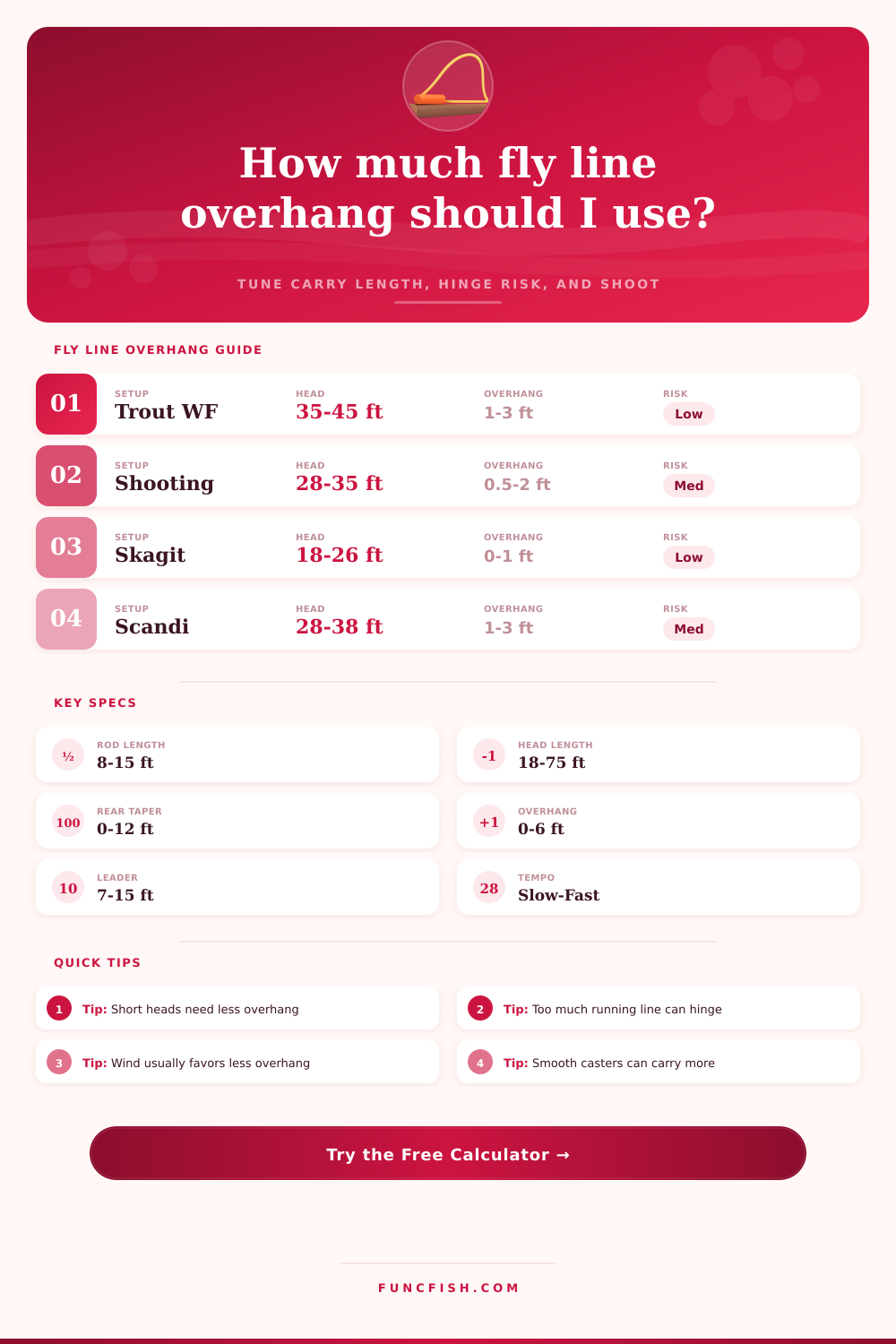
| Line system | Typical head | Starting overhang | Adjustment note |
|---|---|---|---|
| Weight forward trout | 35-45 ft / 10.7-13.7 m | 1-3 ft / 0.3-0.9 m | Use rear taper as a control buffer |
| Integrated saltwater | 30-40 ft / 9.1-12.2 m | 0.5-2.5 ft / 0.15-0.76 m | Shorten in headwind or on boats |
| Separate shooting head | 26-35 ft / 7.9-10.7 m | 0.5-2 ft / 0.15-0.61 m | Keep the junction close to the tip |
| Skagit head | 18-26 ft / 5.5-7.9 m | 0-1.5 ft / 0-0.46 m | Less overhang keeps the anchor solid |
| Scandi head | 28-38 ft / 8.5-11.6 m | 0.75-3 ft / 0.23-0.91 m | Smooth touch-and-go casts can carry more |
| Long belly spey | 55-75 ft / 16.8-22.9 m | 2-7 ft / 0.61-2.13 m | Advanced timing allows longer carry |
| Condition | Overhang shift | Risk effect | Why it matters |
|---|---|---|---|
| New caster on a short head | -0.5 to -1.0 ft | Lower | Less running line outside the guides reduces hinging |
| Smooth advanced caster | +0.5 to +1.0 ft | Moderate | Better tracking can manage extra carry |
| Headwind or boat deck | -0.5 to -1.5 ft | Lower | Compact carry turns over with less slack |
| Long rear taper WF line | +0.5 to +2.0 ft | Moderate | The taper keeps energy transfer smoother |
| Thin monofilament running line | -0.3 to -0.8 ft | Higher | Thin line shoots well but transmits less control |
| Sustained-anchor spey cast | -0.5 to -1.0 ft | Lower | Anchor placement is easier with less overhang |
| Fishing use | Rod length | Line style | Useful overhang range |
|---|---|---|---|
| Small stream trout | 7.5-9 ft | Short WF | 0.5-2 ft / 0.15-0.61 m |
| River trout distance | 9-10 ft | Long WF | 1.5-4 ft / 0.46-1.22 m |
| Saltwater flats | 9 ft | Integrated shooting | 0.5-2 ft / 0.15-0.61 m |
| Pike or musky | 9-10 ft | Heavy shooting head | 0.5-1.5 ft / 0.15-0.46 m |
| Switch rod swing | 10.5-11.5 ft | Switch Scandi | 0.5-2.5 ft / 0.15-0.76 m |
| Winter steelhead | 12.5-14 ft | Skagit | 0-1 ft / 0-0.30 m |
| Summer spey | 12.5-14.5 ft | Scandi | 1-3 ft / 0.30-0.91 m |
| Traditional spey | 13-15 ft | Long belly | 3-6 ft / 0.91-1.83 m |
💡Practical checks
Tip: If the cast collapses behind the head, shorten overhang before changing stroke power. A clean junction near the tip usually loads the rod more predictably.
Tip: If the head is ripping through the guides too early, add overhang in small steps until the back of the head tracks cleanly outside the tip.
Beyond line size and rod length, most guys don’t give much thought to amount of running line that extends beyond their tip prior to making a cast. This overhang will be the deciding factor in a clean shot or a big ol’ mess on the bank. It’s not just about distance; it’s about control.
The calculator handle the math using your head length, rod specs, and casting style so there’s no more guessing at coefficients. And do yourself a favor. Understand the science behind energy transfer with these numbers.
How Much Line to Leave Out for Better Casting
As the line goes through the guides, the rod is loaded when you are casting. The heavier head is dragging the lighter (thin) running line out there on the end of your rod. It’s acting like a brake. So what happens? A lot of times you see the heavy line start to whip around the lighter stuff, a hinge or a collapsing loop. Energy fades away. You don’t get nearly as much distance or accuracy.
If there isn’t enough overhang, the head of tool doesn’t get enough momentum. It may not fully extend out which makes the cast seem abrupt. This is why how much control you have over your cast are important.
An advanced smoother caster can handles more line outside his or her guides than someone who has just started casting. How cleanly do you accelerate that mass? That depends on your stroke tempo. Can you hinge your rod? Less overhang is required if you’re jerking hard. Do you cast with a long lazy loop? You can carry more line because it’s built up gradualy. This pattern are part of what helps the tool adjust its recommendation.
It’s also all about wind. You can get away with a long belly line (three feet or so) in calm water. But add a bit of headwind to the equation and that becomes an unusable rig. That exposed running line picks up the wind, which then tries to push it right back into the rod. This disrupts your anchor point. A short carry reduce the amount of air resistance, facilitating better turn-over and keeping the cast tight and low.
Then there’s the head itself. The design of shooting heads is intended for distance casting. They are a puzzle in themselves. Because these compact shooting heads is short and heavy, you have minimal overhang. An inch or six will do, that’ll just give it time to pull off your tip. You run into trouble trying to manage a twenty-eight-foot head with two feet of running line. The thin line running back from the thick head concentrates the problem area where the two meet. It wants to hang up.
If you look on the page, the reference tables spells it all out: Short heads demand short overhangs, while long lines allow more leeway. Then there’s leader length to consider too. At end of the chain, a nine-foot leader adds significant weight. And if you’re fishing for wary trout, you’ll probably be using something with more taper and less weight, so all that extra line are going to change behavior of the system.
This means you can have a good idea about how far that fly is really going to go, and that goes into the overall fishable cast estimate from the calculator. The only way to know for sure is to test it on the water. Cast it 10 times at suggested overhang length. Is the line collapsing behind the head? Then back off another six inches. Do you feel the head being sluggish or not extending all the way out? Add a little more. It’s a repeating process.
The numbers are a starting place. But you should of listen to your ears to know when you’ve got it. A clean cast has a crisp sound, and a hinging cast sounds like it slaps against the guides. Pay attention for that. The sweet spot for tuning your overhang is when your rod is loading completely and your line are tracking cleanly.
The line type matters. Weight, wind, water, and your pace or rhythm also matter on any particular day. So there’s no “magic number” but once you get that little tweak dialed in, you’ll immediately see increases in distance and presentation. Having one more level of control can make all the difference between seeing the bobber float off into oblivion and feeling the bite.