Fly Rod Grain Window Calculator
Estimate a practical fly rod grain window from AFFTA line standards, head length, carry distance, rod action, fly rig weight, wind, water, temperature, timing, and haul style.
📌Fly line matching presets
⚙Rod, line, and casting inputs
Fly rod grain window
Calculation breakdown
📊AFFTA baseline data grid
Light creeks, small dries, short leaders, and low wind.
Reference trout line weight for 30 ft measured fly line.
Common saltwater, bass, streamer, and windy-bank standard.
Surf, pike, permit, and compact predator taper starting point.
🔀Line style comparison grid
Favors delicate turnovers, longer front tapers, and softer loading rods.
Adds mass for water loading, split shot, yarn, and bulky nymph leaders.
Helps carry weighted flies, sink tips, and large air-resistant profiles.
Short shooting heads concentrate mass and need a wider matching window.
📘Reference tables
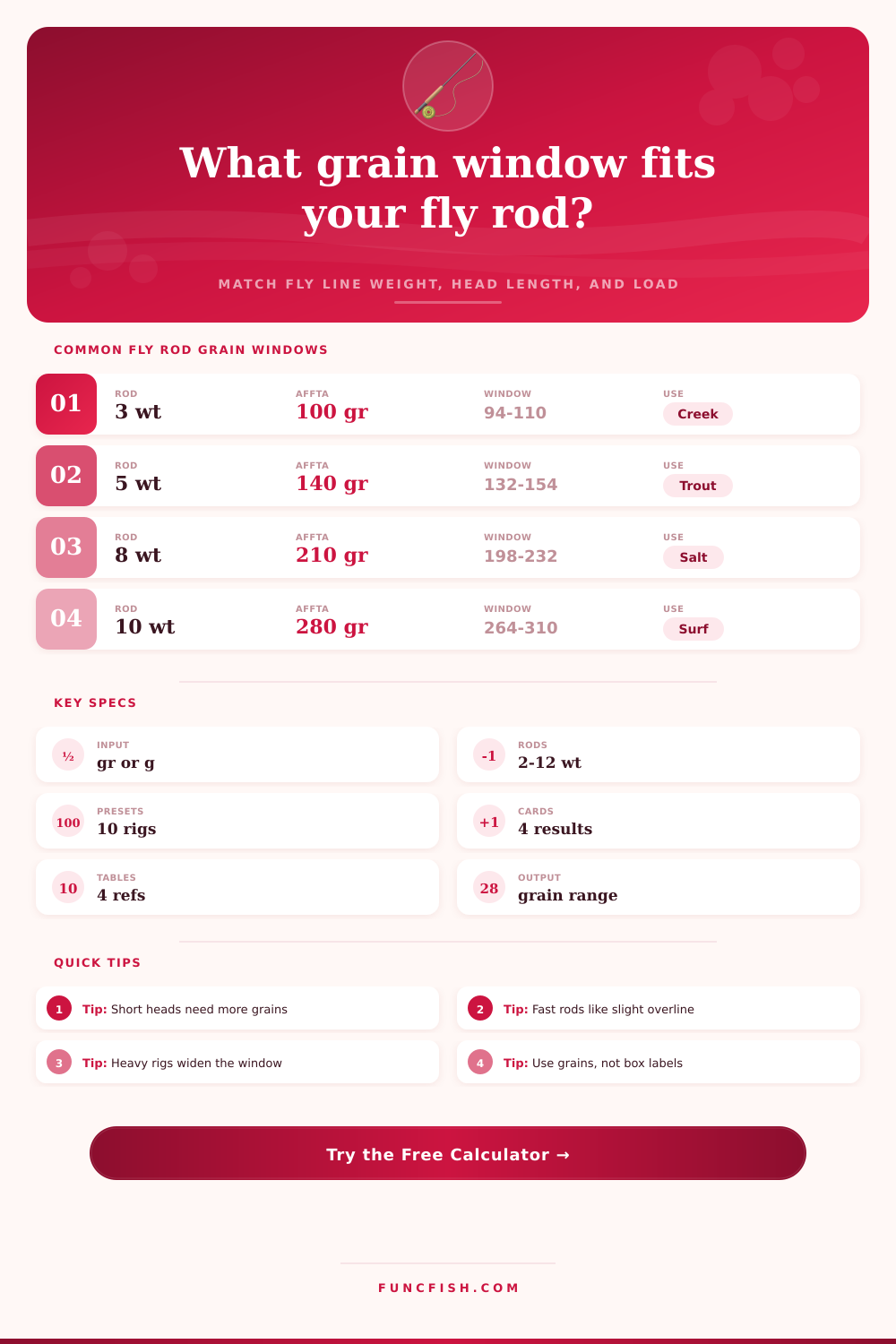
| Rod wt | AFFTA 30 ft target | Typical fishing window | Common use |
|---|---|---|---|
| 2 wt | 80 gr / 5.2 g | 74-90 gr | Tiny creeks, short leaders, very small flies |
| 3 wt | 100 gr / 6.5 g | 94-112 gr | Creek trout, bluegill, dry fly presentations |
| 4 wt | 120 gr / 7.8 g | 112-134 gr | Technical trout, soft hackles, small dries |
| 5 wt | 140 gr / 9.1 g | 132-156 gr | All-around trout, dry-dropper, light nymphs |
| 6 wt | 160 gr / 10.4 g | 150-182 gr | Streamers, windy trout, smallmouth, lakes |
| 7 wt | 185 gr / 12.0 g | 174-212 gr | Bass bugs, light saltwater, large trout streamers |
| 8 wt | 210 gr / 13.6 g | 198-242 gr | Redfish, bonefish, bass, pike, general saltwater |
| 9 wt | 240 gr / 15.6 g | 226-276 gr | Pike, heavy streamers, windy saltwater, boat work |
| 10 wt | 280 gr / 18.1 g | 264-322 gr | Surf, permit, stripers, heavy predator tapers |
| 11 wt | 330 gr / 21.4 g | 312-380 gr | Tarpon, heavy sink tips, offshore fly casting |
| 12 wt | 380 gr / 24.6 g | 360-438 gr | Big game, very large flies, heavy wind |
| Line design | Grain shift | Window width | Best match signal |
|---|---|---|---|
| Presentation WF or DT | -6 to -2 gr | Narrow | Rod forms smooth loops without hinging at the front taper. |
| Standard WF trout | 0 gr | Normal | Loads cleanly at 30 to 40 ft with ordinary single haul timing. |
| Indicator or nymph taper | +10 to +18 gr | Wide | Turns over split shot, bobber, and long leader without collapsing. |
| Streamer or sink-tip | +18 to +30 gr | Wide | Rod recovers after the haul and fly lands without tailing loops. |
| Bass bug or predator | +20 to +34 gr | Wide | Large fly starts easily with a short pickup and solid back cast. |
| Saltwater quick load | +8 to +22 gr | Normal | Line shoots from the deck with two false casts in wind. |
| Compact shooting head | +30 to +55 gr | Very wide | Head loads quickly but does not bounce or kick on the stop. |
| Single-hand spey head | +35 to +70 gr | Very wide | Anchor holds, D-loop forms, and rod unloads without wobble. |
| Fishing scenario | Rod classes | Head length | Adjustment note |
|---|---|---|---|
| Creek dries under cover | 2-4 wt | 28-40 ft | Stay near or below standard to protect presentation. |
| Dry-dropper trout rig | 4-6 wt | 32-45 ft | Add a few grains for leader mass and water pickup. |
| Indicator nymphing | 5-7 wt | 30-40 ft | One-half to one line class over can be practical. |
| Weighted streamer bank work | 6-8 wt | 24-35 ft | Shorter heads and sink tips push the window upward. |
| Bass bug taper | 7-9 wt | 26-36 ft | Bulky flies need concentrated front mass and a wider range. |
| Saltwater flats | 8-10 wt | 35-50 ft | Moderate overline helps fast shots without overloading in heat. |
| Surf shooting head | 8-11 wt | 20-32 ft | Compact heads commonly run well above AFFTA line labels. |
| Trout spey or switch | 3-7 wt | 16-28 ft | Use measured head grains; printed single-hand labels mislead. |
| Symptom while casting | Likely grain issue | Try next | What changes |
|---|---|---|---|
| Rod never bends at normal fishing distance | Too light or head too long for short casts | Add 8-15 gr or use a shorter head | Earlier loading and cleaner pickup |
| Tip bounces and loop kicks down | Too heavy or stroke too abrupt | Drop 8-15 gr or slow the stop | Less rebound and tighter tracking |
| Line lands hard on close dry-fly shots | Too much front mass | Choose presentation taper or lower grains | Softer turnover and less splash |
| Indicator rig piles up | Not enough mass or not enough width | Move upward within the window | More authority through the leader |
| Shooting head hinges at the rear | Head too short or overconcentrated | Use longer head or lower center weight | Smoother transition through guides |
| Good cast in calm, weak in wind | Window too low for conditions | Add wind adjustment and tighten loops | Better line speed and turnover |
💡Practical matching tips
Spool up some line on your five-weight, tune-up your rod and take a few steps onto bank. Make a cast. Nothing. Your line just hangs limply in mid-air, refusing to load the flex for which you shelled out your cash. Or worse yet, it loads hard at the end and you’re trying to wrestle with physics of your rod’s blank.
That’s not bad casting. That’s generaly just the wrong amount of mass. Rod action can vary quite a bit, even within same size class. The weight printed on your rod tube doesn’t match actual weight needed to bend the rod in its intended way. And most of us think of line weights as rigid categories; instead they are loose guidelines.
Why Your Line Weight Might Be Wrong
You can get the calculator to do the math for you with this one, but knowing why it makes sense changes how we approach fishing. Normaly, the AFFTA standard works out to be about 140 grains for a five weight measured from thirty feet away. And that’s just a jumping off place, not necessarily where you’ll land.
On calm water, when you’re fishing short dry flies, that standard can feel like a bit much. When you’re slinging weighted nymph rigs or battling the breeze, it will feel more little. With this tool, they adjusts the baseline to what you’re really doing. They take into account how dense your head is, how resistant your leader is, and even how your line stiffens in cold weather.
So what about head length? As you’d guess, concentrating your mass in a smaller package up top give the rod less total distance to load but it loads faster. That’s why calculator moves that window up when it sees a compact head. Because there’s no mass distributed over a long taper, you’ll need more grains to create the same amount of flex.
On the flip side, when we’re talking presentation line, that mass gets spread out thin to guard delicate offerings from fly fishing equivalent of a punch in the face. The tool knows this change; it adjusts its range to match whether you desire a soft delivery or maximum turn-over authority.
That’s where most anglers stall out. They purchase a standard weight-forward line for all situations and can’t figure out why their streamer cast look so awkward. Unexpectedly, rod action is also a big part of the equation. Graphite rods take more oomph to load correctly because they’re typically fast-action. If underloaded, they will hinge out hard and cause those dreaded tailing loops on your backcast. A fast rod recover faster than a slow one. To account for that, the calculator recommend going up a few grains on extra-fast blanks when trying to get the rod to load cleanly without having to hump it down range.
On the flip side, fiberglass rods is forgiving. Their slower rate of action allow them to bend earlier. Because there is not as much mass at the tip, the tool may recommend you go right around or even below bottom edge of the chart to avoid overwhelming the tip. It’s all about matching the storage capacity of the rod to the energy you put in the cast.
There’s yet another wrinkle that static charts don’t account for: environmental factors. Drag increases from wind. Stiffness increase with cold temperatures (plastic lines are less flexible when cold). The calculator factors this into play by moving the window heavier or wider accordingly. It recognizes that what felt like the perfect line on a calm morning is now feeling sluggish on a gusty afternoon. Don’t adjust your technique, it simply admits that the environment has altered the effective mass of your setup.
This flexibility is where it shines. Although the chart on the page breaks down some basic examples, it’s really all about being able to find your target range and then experimenting with lines inside that range. Don’t get hung up trying to hit the bulls eye with grain. Fly fishing are variable and messy. Finding your range of 20 grains may sound like a small amount of wiggle room. But in reality, there is a lot of room here to experiment.
When you realize its not a marketing term but really about leverage and mass of line you should of quit guessing and begin to load the rod properly on the first cast. Every time.