Football Jig Drag Angle Calculator
Estimate the pull angle of a football jig across bottom by combining depth, cast distance, line bow, current, line diameter, jig weight, trailer drag, and slope.
📌Scenario presets
⚙Drag angle settings
Use 0-5% for tight line, 10-20% for visible belly, and 25% for strong sweep.
Positive slope means the jig is climbing toward you; negative slope means it is dragging downhill.
Football jig drag angle forecast
Full breakdown
📋Line drag reference grid
12 lb Fluoro
15 lb Fluoro
17 lb Copoly
30 lb Braid
📐Drag angle interpretation
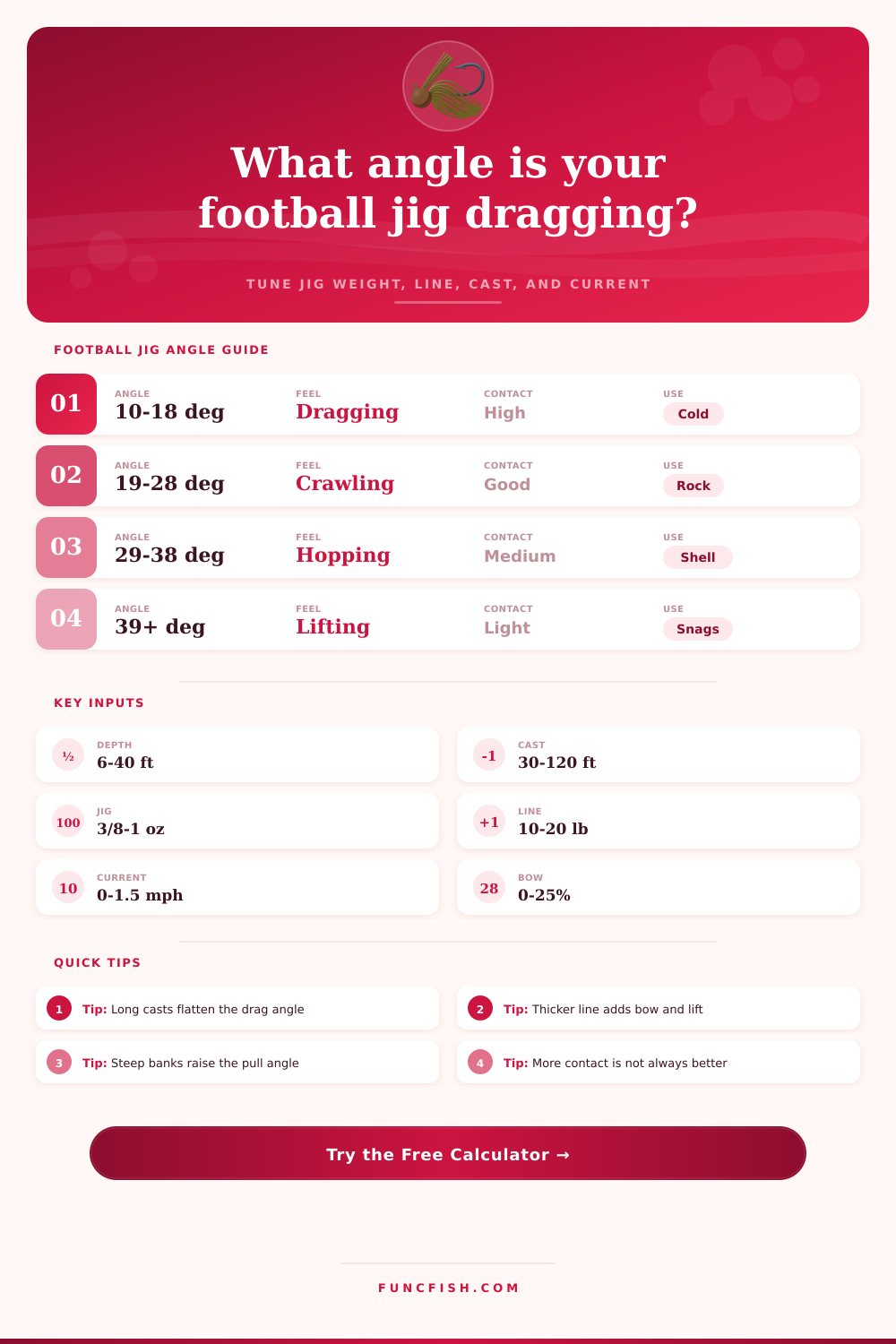
| Corrected angle | Jig action | Bottom contact | Common adjustment |
|---|---|---|---|
| 8-15° | Flat drag | Very high | Good for cold water, but can wedge in chunk rock |
| 16-24° | Crawl | High | Balanced for gravel, shell, and mixed hard bottom |
| 25-34° | Lift-crawl | Medium | Useful when fish want a short hop or the bottom rises |
| 35-45° | Steeper hop | Light | Helps clear snags but reduces feel and bottom pressure |
| 46°+ | Vertical lift | Very light | Shorten the rod lift or move farther off the target |
| Depth and cast | Starting jig | Line range | Angle tendency |
|---|---|---|---|
| 6-10 ft / 35-55 ft | 3/8 oz | 10-15 lb | Moderate to steep unless you cast long |
| 10-18 ft / 50-80 ft | 1/2 oz | 12-17 lb | Balanced football jig window |
| 18-28 ft / 65-100 ft | 5/8-3/4 oz | 15-20 lb | Long line lowers the angle and adds bow |
| 28-40 ft / 80-120 ft | 3/4-1 oz | 15-20 lb | Weight helps contact against line drag |
| Bottom type | Friction factor | Contact target | Angle note |
|---|---|---|---|
| Clean gravel | 0.42 | 70-90% | Steady crawling works well |
| Chunk rock | 0.62 | 55-75% | Too flat can wedge the football head |
| Shell bed | 0.48 | 60-80% | Keep enough angle to tick and release |
| Soft mud | 0.35 | 65-85% | Less friction, more glide per pull |
| Grass edge | 0.72 | 45-65% | Extra angle helps pop strands clean |
| Hard ledge lip | 0.68 | 50-70% | Step angle changes fast on the climb |
💡Practical checks
Tip: If the calculator shows a flat angle with low contact, the line is probably bowing more than the lure is moving. Add jig weight, lower rod tip lift, or shorten the cast.
Tip: On chunk rock, the highest contact number is not always best. A slightly steeper angle can roll the football head instead of wedging it.
A couple degrees make the difference between snatching a football jig from rocks and catching a smallmouth bass. You cast out, feel for bottom, and begin reeling. What happens in your hand doesn’t necessarily match what is happening under water. Rod position, current pull and line bow elevate the jig above bottom before it ever touches a fish. Until you catch something you can’t see, or hit rock after rock, most guys considers drag angle as a vague idea. The calculator will work through geometry of your unique scenario, allowing you to see exactly how your retrieve look and how it affects the bottom.
Now think about the physics of a short pitch compared to a long cast. If you make an eighty-foot cast into eighteen feet of water, that line forms a shallow underwater arc. So, force pulling on your jig is coming at it from way behind the jig. It’s effectively dragging it flat against the gravel. This is perfect for lethargic fish in cold water. They wants something slow and easy.
The Physics of Fishing Jigs
Now make a short cast in same depth. Your line steepens. Every time you twitch it, the jig lift off the bottom. You’re now fishing in mid-water instead of on contour. Knowing how distance affect depth is key to keeping contact.
In regards to line, that’s where equation gets big. Because water resistance isn’t as obvious as air resistance, we need to take into account line. Thick fluorocarbon create drag and acts like a parachute underwater. When you lower your rod tip, the drag of your line pull the jig upward. Current, wind or both are going to compound this force. You’ll find on page the reference table explaining how materials resist these forces. While a thinner line transmits the feel of bottom better, it will also often run faster, spooking wary bass in clear water. It’s always a balancing act between sensitivity and stealth.
Don’t just consider depth in weight selection. Consider depth, but also consider angle of the bottom. When we put a jig in deep water, we tend to use weights that is too heavy. We should of instead weight them based off the angle of the bottom. Gravity is your friend if you’re fishing a sharp break, so your lure stays on that angle. That lighter jig may be a better choice because it doesn’t dive hard and stay with the contour. But that same light jig will float off the bottom on a flat shelf if you quit reeling. You has to counteract line drag and buoyancy to make contact.
Adding force horizontally in form of current changes everything. Current pushes your line downstream and lifts your presentation. In a river or near an inflow, the current pushes your line downstream, increasing the bow and lifting your presentation. On top, you may think you’re feeling a lot of weight, but instead of being on the bottom, you’re pulling your jig up to surface. To combat this lift, consider moving to a heavier head or adjust your rod angle to fight the current. It’s a balancing act between keeping your lure on the ground without letting it pull on you with every step.
So the math is done and now it’s all about interpreting what you’re feeling on the rod tip. Generally speaking when you get a sharp tick, you’re over rock/shell. When you get a dull thud… It’s soft sediment/mud. But if you’re dragging at too steep an angle you won’t feel the subtle ticks because your jig isn’t crawling, it’s bouncing. Too flat, and it’ll wedge itself in the crevices for good. Adjusting the position of your rod and the speed of your retrieve is how you find that sweet spot where it’s just skipping off the top of that head with no digging in.
The variables make you better sooner Knowing what’s happening will allow you to choose exactly how far to cast, what size line to use, or how much weight to put on your jig. This helps you get the perfect action for whatever they are wanting on a particular day. When you know why your lure is dragging or lifting, you’re no longer guessing and are able to control things. The next time you miss a bite, make sure you check your angle before you reach for another bait. Getting that lure back down where it should be can sometimes be as simple as casting it a little further out or lowering your rod tip. Actualy, this is naturaly more comfortabley than guessing.