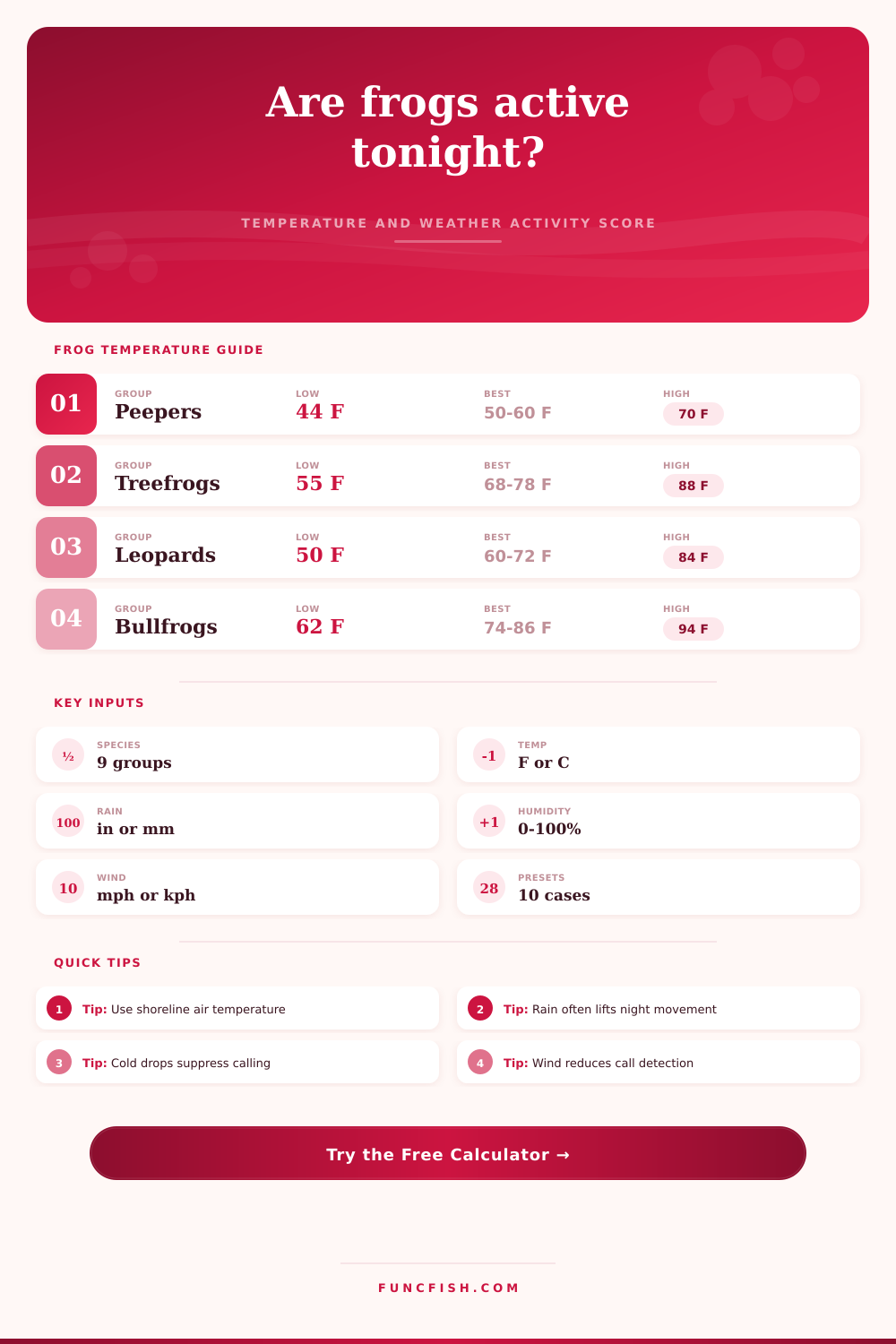
Frog Activity by Temperature Calculator
Estimate frog calling, shoreline movement, and feeding activity from species group, air temperature, water temperature, night low, recent temperature swing, rain, humidity, wind, season, and cover.
🏷Activity labels
📌Frog activity presets
⚙Temperature and habitat inputs
Frog activity temperature results
Formula breakdown
📊Current factor grid
Species
Temperature
Moisture
Exposure
📋Reference tables
| Frog group | Active lower edge | Best activity band | Upper watch edge | Temperature style |
|---|---|---|---|---|
| Spring peeper | About 42°F / 5.6°C | 48 to 62°F / 8.9 to 16.7°C | 70°F / 21.1°C | Cold spring caller |
| Chorus frog | About 45°F / 7.2°C | 50 to 66°F / 10.0 to 18.9°C | 76°F / 24.4°C | Cool ditch and pool caller |
| Wood frog | About 40°F / 4.4°C | 44 to 58°F / 6.7 to 14.4°C | 68°F / 20.0°C | Brief thaw-pool breeder |
| Green frog | About 55°F / 12.8°C | 66 to 78°F / 18.9 to 25.6°C | 88°F / 31.1°C | Warm edge resident |
| American bullfrog | About 60°F / 15.6°C | 74 to 86°F / 23.3 to 30.0°C | 94°F / 34.4°C | Hot-weather pond frog |
| Leopard frog | About 48°F / 8.9°C | 58 to 72°F / 14.4 to 22.2°C | 84°F / 28.9°C | Cool grass-bank mover |
| Activity index | Band | Expected field signal | Call read | Movement read |
|---|---|---|---|---|
| 0 to 19 | Quiet | Little visible activity | Mostly silent | Hidden or inactive |
| 20 to 39 | Low | Scattered individuals | Few calls | Short edge moves |
| 40 to 59 | Moderate | Localized activity | Patchy chorus | Some bank travel |
| 60 to 79 | High | Strong shoreline signal | Reliable chorus | Frequent movement |
| 80 to 100 | Peak | Broad active window | Heavy chorus | High shoreline use |
| Condition factor | Activity boost | Activity drag | Calculator role | Field note |
|---|---|---|---|---|
| Rain in 24 hours | 0.10 to 1.20 in / 3 to 30 mm | No rain or hard flush | Moisture multiplier | Moderate rain lifts travel |
| Humidity | 70 percent plus | Below 45 percent | Skin moisture buffer | Dry air limits exposure |
| Wind | 0 to 8 mph / 0 to 13 kph | 18 mph / 29 kph plus | Calling and movement drag | Wind hides calls and dries banks |
| Night low | Near species lower edge | Sharp cold drop | Overnight penalty | Cold lows shorten chorus time |
| Cover | Grass, pads, brush | Bare bank | Refuge multiplier | Cover extends usable warmth |
| Habitat setting | Typical temperature response | Best activity mode | Model adjustment | Sampling caution |
|---|---|---|---|---|
| Vernal pool | Warms fast, cools fast | Breeding / calling | Early season boost | Night lows matter strongly |
| Farm pond edge | Stable shallow warmth | Calling / feeding | Balanced baseline | Oxygen and cover vary |
| Marsh pocket | Warm protected water | Movement / calling | Cover and humidity boost | Wind shelter changes by pocket |
| Slow creek margin | Cooler moving edge | Movement | Lower heat stress | Rain can alter flow quickly |
| Lake cove | Broad solar warming | Feeding / forage | Warm-bank boost | Main-lake wind can suppress calls |
💡Calculation tips
Temperature tip: Use the air temperature at the actual shoreline and the shallow water temperature where frogs sit, because exposed banks can differ from nearby weather stations.
Moisture tip: A small warm rain often matters more than a large cold storm. The calculator rewards moderate rain but penalizes sharp cooling and strong wind.
It’s early spring and the air’s chilly, but the pond’s still cold. You’re standing there listening. Should you head indoors? Will frogs be calling tonight? If you’re a human hoping to witness the awakening of an amphibian, this wait-and-see can feel familiar.
But it doesn’t have to: There are certain environmental triggers that set amphibians off; their activities isn’t random. Knowing what those triggers are is all it takes, you don’t even have to guess at whether conditions are right. But when you plug in your local information into the calculator (above), it does all that for you. You don’t have to convert coefficients by hand anymore. Instead, it combine actual current weather conditions with each species’ thermal requirements and spits out a number… An activity index. That’s the number that will let you know if it’s going to be quiet or noisy.
Why Frogs Call
To get a handle on how things change, we have to look beyond temperature alone. The temperature is the main driver here. But wind and humidity is controlling factors. The big takeaway for most folks is that they tend to concentrate entirely on air temperatures, but that’s actualy where they get it wrong.
Frogs require moist skin to breathe; they’re semi-aquatic animals and the air being warm matter, but so does the air being humid. Frequently, a cool night with high humidity are more productive than a warmer night with low humidity. Referencing the table above, you can see how moisture allow them to stay out of the water. If it’s dry out, frogs tuck into the water or mud so they don’t dry out. Hydration trumps callin’.
Similarly, frog behavior are affected by rain. Even after a rainstorm has passed, a light rainfall during the previous day will typically increase their activity. It gets the banks wet, making it easier for them to move around without drying out. It also removes some of their predator that drive them into hiding. A heavy rain, though, can interfere with calling. Heavy downpours can break up males’ acoustic signals used to entice females. The tool takes all this into account, rewarding moderate amounts of moisture and penalizing both extremes of drought and heavy rain.
But wind also decreases frog activity. Even if you’ve got the humidity and right temperatures, it’s hard to get sound to travel with strong winds. Wind also chills frog bodies, making them want to tuck in. And it scatters their calls so that they don’t carry very far either. The last part of the score take into account wind exposure.
It says a warm night is like a calm night. So when you put all these things together on the same screen, you can see where the ideal nights are for calling frogs out. It’s not just about different weather; it matters what kind of frog or toad they are, too. For example: Spring peepers begin calling at around forty-five degrees Fahrenheit in the air. American bullfrogs likes it a lot warmer, seventyish, and won’t do their thing until it gets warm enough. That means if you’re expecting spring peepers one minute and then realize you’re actually looking for a different species, and expect them to call, too…well, no surprise if they don’t happen. With this tool, you can choose which set of critters you’re following.
Weather data matched up with biology. That’s what it means to predict frog behavior. Reading the forces in balance. Understanding that heat isn’t the only thing required; you need warmth accompanied by humidity. You need calm air to transmit the sound. The proper species must be present.
And then there are those moments when all the factors line up. The silence is shattered, the pond springs to life and you know: this is where I’m supposed to be. You should of seen it.