Gape Width by Bait Diameter Calculator
Estimate whether a bait's thickest section fits a target fish's mouth width, including species gape scaling, bait profile, softness compression, hook clearance, and strike-condition margin.
📌Gape-fit presets
⚙Measurements and fit factors
Used to estimate gape width when no measured gape is entered.
Enter 0 to use the species length model.
Most strikes are not a perfect maximum-mouth capture.
Gape-to-bait fit results
Full calculation breakdown
🐟Species gape comparison grid
Largemouth bass
Smallmouth bass
Walleye
Pike and musky
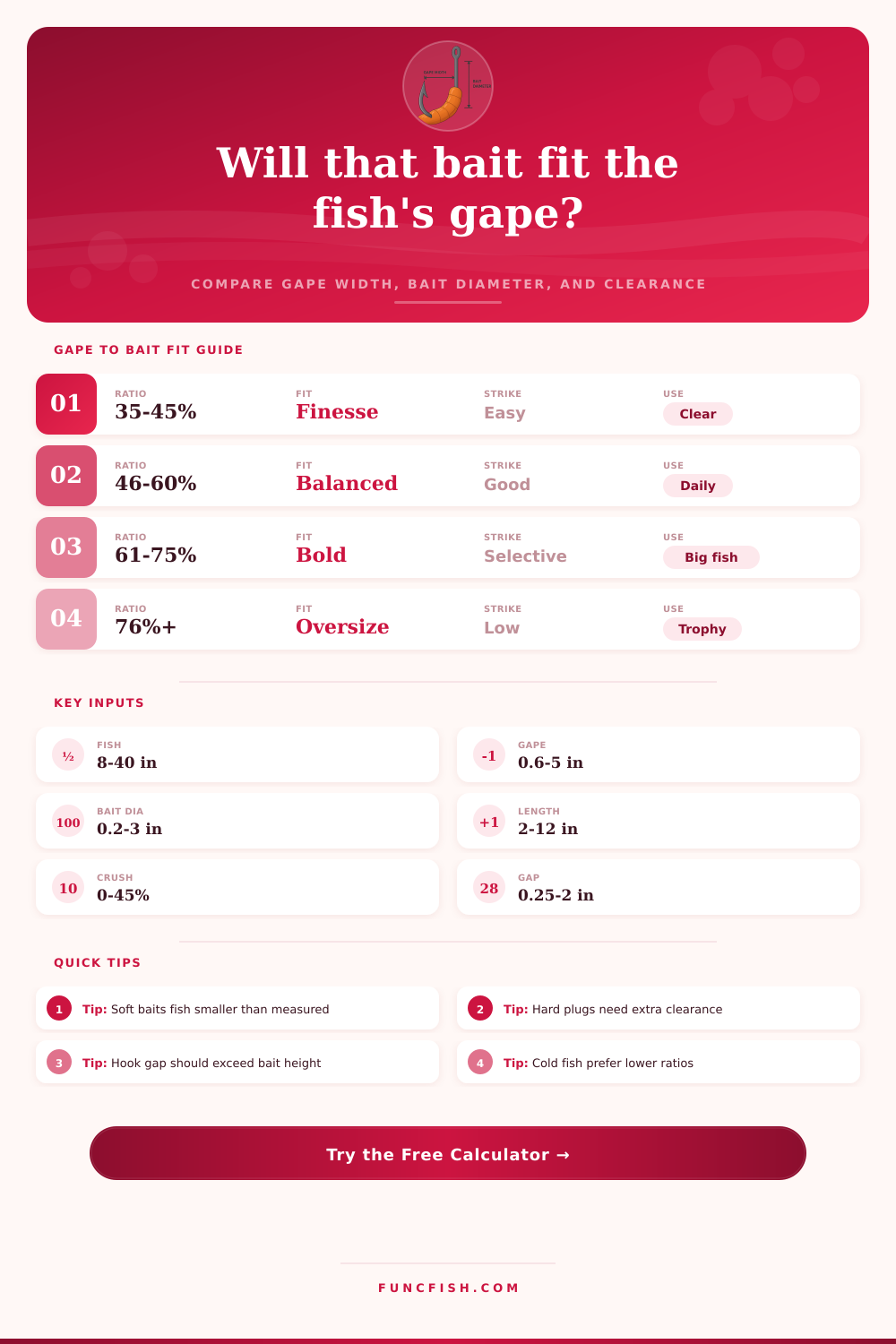
📊Gape ratio interpretation
| Bait diameter as gape | Fit class | Best use | Hooking note |
|---|---|---|---|
| Under 35% | Small and easy | Pressured fish, cold fronts, small forage | Good hook exposure, may lack big-fish selectivity |
| 35-50% | Finesse matched | Trout, walleye, smallmouth, crappie, neutral bass | Reliable mouth entry with most single hooks |
| 51-65% | Balanced power | Everyday bass, redfish, catfish, feeding pike | Watch hook gap and plastic bulk |
| 66-78% | Selective large profile | Trophy bass, pike, musky, dirty water reaction bites | Needs strong gape and clean point exposure |
| Over 78% | Oversize risk | Only when seeking larger fish or short-window reaction strikes | Missed strikes rise unless the bait compresses well |
🧰Bait profile diameter modifiers
| Profile type | Effective diameter factor | Compression response | Fit concern |
|---|---|---|---|
| Round soft plastic | 1.00 x measured diameter | Moderate collapse | True diameter matters more than length |
| Flat-sided soft bait | 0.86 x measured diameter | Good sideways collapse | Can fit smaller mouths than calipers suggest |
| Paddle-tail swimbait | 1.08 x body diameter | Tail and belly add bulk | Hook slot and belly thickness limit gap |
| Hard plug or crankbait | 1.18 x body diameter | Little collapse | Trebles require clearance around rigid body |
| Tall glide bait | 1.28 x body diameter | Very little collapse | Height blocks deeper mouth entry |
| Tube bait | 0.82 x diameter | Hollow body crushes | Internal jig head can reduce collapse |
| Chunk or cut bait | 1.12 x thickest chunk | Soft but irregular | Square edges can feel larger |
| Shrimp or craw profile | 1.05 x body diameter | Appendages fold back | Claws and legs add first-contact bulk |
🪝Hook gap and bait diameter guide
| Rig style | Hook gap target | Clearance allowance | When to size up |
|---|---|---|---|
| Open jig hook | 1.10 x compressed bait height | Low | When plastic balls on the bend |
| Texas rig offset hook | 1.30 x compressed bait height | Medium | When the point stays buried after pressure |
| Treble-hook hard bait | 0.80 x body height for mouth entry | High | When fish slap without engulfing |
| Single swimbait hook | 1.35 x belly height | High | When hook point sits low in the plastic |
| Circle hook bait rig | 1.20 x bait chunk height | Medium | When the bait blocks the circle opening |
| Stinger or trailer hook | 1.00 x body diameter | Low | When short strikes hit behind the main hook |
| Weedless exposed point | 1.25 x compressed profile | Medium | When the guard or skin hook masks the point |
📐Common species and bait fit ranges
| Species | Example fish length | Estimated gape width | Balanced bait diameter |
|---|---|---|---|
| Largemouth bass | 16 in / 41 cm | 2.1 in / 5.3 cm | 0.9-1.4 in / 23-36 mm |
| Smallmouth bass | 16 in / 41 cm | 1.6 in / 4.1 cm | 0.7-1.0 in / 18-25 mm |
| Rainbow trout | 14 in / 36 cm | 1.1 in / 2.8 cm | 0.4-0.7 in / 10-18 mm |
| Walleye | 20 in / 51 cm | 1.8 in / 4.6 cm | 0.7-1.0 in / 18-25 mm |
| Northern pike | 28 in / 71 cm | 2.3 in / 5.8 cm | 1.1-1.6 in / 28-41 mm |
| Crappie | 11 in / 28 cm | 1.0 in / 2.5 cm | 0.35-0.55 in / 9-14 mm |
Gape width tip: Measure the bait at the thickest point that must enter first, not at the tail tip. For swimbaits, that is usually the belly where the hook rides; for plugs, it is the rigid body height near the front treble.
Hook clearance tip: A bait can fit the mouth and still miss fish if the hook gap is crowded. The calculator separates mouth-entry clearance from hook exposure so an oversized soft plastic does not look better than it fishes.
So you’ve got all of those fancy lures in the tackle box. You take ’em out on the water and something doesn’t work right. They get ’em to chase them down. They slap them around. But then they get away before hook ever sets. It becomes a frustrating puzzle.
Then one day you put two and two together and come up with four; that’s not usually the color or the action; it’s almost always the fit. An eighteen-inch largemouth bass doesn’t have an eighteen-inch-wide mouth. And knowing difference between bait diameter and gape width will change everything on every cast. Because it’ll shift emphasis off of what looks good to what realy fits.
Why Bait Fit Matters More Than Size
After choosing your target species and entering your lure size, the calculator (above) do the rest for you. All you do is enter largest diameter your bait will fit into (not the total length), since this is where the bait gets stopped up. From there, it calculates approximate inner width of the fish’s mouth from biological models and how it relates to the shape of your lure.
In other words, it gives you an idea if you’re offering them something they can handle or something so big they hesitate and don’t bite. In short, it makes a complicated shape question easy, can I expect him to eat it? Or not?
Most anglers judge their baits by length. That’s also what gets written on the package, so a six inch swimbait sounds big right? It sounds big until you realize it is wide enough to wiggle through narrow, moving opening. Width are the limiting factor there.
Hard baits don’t give, but soft plastics will compress a bit under pressure. This makes a huge difference when trying to match the hatch or trick picky trout. The tool consider this with questions regarding expected compression and profile of the bait. A flat sided worm of the same nominal size as a round grub will slip into a tighter space easier, for instance. Ignoring that means you’ll overestimate what fits, causing you to miss opportunities and fish you could of caught.
Finally, there’s the hook gap. This one is something you don’t really think about until you’re out there and can’t seem to get it through the fish’s lip. The bait fits into the mouth, but point of the hook isn’t exposed enough to go through once they bite. To make sure we have enough gap for penetration on the trigger bite, the calculator measure hook exposure. An offset hook needs more room than say a bare jig does, depending off how much bulk and weight is hanging off of it in the fish’s mouth. That is also why they use smaller hook gaps and lighter offerings like a Texas rigged worm. This maximize their chance to find the hook instead of simply riding down the top of the fish’s mouth.
Bait size is an important factor to a bass’s preference but even more so with fish that have become very particular. They can get picky depending on water conditions. When the water is more clear, it has to be exact. They want to look at their meal and if something doesn’t pass the test they won’t touch it. That’s why the calculator also takes into account margin of strike conditions. So if something would work in the summertime when they’re aggressive and metabolisms is high, it may be ignored when the weather cools down and a front blows through. Lastly, it allows you to avoid the head scratching of throwing a big bait when a little one should do the trick.
To conclude, Matching your presentation with the physical limitations of your quarry are always a big key to catching more fish. But larger does not necessarily mean bigger. In fact, sometimes downsizing drastically gets your bait past what it will accept. The gape width concept remind us there are some hard boundaries in nature. Even though you may be using the best retrieve in the world, it won’t matter if the geometry is off. Respect the mouth size limits and keep the proportions sensible and you’ll be sure to have fewer misses and happier days of fishing and trips home. This simple principle can make a good angler into a great one because it focuses on what realy gets swallowed as opposed to what merely looks impressiv from the boat deck.