
What comes to mind? It is likely a giant squid coming up from depths to pull boats beneath the waves. Well, that’s Hollywood. The truth is much darker and more complex. These mysterious animals has spent millions of years hiding in the dark, crushing pressures of the sea’s depths. We’ve rarely been able to get cameras down there and see them alive. But when they does get caught in nets or drift dead to surface, they let us know they’re here.
How big are they really? And what does that tell us about who they realy are? It turns out that they’re monstrous, but not in the sense of legend. They’re just highly specialized survivors. But there is some biological rules to their size, and those are things marine biologists has learned over decades of work with them.
The Truth About Giant Squid
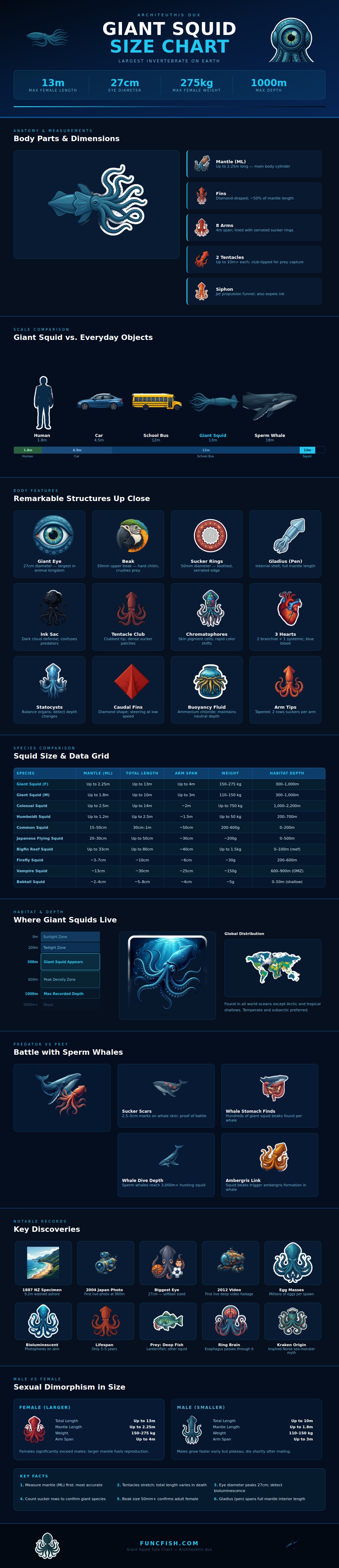
The anatomy is explained nicely in infographic above. As it describes, the standard of measurement is what is called mantle length. Why? Because total length of a dead squid is inflated by its dying tentacles. They stretch out after death and make overall length appear longer. You’re actualy measuring decay, not biology, if you take rotting squid’s tip-to-tail measurement. What scientists like about mantle length is that it don’t change and is rigid.
It also reveals that females become much larger then males, something we see in cephalopods but never to this extreme. In fact, the largest known female was more than 13 meters long, compared to just less than ten meters for males. That is a significant difference in size. Sexual dimorphism are because females must be extremely well-endowed with energy stores to produce eggs. They go all-in on mating, and then perish. Males max-out their growth at a size sufficient to mate, and then quit, forever. So, in the deep sea economy, it’s an ugly trade-off.
Giant squid live in water under immense pressure and near-freezing temperatures in bathypelagic and mesopelagic zones. As the chart says, these depths extend from three hundred to one thousand meters below the surface. These are the twilight waters, where the sun vanishes into blackness.
How do the giant squid survive? They have adapted with some very special features. First, their eyes is the largest known in any animal, up to twenty-seven centimeters across. In other words, about as big around as a human’s head. Why such monstrous orbs? Because they need massive eyes to sense tiny light signals, the bioluminescence of predators or prey (in an environment of total darkness). Otherwise, they’d be blind… And dead.
And look at their blue blood (as shown on the chart). Hemoglobin carries oxygen through our blood vessels; but because it doesn’t work well in low-oxygen, cold conditions, giant squid has another protein: a copper-based molecule called hemocyanin that transports oxygen far more effectivly. It allows them to function where other animals would drown.
The sperm whale is their main predator. And if you look at the whales you can see evidence of their struggles. Scarred sucker ring marks tells the tale of a violent fight with squid. The infographic shows that these scars are proof of contact. This is one of the few times people has seen these two giants of sea interact directly.
Squid rely heavily on ink to confuse an adversary and to help them escape. The only thing left behind when the squid decomposes is its hard chitin beak. When found inside a whale’s belly it tells us both what they consume and how frequently.
The visual compares the giant squid to others, such as the colossal squid. It uses a data grid to compare them in terms of size and placement on food chain. Though prey for bigger mammals, they is an apex predator in their own right.
For many years, almost nothing was known about them. Bones occasionally washed up on shore after a storm or got caught in fishermen’s nets. However, the earliest record of one alive was recent enough that most of us could of remember seeing it as breaking news. And now that we’ve seen live video footage, we know: They’re not drifters. They actualy move around in the water. They have a ring-shaped brain (with esophagus running through the middle) and a complex nervous system. It’s an odd design, but it fits their lifestyle perfectly.
Because they live such a short time, between three and five years; they needs to grow quickly and feed continuously. We project our own terrors into the dark depths, keeping the myth of the kraken alive. But the giant squid isn’t a monster at all; it’s a highly specialized animal whose adaptations makes it a survivor of extreme environments. When we understand how big it really is and what makes it tick, we gain respect for the ocean’s hidden complexities instead of just fearing its unknown perils.