Handling Time Survival Calculator
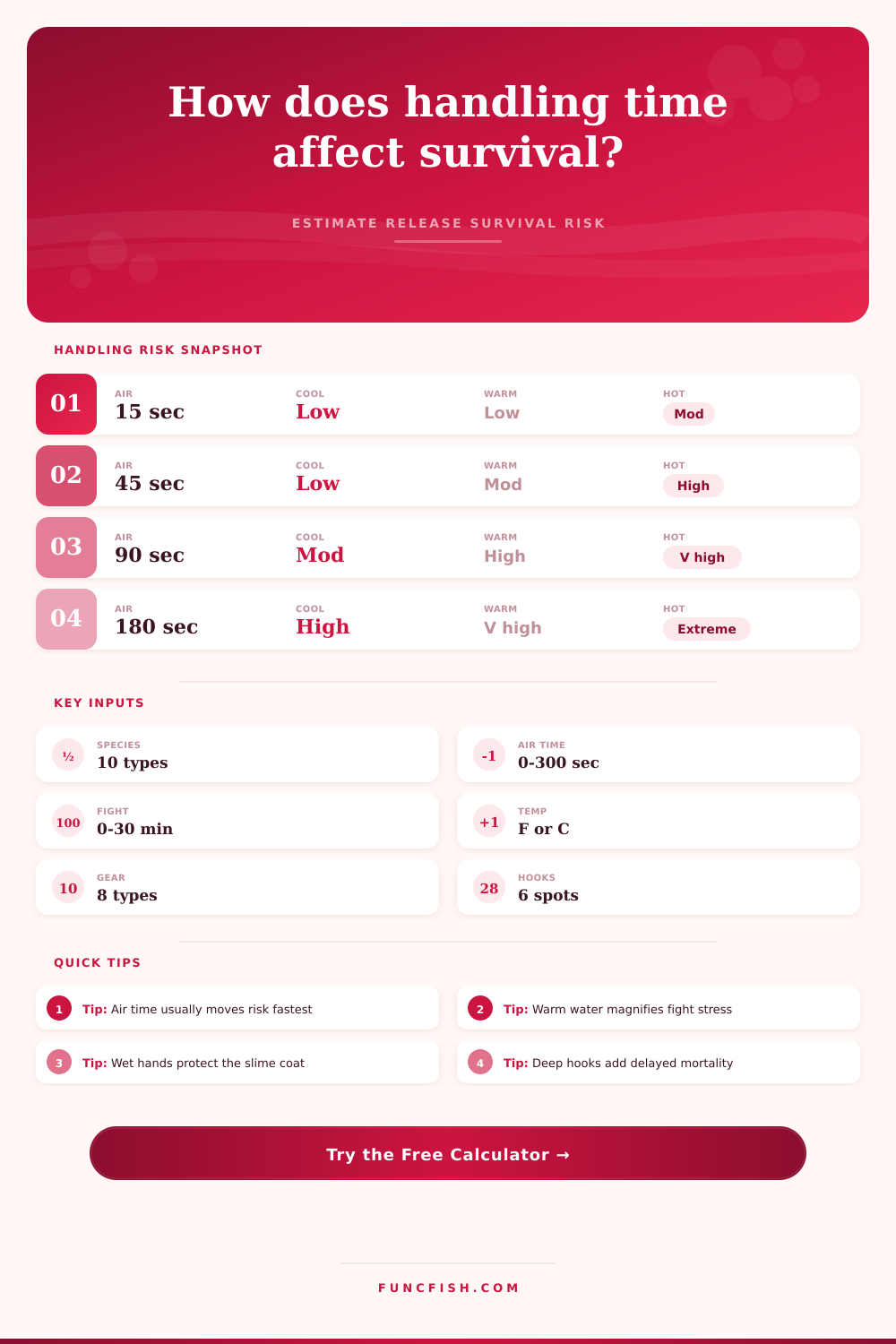
Estimate post-release survival from air exposure, fight duration, water temperature, hook location, landing gear, species tolerance, and fish condition at release.
📌Handling survival presets
⚙Calculator inputs
The model estimates handling-related survival only. It does not evaluate closed seasons, harvest rules, or location-specific regulations.
Handling survival estimate
Calculation breakdown
🧰Species and gear grid
Bass handling
Trout handling
Toothy fish
Inshore drum
📊Species tolerance reference
| Species profile | Typical length | Preferred temp | Handling tolerance | Release focus |
|---|---|---|---|---|
| Largemouth bass | 12-22 in / 30-56 cm | 60-78 F / 16-26 C | Moderate-high | Limit hot-weather air time |
| Smallmouth bass | 10-20 in / 25-51 cm | 58-72 F / 14-22 C | Moderate | Watch deep summer fight stress |
| Rainbow trout | 8-20 in / 20-51 cm | 50-64 F / 10-18 C | Low-moderate | Keep in water while unhooking |
| Walleye | 14-28 in / 36-71 cm | 55-70 F / 13-21 C | Moderate | Reduce fight time and deep hooks |
| Northern pike | 20-40 in / 51-102 cm | 50-68 F / 10-20 C | Moderate | Support weight horizontally |
| Striped bass | 20-40 in / 51-102 cm | 55-72 F / 13-22 C | Low-moderate | Avoid long fights in warm water |
📏Handling factor table
| Factor | Low stress | Moderate stress | High stress | Calculator effect |
|---|---|---|---|---|
| Air exposure | 0-30 sec | 31-90 sec | 90+ sec | Largest direct penalty |
| Fight time | Under 2 min | 2-6 min | 6+ min | Scaled by species stamina |
| Hook location | Lip or jaw | Mouth interior | Gill, eye, deep | Delayed mortality penalty |
| Surface contact | Wet hand or cradle | Knotless mesh | Deck or dry hand | Slime-coat abrasion factor |
| Release condition | Strong upright | Slow upright | Bleeding or rolling | Overrides action priority |
🌡Temperature response table
| Water condition | Range F | Range C | Stress pattern | Adjustment used |
|---|---|---|---|---|
| Cold water | 40-50 F | 4-10 C | Slow recovery but high oxygen | Small fight penalty |
| Cool optimum | 51-64 F | 11-18 C | Best trout and walleye recovery | Lowest temp penalty |
| Mild warm | 65-74 F | 18-23 C | Good bass recovery | Moderate species scaling |
| Warm | 75-82 F | 24-28 C | Lower dissolved oxygen margin | Added fight and air penalty |
| Hot | 83+ F | 28+ C | Fast exhaustion risk | Strong penalty |
🔗Gear matching table
| Setup | Common line | Best landing aid | Handling note | Risk direction |
|---|---|---|---|---|
| Ultralight panfish | 2-6 lb / 0.9-2.7 kg | Wet hand or small net | Small fish dry quickly | Low if fast |
| Bass spinning | 8-15 lb / 3.6-6.8 kg | Rubber net | Lip grips are brief only | Low-moderate |
| Walleye jigging | 6-12 lb / 2.7-5.4 kg | Knotless net | Long summer fights add stress | Moderate |
| Surf casting | 15-30 lb / 6.8-13.6 kg | Wet sand support | Avoid tumbling wash | Moderate-high |
| Pike casting | 20-50 lb / 9.1-22.7 kg | Cradle or rubber net | Have long pliers ready | Moderate |
| Offshore trolling | 30-80 lb / 13.6-36.3 kg | Dehooker or cradle | Fight exhaustion dominates | High |
💡Handling calculation tips
Air-time math: Treat the longest continuous air interval as the critical input. Three quick lifts can be safer than one long measuring and photo pause.
Gear matching: Landing gear changes survival indirectly by changing fight duration, surface contact, and unhooking speed. Wet, knotless, fish-supported tools score best.
When you set the hook on a fish, it trigger a metabolic explosion. Oxygen demand go through the roof, lactate build up in the blood, and the gills are pushed beyond their delicate limits. Post-handling time isn’t just convenient; rather, its sufficient time for the animal to repay its oxygen debt prior to release. These biological pressures drives post-release survival, and the calculator above converts those subjective feelings into an objective risk score.
The one variable in this equation that usualy trumps all others is air exposure. Fish are not designed to breathe air. The gills relies on the water to support the lamellae. If they are out of the water for as few as thirty seconds, it can permanently damage them. As a result, the fish’s ability to exchange gases is less efficient and when they do return to the water recovery is harder. Warm water make this issue worse as it decreases dissolved oxygen. While a bass may be able to handle a minute out of the water in sixty degree water, that same bass in eighty-five degree water could sustain life threatening stress from just thirty seconds out of the water. The tool consider temperature and helps you determine your actualy margin.
How to Keep Fish Alive
The length of time fighting the fish also add an additional stress that is frequently overlooked. As the fish tires it lose more and more glycogen and begins filling up on lactate, which isn’t good. Walleye and trout are even more susceptible to this since they don’t have as high a tolerance for exertion than do pike and bass. To combat this, a faster fight (which you’ll get with heavier line) or keeping the hook in the corner of the fish’s mouth with circle hook will help.
On the other hand, if the fish is hooked deep, then you’ve got a whole separate issue here. Not only does it cause physical injury to the fish, but it may result in delayed death several days down the road. Hook location is consider when calculating survival chance. This matter more than people realize.
Nets protect the slime coat, which is the fish’s first line of defense against parasites and infection. This slime coat gets stripped off when it comes in contact with dry hands or rough boat decks. The fish will then be prone to secondary infections that will kill them over time. A small step of wetting your hands before handling the fish make a huge difference. Knotless mesh protects the slime coat.
Included with the tool is a series of reference tables that detail recommended tackle as well as how much each species can handle in various setups. You can see where your particular setup will increase or decrease the risk. Long fights and deep hooking are more common for offshore trolling; short fights paired with high air temperature are more typical for inshore fishing. You can plan for all of this. So if you know you’ll be fishing in warm water, think about minimizing photo time and using a net. The fewer panicked decisions when the fight gets hot the better.
The last part of the puzzle is recovery support. Positioning the fish into current allows water to be forced through the gills and helps in recovering a fish. It’s particularly critical for an exhausted or rolled-up fish. Don’t ever release a fish if it’s not standing upright. Either hold it in your hand so long as it stays underwater or in the livewell till it rights itself. Based off how you released the fish, the tool would of give you a priority to indicate what to do. If the fish is swimming strongly upright, then go! Does the fish look like it’s going to roll? That requires assistance. Anglers’ most common error here are to ignore this message.
But more than catching the fish, it’s about keeping the fish alive. Many stress factors work together like a perfect storm. Warm water, air exposure, and rough handling leave the fish with very few chances to survive. It’s important to know how each of these inputs impact the overall score so you’ll have an opportunity to make better choices while you’re on the water. You don’t have to remember all of the biology to use this information. All you really need is to understand its limitations, to respect the animal. The math give you a framework. What happens next is up to you.
Every touch matters. Every second counts. Those last few moments before the fish goes out of sight can be the difference between success and failure.