Hook Penetration Force Calculator
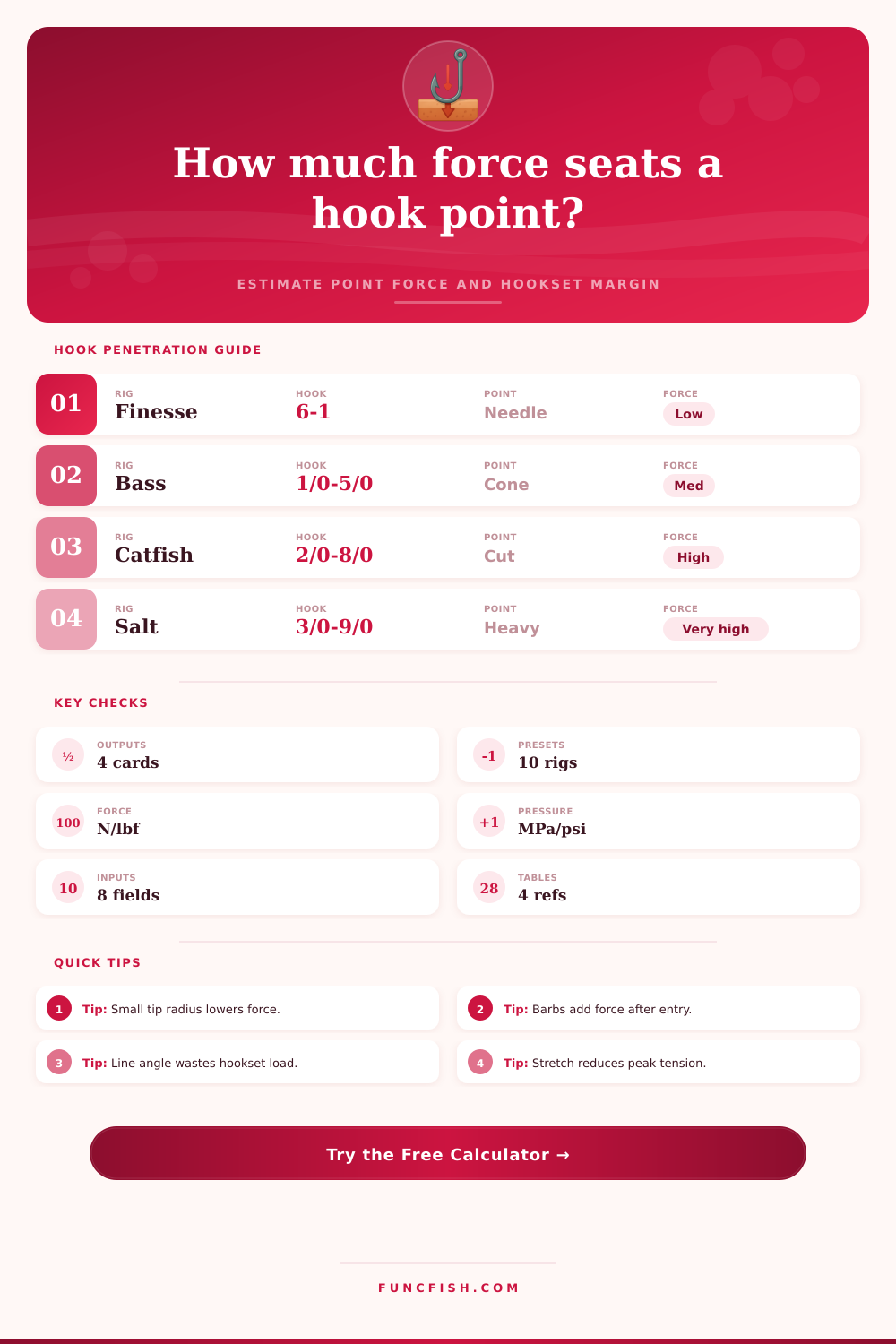
Estimate the point force, line tension, point pressure, and hookset margin needed to start and seat a hook using hook geometry, sharpness, mouth hardness, line angle, and tackle efficiency.
📌 Hookset presets
⚙ Hook, point, and tackle inputs
Hook penetration estimate
Calculation breakdown
📊 Live hook and tackle checks
Point shape, angle, and tip radius combined.
Extra seating force after initial puncture.
Force lost when pull is not aligned with point.
Rod, slack, stretch, and sweep absorption.
⚖ Hook point comparison
Fine taper starts easily in soft tissue, but can roll if pushed into hard jaw plate.
Balanced entry and durability for most bass, walleye, trout, and bait hooks.
Edges reduce puncture load in firm tissue, with a wider cut channel after entry.
Stronger geometry resists damage, but needs more tension to fully seat.
📘 Reference tables
| Hook profile | Typical wire | Tip radius range | Force factor |
|---|---|---|---|
| Dry fly / fine wire | 0.35-0.55 mm / 0.014-0.022 in | 8-18 micron | Low, 0.72-0.90 |
| Aberdeen / bait holder | 0.45-0.75 mm / 0.018-0.030 in | 12-28 micron | Low-medium, 0.86-1.05 |
| EWG worm hook | 0.85-1.35 mm / 0.033-0.053 in | 18-38 micron | Medium, 0.95-1.22 |
| Circle hook | 1.10-2.40 mm / 0.043-0.094 in | 20-50 micron | Medium-high, 1.05-1.35 |
| Treble hook point | 0.70-1.50 mm / 0.028-0.059 in | 16-40 micron | Medium, 0.92-1.22 |
| Heavy saltwater single | 1.80-3.80 mm / 0.071-0.150 in | 28-65 micron | High, 1.20-1.55 |
| Mouth hardness | Example species | Base resistance | Hookset note |
|---|---|---|---|
| Soft | Trout, panfish, crappie | 1.7 MPa / 247 psi | Light wire and a clean point usually need modest tension. |
| Medium | Bass, walleye, perch | 2.7 MPa / 392 psi | Point alignment and line stretch often matter more than raw pull. |
| Firm | Catfish, carp, sheepshead lips | 3.8 MPa / 551 psi | Barb seating can dominate after the point breaks skin. |
| Bony | Pike, drum, hard jaw plate | 5.4 MPa / 783 psi | A cutting point or improved angle helps more than oversetting. |
| Firm saltwater | Redfish, snapper, small tuna | 4.6 MPa / 667 psi | Heavy hooks need higher line tension and less slack. |
| Tackle setup | Efficiency band | Common loss source | Useful adjustment |
|---|---|---|---|
| Braid, fast rod, tight line | 72-88% | Rod bend and drag slip | Lower line angle, steady sweep |
| Fluorocarbon, medium rod | 58-74% | Line stretch and sweep delay | Reel down before setting |
| Monofilament, long cast | 42-65% | High stretch over distance | Use sharper hooks and less slack |
| Circle hook, rod load | 48-70% | Pull angle changes as fish turns | Let tension rotate the point |
| Kayak or moving boat | 35-62% | Boat drift and rod movement | Keep line tight before sweep |
| Hookset margin | Ratio | Result class | Reading |
|---|---|---|---|
| Below need | < 1.00x | Unreliable | Point may prick or drag without full barb clearance. |
| Small surplus | 1.00-1.25x | Marginal | Works when point is fresh and pull angle is clean. |
| Working margin | 1.25-1.75x | Good | Enough headroom for normal stretch and fish movement. |
| High margin | 1.75-2.50x | Strong | Usually seats quickly unless the hook hits hard bone. |
| Very high | > 2.50x | Aggressive | Plenty of force; monitor light wire hooks for opening. |
🚩 Practical calculation tips
The fish is hooked. Your rod doubles over. You sweep the handle. And then…silence. That’s frustrating, right?
You did everything right. But there was one invisible variable that didn’t play out. Typically, it’s not due to a tired fish or “bad luck”. It’s physics. More specificly, there is a difference between the force needed to penetrate skin, bone, or jaw plate and the force you can delivers with your rod. While most anglers considers line strength and drag settings, few consider tissue resistance or point geometry of their hooks until they’re looking at an empty knot. Use this calculator to close that gap.
The Science of Hooking Fish
Plug in your environmental conditions and gear specs. And it will tell you if you’ve got the necessary power to drive the barb home before the fish shake its head.
Everyone overlooks sharpness. Sharp is sharp, right? New hooks are sharp and old hooks aren’t. Wrong. A chemically sharpened point have a tip radius measured in microns. Even a slight widening of tip radius due to handling or wear results in an explosive spike in force required to pierce tissue. It is not linear either. It increases exponentialy. In order to account for this, the tool allow you to enter the tip radius.
So if you’re sticking a fine-point needle into a bass worm hook, the math is heavily stacked in your favor against soft mouth of a trout. However, if it’s a few degrees off-angle on a pike’s hard jaw, that fine point will roll over and cause problems. That is the trade-off. You can’t optimize all of factors simultaneously.
And then there’s line angle. Of course, we’re supposed to pull straight back; the problem is that the underwater world doesn’t always follow our lead. A lot of lateral energy (a big waste of your sweep force) occur when your line hits hook from a sharp angle. The calculator accounts for that energy loss. So what if you’re trying to deliver 10-pounds of tension, but your line-to-point angle is steep? The point is only feeling four. That loss of energy explain the failure of heavy gear on light bites. You’re wasting energy before it ever contacts the fish. Thanks to geometry.
Another hidden problem is tackle efficiency. Monofilament stretches. Soft rods absorbs shock. Drag systems slip microscopically on that first jerk. All reduce peak force delivered to the hook eye. Use the tool’s preset options to visually simulate those losses by comparing a stiff braid setup to a stretchier mono configuration. This helps you see just how much more aggressively you need to be with low-efficiency setup versus a high-efficiency one to get the hook seated the same way. That’s what makes going back and forth between line types feel like changing rods sometimes.
Are hooks sharp? Yes. But so is mouth hardness. A trout’s lip is spongy. A catfish’ lip is calloused leather. A pike’s jaws is armor plating. If you’ve ever had a hook pull out of a bluegill’s mouth, and then set on a snapper with just enough force to pierce it, it would of bounce off the snapper’s jaw. The tool has tables that explains this resistance of fish tissue, in terms of how much pressure is required to penetrate each one.
So when choosing a hook style, does it have a cutting point for hard mouths, or is it a straight conical point for general bass applications? You’re matching weapon to target.
The main takeaway is that this isn’t “the right amount.” It is margin. You can build a buffer by sharpening hooks and choosing better gear to increase your margin of error. You’ve got just enough tension to meet the penetration force requirement and nothing more; if you miss even a little, it’s over. Sharpen the hooks, tighten up the line, and use appropriate profiles to gain margin. You’ll be able to hook more fish without increasing your hookset effort. But it won’t feel like brute strength. It’ll feel like efficient energy moving from your wrist to the fishes mouth.
From there, you’re no longer guessing, you’re engineering your hookset based off what you’ve observed about those variables working together. Next time that rod loads, you’ll know precisely why the point stayed put.