Hook Size by Bait Size Calculator
Estimate a hook size from the bait body, bite window, hook family, target species, line test, cover, and water clarity.
📌Bait match presets
⚙Bait and hook inputs
Bait-to-hook match
Full breakdown
📋Hook family data
Fine-wire J
Standard J
EWG Worm
Circle
📊Bait size reference tables
| Bait body | Typical body length | Typical thickness | Starting hook range | Gap target |
|---|---|---|---|---|
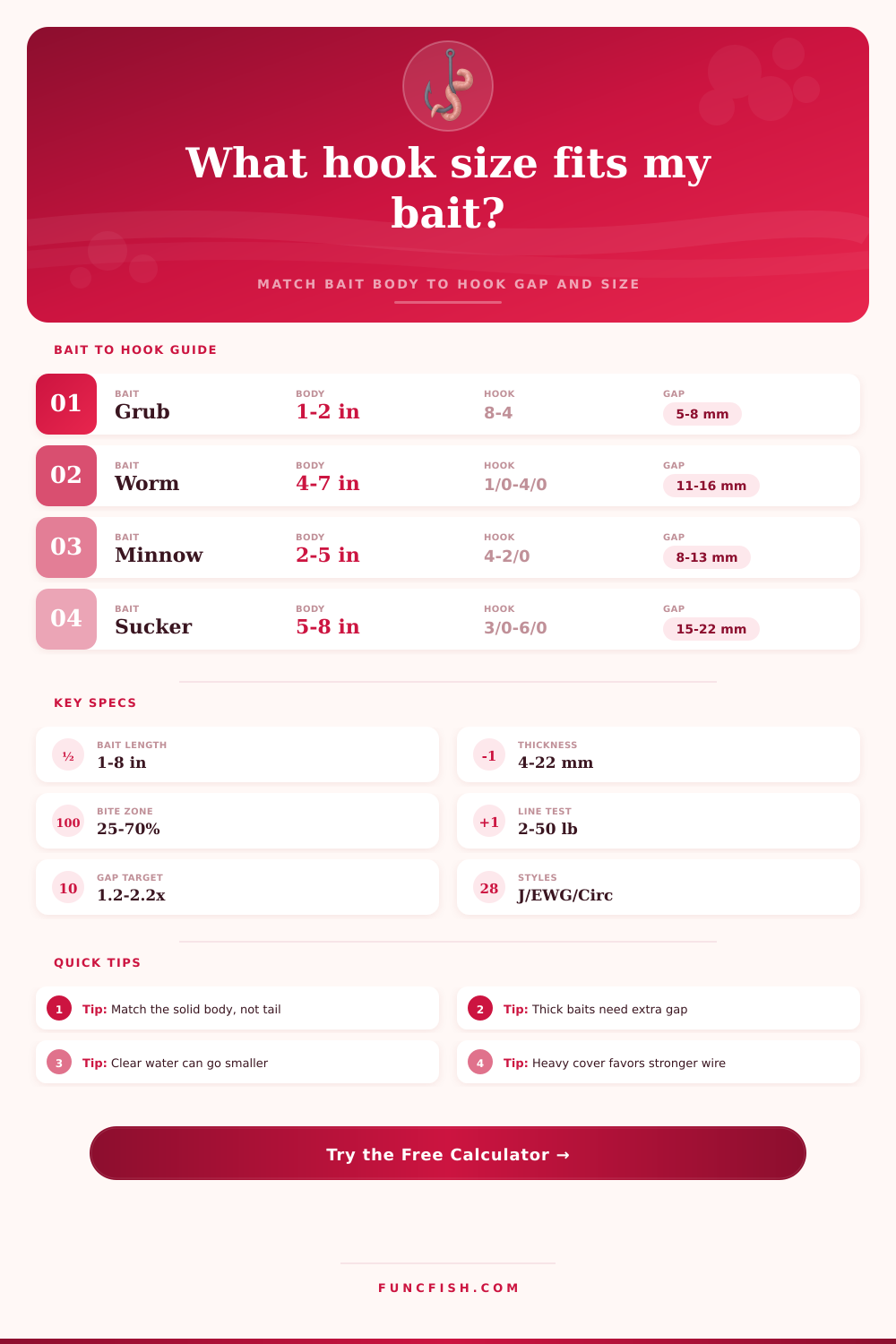
| Micro grub / nymph | 0.75-1.75 in / 19-44 mm | 0.08-0.16 in / 2-4 mm | 10-6 fine J | 5-7 mm |
| Crappie tube / small grub | 1.5-2.5 in / 38-64 mm | 0.14-0.24 in / 4-6 mm | 8-4 jig or J | 6-9 mm |
| Leech / slim worm | 2-4 in / 51-102 mm | 0.14-0.30 in / 4-8 mm | 6-1 octopus | 7-11 mm |
| Stick worm | 4-7 in / 102-178 mm | 0.32-0.56 in / 8-14 mm | 1/0-4/0 EWG | 12-18 mm |
| Creature bait | 3-5 in / 76-127 mm | 0.35-0.70 in / 9-18 mm | 2/0-5/0 EWG | 14-22 mm |
| Minnow | 2-5 in / 51-127 mm | 0.18-0.48 in / 5-12 mm | 4-2/0 octopus | 8-15 mm |
| Cut bait chunk | 2-4 in / 51-102 mm | 0.45-0.95 in / 11-24 mm | 1/0-5/0 circle | 14-24 mm |
| Sucker / large baitfish | 5-9 in / 127-229 mm | 0.55-1.10 in / 14-28 mm | 3/0-8/0 circle or J | 17-28 mm |
| Hook size | Approx gap | Approx length | Useful bait body | Common use |
|---|---|---|---|---|
| 10 | 5 mm / 0.20 in | 10 mm / 0.39 in | tiny nymphs | panfish, trout |
| 8 | 6 mm / 0.24 in | 12 mm / 0.47 in | micro grubs | panfish |
| 6 | 7 mm / 0.28 in | 14 mm / 0.55 in | small worms | trout, crappie |
| 4 | 8 mm / 0.31 in | 16 mm / 0.63 in | leeches | walleye |
| 2 | 9 mm / 0.35 in | 18 mm / 0.71 in | minnows | walleye, bass |
| 1 | 10 mm / 0.39 in | 20 mm / 0.79 in | large leeches | bass, walleye |
| 1/0 | 11.5 mm / 0.45 in | 23 mm / 0.91 in | small plastics | bass, catfish |
| 2/0 | 13 mm / 0.51 in | 26 mm / 1.02 in | 4 in plastics | bass |
| 3/0 | 14.5 mm / 0.57 in | 29 mm / 1.14 in | 5 in plastics | bass, inshore |
| 4/0 | 16 mm / 0.63 in | 33 mm / 1.30 in | thick worms | bass, pike |
| 5/0 | 18 mm / 0.71 in | 37 mm / 1.46 in | creatures | bass, catfish |
| 6/0 | 20 mm / 0.79 in | 41 mm / 1.61 in | large baits | pike, surf |
| 7/0 | 22 mm / 0.87 in | 46 mm / 1.81 in | big chunks | catfish, surf |
| 8/0 | 24 mm / 0.94 in | 51 mm / 2.01 in | large baitfish | pike, surf |
| Adjustment | Size effect | Gap effect | Why it matters |
|---|---|---|---|
| Clear water | one small lean | slightly tighter | keeps the rig less visible |
| Heavy weeds or wood | one large lean | extra clearance | helps clear plastic and cover |
| Short bites | shorter coverage | neutral gap | keeps point closer to strike zone |
| Hard mouth | stronger wire lean | slightly wider | supports a firmer hookset |
| Thick soft plastics | larger family lean | wide gap | prevents body blocking the point |
| Treble replacement | smaller size lean | compact gap | balances hard-bait action |
💡Calculation checks
Gap check: The calculator compares bait thickness times the clearance multiplier against each hook gap, then adds cover and presentation adjustments.
Length check: The bait coverage result shows how much of the solid bait body the recommended hook occupies before the point exits.
Choosing an hook for your piece of bait require that you consider the size of the bait and the size of the hook. If the hook is too small, the point of the hook may be buried within the bait. If the hook is too large, the point of the hook may be too far outside of the bait.
If the point of the hook is within the bait, the fish may spit the bait before the hook can engage with the fishs mouth. If the point of the hook is too far outside of the bait, the fish may not be able to properly inhale the bait to consume it. To properly measure the bait, you must consider two measurement.
How to Pick the Right Hook for Your Bait
The first is the solid body length of the bait, which is the portion of the bait that should rest on the shank of the hook. The second is the thickest cross section of the bait, which the bend of the hook must clear. Once you have determine these two measurements for your bait, you can determine how the hook will work with that specific type of bait.
Furthermore, additional consideration of the way that you will rig the bait, the way the fish will strike at the bait, and the amount of cover that is present in the area that you are fishing will allow you to make an even better decision about which hook to use. The way that you present the bait will impact the type of hook that you should use when you are fishing for those specific types of fish. For instance, if you are nose-hooking a minnow, you will want to use a hook with a shorter shank.
If, however, you are threading the minnow up the back of the fish, you will want to use a hook with a longer shank. Additionally, if you are using Texas rig for your bait, you will need to ensure that your hook point can push through the plastic of the bait to hook the fish. The type of cover that is present in the water and the clarity of the water will also impact the type of hook that you should use.
For instance, if there is heavy cover in the area in which you are fishing, you will need a hook with a wider gap and wire strength so that the hook is able to push through the cover. Clear water allows fish to see the bait more easy, so smaller hooks will look less suspicious to the fish. You can enter these factors into the calculator so that the calculator can provide you with a recommendation for hook size based off the cover and water clarity.
The line test that you are using will also impact the type of hook that you should use. For instance, if you are using a heavy line, you can use a larger hook with thicker wire. However, if you are using a lighter line, you will not want to use a large hook with thick wire, as it will appear clumsy on the line.
The strike style of the fish that you are targeting will also impact the type of hook that you use. For instance, if the fish utilize short bites, you will want to use a hook where the point of the hook is within the bait to ensure that the fish cannot spit at the bait. If, however, the fish engage in engulfing bite, you can use a longer shank to the hook.
Additionally, if the species that you are targeting has hard mouth, you will also want to ensure the hook has extra wire strength to hook the species. The reference tables include information about the solid body length of the bait and the thickest cross section of the bait. These tables is helpful if you are changing from one type of bait to another, such as from a four-inch stick worm to a live sucker.
These tables include information about the different size of hooks and there range of gaps and shank length. You can use these measurements in the calculator to provide you with a recommendation for hook size. The goal is to find a hook where the point of the hook clears the bait, the shank of the hook supports the body of the bait, and the wire of the hook is of a strength that can handle the species of fish that are in the water.
By ensuring that the point of the hook clears the bait, that the shank supports the body of the bait, and that the wire match the pressure of the fish in the water, you will have more predictably in the results of your cast.