Hooklength Diameter To Hook Size Calculator
Match hooklength diameter to hook size, gape, wire strength, bait width, and mainline balance for coarse, carp, predator, fly, and light sea rigs.
🐟Real Rig Presets
⚙Hooklength Inputs
Hooklength Match Results
📏Material Strength Data
🧵Diameter To Hook Size Reference
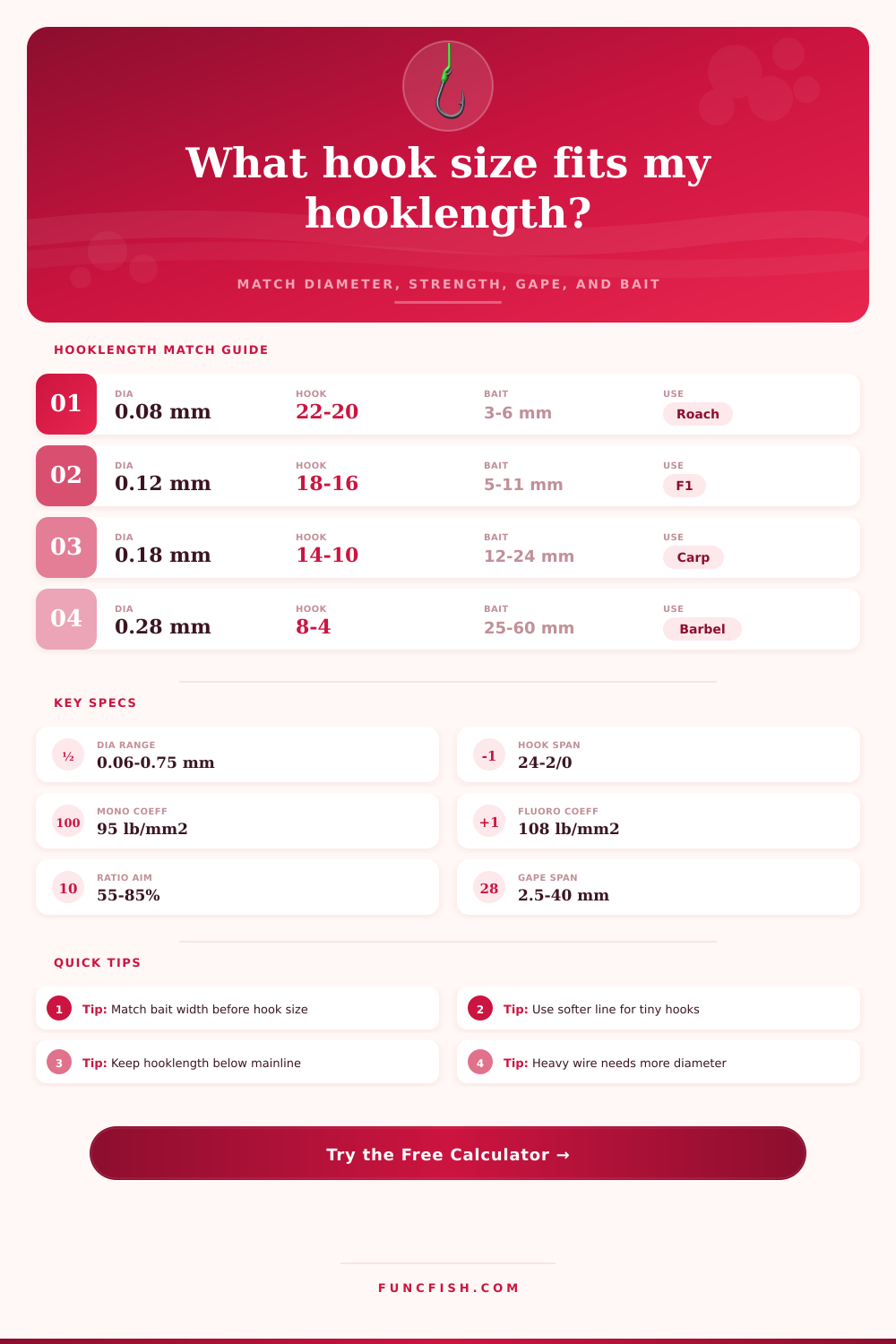
| Hooklength diameter | Usual hook size | Typical bait width | Typical use |
|---|---|---|---|
| 0.06 to 0.08 mm | #24 to #22 | 2 to 4 mm | Punch crumb, bloodworm, tiny fly |
| 0.08 to 0.10 mm | #22 to #20 | 3 to 6 mm | Canal roach, dace, squatt |
| 0.10 to 0.13 mm | #20 to #18 | 4 to 8 mm | Roach, skimmers, small pinkie |
| 0.12 to 0.15 mm | #18 to #16 | 7 to 11 mm | F1, pellet waggler, small corn |
| 0.14 to 0.18 mm | #16 to #14 | 9 to 14 mm | Chub, tench, commercial silvers |
| 0.16 to 0.22 mm | #14 to #12 | 12 to 18 mm | Pellet, corn, maggot bunch |
| 0.18 to 0.25 mm | #12 to #10 | 15 to 24 mm | Method feeder and small carp |
| 0.22 to 0.30 mm | #10 to #8 | 20 to 32 mm | Carp, tench, feeder work |
| 0.26 to 0.35 mm | #8 to #6 | 28 to 45 mm | Barbel, heavy carp, meat |
| 0.30 to 0.42 mm | #6 to #4 | 35 to 60 mm | Big pellet, boilie, deadbait strip |
| 0.35 to 0.50 mm | #4 to #2 | 50 to 80 mm | Large bait, snag work, light pike |
| 0.45 to 0.75 mm | #1 to 2/0 | 70 to 140 mm | Wire trace, sea, predator bait |
🎣Species And Technique Grid
| Species or rig | Diameter band | Hook size band | Balance note |
|---|---|---|---|
| Canal roach and dace | 0.07 to 0.10 mm | #24 to #20 | Prioritise fine wire and soft mono |
| Skimmer bream pole rig | 0.09 to 0.13 mm | #20 to #16 | Small gape, light bait, controlled elastic |
| F1 pellet waggler | 0.12 to 0.16 mm | #18 to #14 | Hook must hold pellet without overpowering line |
| River chub | 0.14 to 0.22 mm | #16 to #10 | Increase diameter when flow pins the rig |
| Carp method feeder | 0.18 to 0.28 mm | #12 to #8 | Short hooklengths need stronger knots |
| Tench near weed | 0.20 to 0.32 mm | #12 to #6 | Use abrasion margin and a wider gape |
| Barbel fast river | 0.25 to 0.35 mm | #10 to #6 | Flow pressure favours stronger wire hooks |
| Pike deadbait trace | 0.36 to 0.60 mm | #6 to #1/0 | Wire diameter and bait size dominate |
| Fly trout tippet | 0.10 to 0.18 mm | #20 to #12 | Fly width should be the hook-size driver |
| Surf whiting and light sea | 0.18 to 0.35 mm | #10 to #4 | Saltwater abrasion pushes sizes upward |
⚖Hook Pattern Comparison
| Hook pattern | Best diameter match | Wire behaviour | Calculator adjustment |
|---|---|---|---|
| Fine wire spade-end | 0.06 to 0.14 mm | Penetrates easily, bends sooner | Scores lighter hooks and small baits higher |
| Standard eyed hook | 0.10 to 0.24 mm | General balance for mono or fluoro | Neutral adjustment across most coarse rigs |
| Wide gape pellet hook | 0.12 to 0.28 mm | Holds pellet, corn, and hair rigs well | Adds gape value for round baits |
| Strong carp hook | 0.18 to 0.35 mm | Resists straightening under pressure | Favours larger hooks and stronger hooklinks |
| Circle or light sea hook | 0.18 to 0.45 mm | Needs open gape for corner-hooking | Raises minimum gape requirement |
| Predator treble | 0.30 to 0.75 mm | Wire trace, bait spread, and gape control | Scores bait size and material strength heavily |
📊Mainline Ratio Reference
| Hooklength strength ratio | Meaning | Best use | Adjustment |
|---|---|---|---|
| Under 45% | Very light hooklength | Clear water, small hooks, cautious bites | Check for break-offs on heavy fish |
| 45% to 65% | Delicate but practical | Roach, skimmers, F1s, flies | Good when hooklength is sacrificial |
| 65% to 85% | Balanced strength | Most feeder, waggler, and commercial rigs | Preferred general-purpose band |
| 85% to 100% | Near-mainline strength | Snags, weed, barbel, light sea | Use only with sound knots and drag setting |
| Over 100% | Hooklength stronger than mainline | Specialist abrasion rigs only | Mainline may become the weakest link |
💡Calculation Tips
Formula notes: monofilament-style breaking strain is estimated as material coefficient × diameter², then reduced by knot efficiency and pressure. Braid and wire coefficients are higher because stated diameters are not directly comparable with nylon.
Every angler have that moment where the line breaks. And there’s always a bit of silence, too, because the hook wasn’t even set up right. You had the knot down pat. Your hook was sharp enough to bleed. But something still broke.
We get so caught up in the details of the pieces that we forget the whole thing work together as a system. A heavy line paired with a fine wire hook looks strong until it sags halfway back during a fish fight, Light tackle outfitted with a thick hooklength makes the very fish you are trying to land skittish.
How to Choose Your Fishing Gear
Plugging in the baits’ dimensions and your line diameter, the above calculator cranks out the numbers for you. It takes the raw values and turns them into a suggestion tailored to your situation. You don’t have to fumble around with all the small trade-offs between strength versus visibility.
But to boil it down to the core: Line size doesn’t live in a vacuum. Its breaking strain is directly related to its makeup. A 0.16mm strand of fluorocarbon hold more weight than a 0.16mm strand of nylon. Because of this, the tool takes into account the type of line (mono, copolymer, stiff fluorocarbon) and then tweaks the estimate accordingly.
It even considers knot efficiency. No knot ever keep 100 percent of the line’s original strength. An improved clinch might give you around 88 percent of the rated strength while a rushed tie or stiffer material could drop that number much lower. That is what makes the reduction so hard to see until it’s too late, and that is when it matters most. So the calculator would of adjust for that as well. Instead of knowing what your line can do in dry conditions, you’ll know what you have in the water.
Hook size is also greatly influenced by how wide the bait is, something that gets overlooked when building rigs. You want enough gape for a tight hookset on things like a big maggot bunch or a stiff pellet where you don’t mask off the point. However, if the bait is wider than what the hook can handle, you’re losing penetration power and your ability to detect bites.
The page contains a chart that pairs common bait sizes/widths per species with diameter bands so you can get an idea if the bait will be too prominent physically for the line you’ll need to use (for penetration) yet still be fairly subtle to avoid spooking wary fish in clear water.
The other factor here is the mainline balance. We all like our hooklengths to be weaker than the mainline but strong enough so if we do tangle up and lose our terminal tackle, the hooklength will break off before the mainline does, hence the sacrificial link. Hooklength is too strong? You may just spin your reel out of control and snap the end of an expensive rod. The tool also checks this against your main input to keep you operating safely.
It’s not about having the strongest line. It’s about making a rig which predictably breaks under the right circumstances.
In practice it all comes down to presentation. In a fast river, the need for power and abrasion resistance is more important than finesse. You can tolerate a less balanced line because this is not delicate work, but upping the hook size and line thickness make sense when dealing with aggressive predators like barbel. On a still water canal where stealth is key, things are reversed: the finessing must take priority over sheer muscle power so you’re willing to sacrifice some balance. The calculator factors those considerations in and recommends accordingly, according to whether you’re going after cautious roach or predatory monsters.
Also consider the wire size. A heavy wire hook require some meaty line to work properly, so it’s a bottleneck when you pair a stout hook with fine line and the line breaks before the hook can set. The tool understands that mismatch and compensates for it in its output. It gets you thinking about the rig as an interconnected system instead of isolated components.
As everything begins working together, fighting becomes controllable versus crazy. You begin believing in your rig instead of cursing your luck, allowing you to focus on the fish without worrying about what might go wrong. The actualy results helps you avoid a bad rig and ensures you recieve better results when fishing with moddern gear.