Hypothermia Survival Time Calculator
Estimate a conservative cold-water exposure window for fishing accidents using water temperature, protective gear, flotation, activity, wind, and likely rescue time.
📌Fishing exposure presets
⚙Cold exposure inputs
Cold-water exposure result
Formula breakdown
🌡Cold-water data grid
Many boating safety references treat water below this level as cold-water exposure.
Gasping and rapid breathing can dominate the first minutes after sudden immersion.
Hands, grip, and swim coordination often fail before deep hypothermia dominates.
Cold water can remove heat several times faster than cold air at the same temperature.
🎣Gear and species comparison grid
Float suit or dry suit for crappie, perch, and bluegill work around early or late ice edges.
Neoprene waders, belt, and life jacket improve survival odds after stream slips near seams.
Life jacket, dry top, and quick re-entry plan matter when chasing prespawn bass from a kayak.
Surf belt, wetsuit layers, and flotation reduce risk when waves flood waders at night.
Cold rain, wet cuffs, and river wind can chill driftboat anglers even without full immersion.
Heavy boots and cotton layers shorten time after a night-bank slide into moving water.
Immersion suit, beacon, and flotation make the biggest difference for tuna or mahi trips.
Float bibs and insulated gloves protect jigging crews from spray, wind, and accidental falls.
📊Reference tables
| Water temperature | Cold shock risk | Useful motion estimate | Conservative planning window |
|---|---|---|---|
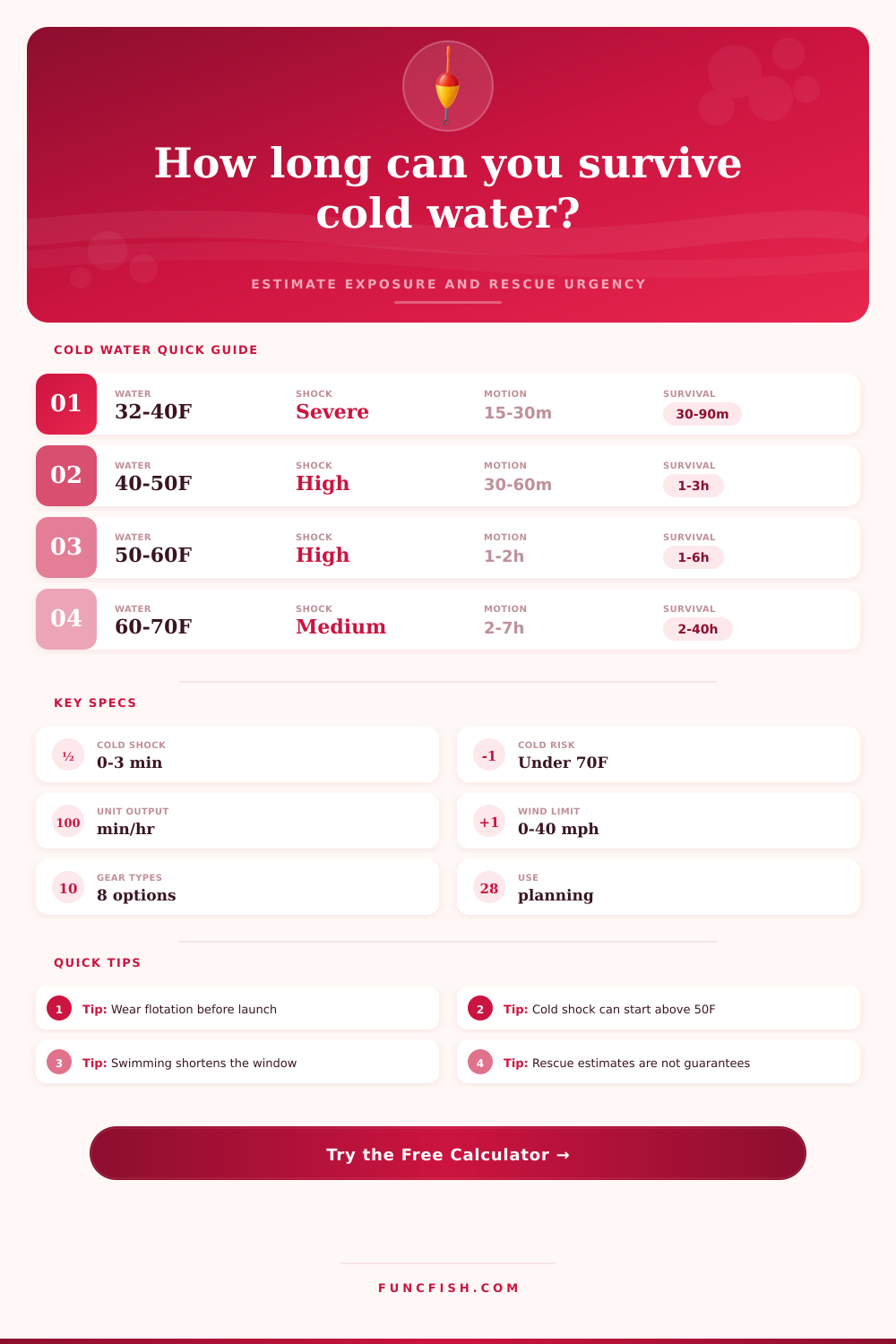
| 32-40°F / 0-4°C | Extreme gasp and breathing risk | Under 15-30 minutes | About 15-90 minutes without strong protection |
| 40-50°F / 4-10°C | Severe cold shock likely | About 30-60 minutes | About 1-3 hours for many unprotected adults |
| 50-60°F / 10-16°C | High shock and swim failure risk | About 1-2 hours | About 1-6 hours depending on gear and flotation |
| 60-70°F / 16-21°C | Moderate shock, fatigue still serious | About 2-7 hours | Wide range; rescue planning still matters |
| Protection choice | Insulation factor | Flotation effect | Best fishing use |
|---|---|---|---|
| Cotton layers, no life jacket | 0.62x | Poor airway support after fatigue | Not suitable for cold-water planning |
| Rain gear plus life jacket | 0.95x | Good float support, limited insulation | Boat anglers near shore in cool rain |
| Neoprene waders, belt, life jacket | 1.22x | Good if belt limits flooding | Trout, salmon, surf, and bank fishing |
| Dry suit with thermal base | 2.25x | Excellent if seals remain intact | Kayak, winter boating, cold rivers |
| Marine immersion suit | 3.80x | Excellent emergency flotation | Offshore and remote cold-water runs |
| Fishing scenario | Typical water | Main failure mode | Calculator adjustment |
|---|---|---|---|
| Ice edge panfish | 32-36°F / 0-2°C | Cold shock, grip loss, failed self-rescue | Full immersion plus ice-surface wind penalty |
| Spring kayak bass | 42-55°F / 6-13°C | Swim failure before reaching shore | Full immersion with PFD and short-swim activity |
| Surf striper wading | 45-58°F / 7-14°C | Flooded waders, waves, and exhaustion | Wader-flood scenario with movement penalty |
| Cold rain boat fishing | 50-65°F / 10-18°C | Wet clothing, wind chill, slow cooling | Rain and spray scenario with air/wind weight |
| Activity after entry | Heat-loss effect | Best use | Warning sign |
|---|---|---|---|
| HELP posture or floating still | Slower cooling than active swimming | Waiting for nearby rescue while wearing flotation | Shivering stops or speech gets confused |
| Short planned swim | Faster cooling but may end exposure | Close boat, dock, ice edge, or bank in sight | Hands fail to grip or kick rhythm breaks |
| Hard swimming or current | Much faster fatigue and heat loss | Only when staying put is more dangerous | Breathing cannot settle after the first minute |
| Repeated climb attempts | High fatigue with wet clothing | Use once or twice, then conserve heat and signal | Arms cannot pull chest above edge or gunwale |
💡Calculation tips
The reality of losing body heat to water doesn’t require a docu team to drive that point home. A slip off the bank in late April will be enough on most occasions to get things started. Even though it’s a nice crisp day and air feels good, the water will remain cold well past when ice has melted. It’s this difference in temperatures that becomes dangerous.
While you can look to the sky and note if there is sunlight or not, that isn’t as important as knowing how much time you have against hypothermia. Once you’re in the water there’s no hiding and you won’t block wind with your jacket.
Why Cold Water Is Dangerous
So don’t worry about converting between units or messing with any coefficients, the calculator will take care of it for you based off your set of conditions, gear, and scenario. You should of know, however, how heat is removed from your body prior to entering these values into the calculator. Air removes heat from you approximately 4x slower than cold water of equal temperatures. That’s why it’s so much worse to be wet in fifty degree water then it is to stand in air when it’s also fifty degrees out.
Water removes both insulation from your skin and your clothing, which quickly robs your body of its heat protection. Water temperature is huge, and most guys thinks about it. But what happens if you don’t have the right gear? I know that’s a big topic. Until it’s too late, most people don’t even think about gear coefficient.
That’s why cotton sucks so much. It doesn’t insulate at all when it’s wet and it hold water next to your skin. A life vest will help you float, but if you are shivering in a t-shirt under there, it won’t keep you from cooling off. The tool takes care of that by factoring dry suits and neoprene waders into the survivable window. It adjusts based on whether you has something keeping you warm or if you only have rain gear on.
People often make this mistake. They buy their boat first and then go out and try to figure out what to wear. Depending on the layering you choose, it will either increase your window time by several hours or reduce it to just minutes.
Finally there’s cold shock, which is separate from hypothermia. Within minutes, your body kicks into fight or flight mode as you panic, start gasping, hyperventilate and so on. At this point you’re not even all that cold inside. But this reaction can kill a strong swimmer if they thinks they can power through.
The shock response is calculated separately from the long term survival response because they call for different actions. To deal with shock, breathe deeply and stay relaxed. To survive, wait it out and conserve heat. Merging these two doesn’t work well at all.
If you believe you’ll get yourself back to land by swimming hard, you’ll burn off heat and increase your rate of cooling (because all that moving pump warm blood to your limbs). Activity level after entry is what matters. Once you’re in the water, burning through your body’s thermal reserves happens fast if you’re fighting current or treading water.
To conserve core heat and reduce your exposed surface area, remain still and use the HELP position. Although it seems counterintuitive, movement kill faster than cold in many cases. The reference table on the page illustrates this. As water temperature decreases, the window for “useful” motion decreases until at near-freezing temperatures, it shrinks to just fifteen-to-thirty minutes.
After that time, your fitness level doesn’t matter; you’re drifting into unconsciousness. The last variable, which brings all of this down to earth, is rescue timing. Maybe you’ve got hours to live, but are only minutes from being rescued. And then what happens? In wind, getting out becomes even more difficult. Falling into water will chill you faster.
Cold clothes also become more uncomfortable and are less likely to be worn as you attempt to return to the ice or boat. Enter your best guess at rescue time and let the tool compare how much time you’ve got vs. How long you could survive before exiting. If those don’t line up, it’s time for better gear or a safer safety net.
Your fishing record doesn’t matter. Your confidence won’t matter. Cold water doesn’t care about what matters to you. It is all biology and physics. Prepping for the worst case is what keeps you alive when it comes down to it. Knowing how much room you have to work with lets you be relaxed in the moment. Enjoy the bite on the end of your line, enjoy the cast and enjoy the quiet morning.