
The biggest mistake most new koi keepers make is buying a tiny decorative bowl. They purchase a few fish and put them into small bowl thinking that if it’s small they’ll stay small. That doesn’t work in nature. Koi are big carp, which grow according to available space when water conditions support growth. Know this from the start. Not only does it save money, but it saves on algae and keeps your fish healthy too.
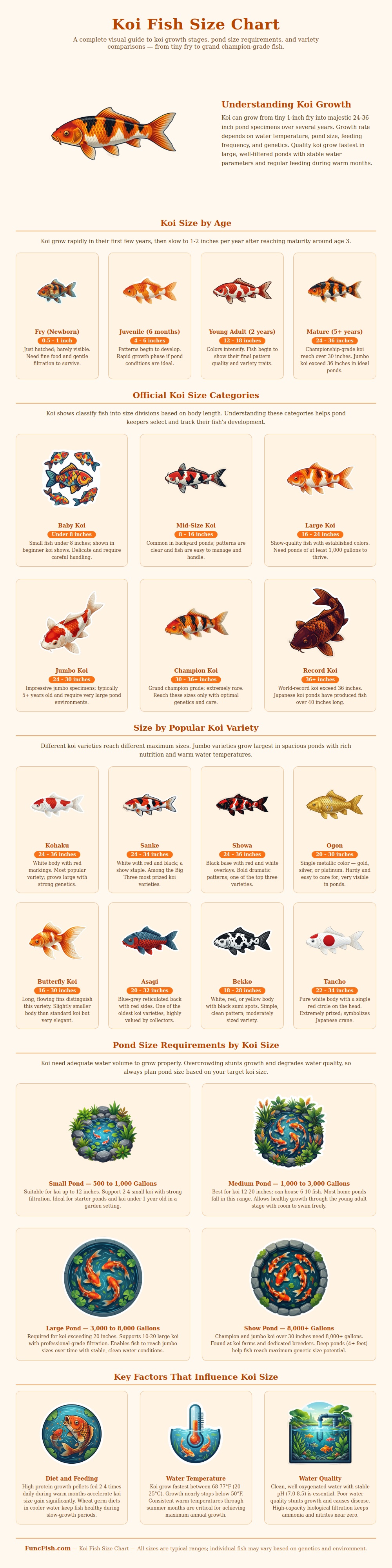
The guide up top illustrates how much room these animals require at all stages of development. Knowing that lets you know what size pond to build so you don’t go overboard buying young fish.
How Koi Fish Grow and What You Need to Know
Newborns is very small and require very clean water. Gentle filtration that removes toxins without harming newborns work best. A controlled environment are good for newborns. After the first year, they get much bigger faster. If you feed them high protein foods and have warm water, they will double or even triple in size within just a few months. This rapid growth cause overcrowding in backyard ponds.
You purchase five little fish as a decoration. They grow fast and become big creatures requiring more space in just a few months by winter. By age two, changes are occurring in development. Growth slows dramatically, patterns and colors take center stage and this is where you determine the real koi quality. A Sanke with sharp black contrast or a Kohaku with vivid red markings looks very different at ten inches than twenty inches. Those transitions from juvenile to adult can be seen on the chart.
Quality advances with age. Body shape hardens, scale brightness increases, and thicker skin is acquire. It’s not all about size. Koi are not all the same. Some varieties reach different sizes. The traditional tri-color koi doesn’t always reach the same size as metallic Ogon or Butterfly variety. Butterfly koi will be more delicate in terms of body mass since they invest their energy into their fins (which appear nice) rather than bulk. It’s a choice, you’re willing to sacrifice some bulk for something else (looks). Standard scaled koi go big; long finned koi won’t get quite as big but are more graceful (they is visually appealing in another way).
Limiting Size Pond size also limits growth potential. The environment doesn’t let you force a fish to be bigger than it can get. For example, a few small koi does very well in a thousand gallon pond, but larger fish won’t reach their full size. Small amounts of water don’t take long to degrade with accumulation of waste products. In small ponds, ammonia levels rises quite often. Temperature and chemistry stabilize naturaly within a large pond holding several thousand gallons. Waste is easily diluted and the biological filter do its job without breaking down. The result is the ability of fish to live into their 20s, rather than die from disease and/or stress at an earlier age.
Feed is one of the main factors in growth. In warmer water, high protein food will fuel fast growth; in colder water below sixty degrees, slower digestion occurs and it’s harder to digest heavy food. It does more bad than good if you feed heavily in the cold water since it takes longer for your fish to digest. To protect their internal organs, stop feeding completely or switch to light food once the water cools. Remember, learn this time sequence.
Raising koi takes some planning and patience. They grow bigger than you expect. They need space to grow, good water quality to thrive, and maintenance to stay beautiful. Meeting these requirements from day one prevents common errors such as overpopulation and poor fish health. Instead, you establish an environment that fosters health in all of the koi, allows each individual fish room to move around freely, and helps it reach its full potential.
For the hobbyist, watching a tiny fry become a big adult is a fulfilling experience. It’s not easy; you should of plan ahead. But the reward is having an active livivng display for many years.