Leader Diameter Step Down Ratio Calculator
Build a cleaner leader taper by matching butt diameter, tip diameter, material stiffness, knot bulk, and step count before you tie the rig.
📌Rig presets
⚙Leader taper inputs
Leader taper results
Formula breakdown
📋Material tolerance grid
Nylon Mono
Soft Copolymer
Hard Mono Butt
Fluorocarbon
Hybrid Leader
Furled Butt
Coated Wire
Single Wire
📏Leader taper reference tables
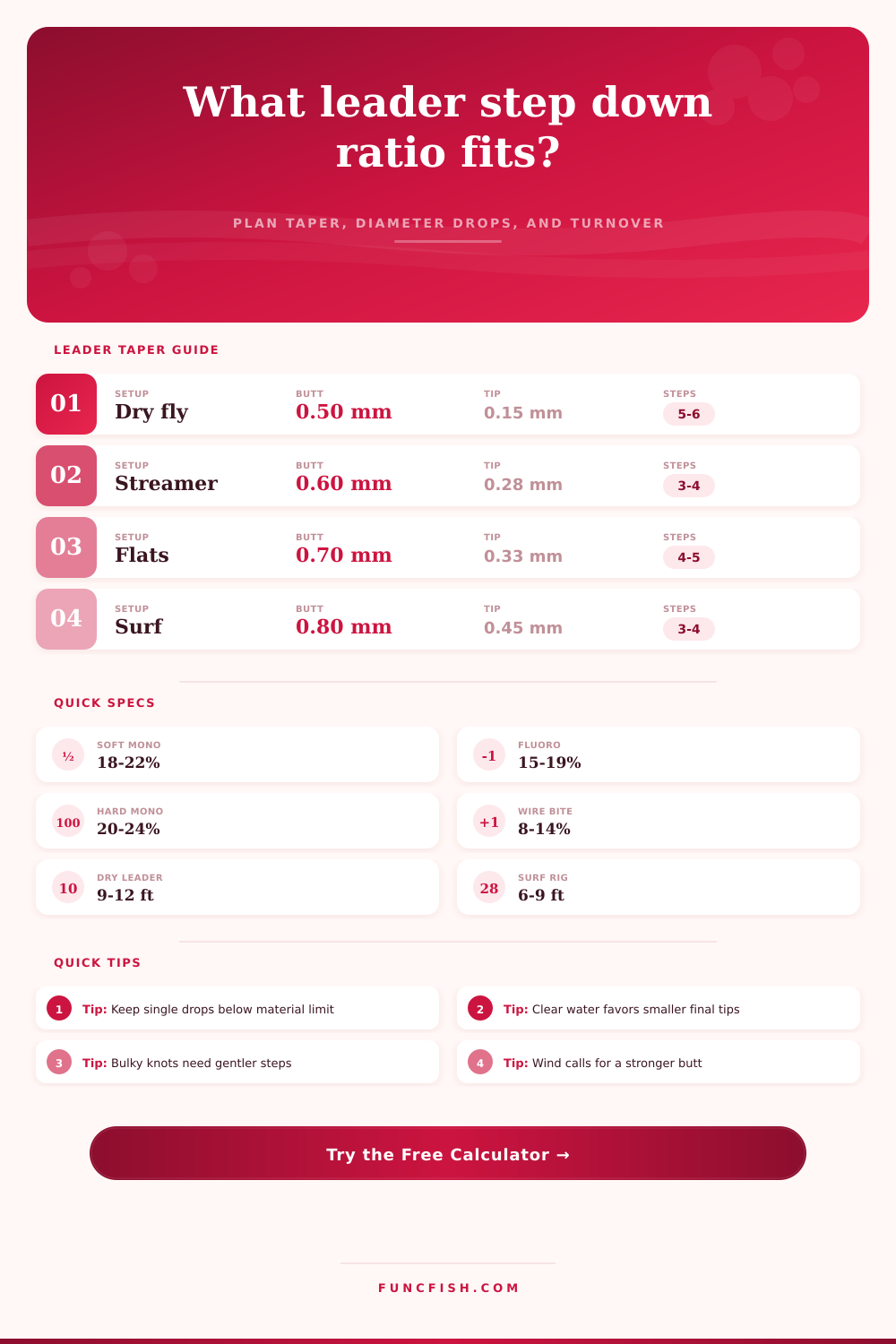
| Fishing setup | Common butt diameter | Common tip diameter | Typical step count |
|---|---|---|---|
| Dry fly trout leader | 0.019-0.022 in / 0.48-0.56 mm | 0.005-0.007 in / 0.13-0.18 mm | 5-7 taper steps |
| Indicator nymph leader | 0.020-0.024 in / 0.51-0.61 mm | 0.007-0.009 in / 0.18-0.23 mm | 4-6 taper steps |
| Streamer leader | 0.022-0.028 in / 0.56-0.71 mm | 0.010-0.014 in / 0.25-0.36 mm | 3-4 taper steps |
| Bass bug leader | 0.024-0.030 in / 0.61-0.76 mm | 0.012-0.018 in / 0.30-0.46 mm | 3-5 taper steps |
| Pike bite section | 0.028-0.034 in / 0.71-0.86 mm | 0.014-0.020 in / 0.36-0.51 mm | 2-4 taper steps plus bite wire |
| Flats sight leader | 0.026-0.032 in / 0.66-0.81 mm | 0.012-0.017 in / 0.30-0.43 mm | 4-5 taper steps |
| Surf shock leader | 0.030-0.040 in / 0.76-1.02 mm | 0.018-0.025 in / 0.46-0.64 mm | 3-4 taper steps |
| Connection style | Diameter drop behavior | Best taper use | Calculator adjustment |
|---|---|---|---|
| Blood knot taper | Slim barrel with even pull | Mono or fluoro leaders with close diameters | Allows the baseline drop limit |
| Triple surgeon taper | Fast knot with more tag bulk | Cold hands, night work, and short rigs | Reduces the limit by 2 percentage points |
| Loop-to-loop section | Hinges more than a tied step | Removable sink tips or prebuilt tippets | Reduces the limit by 4 percentage points |
| Micro swivel break | Stops twist and creates a hard transition | Nymph, float, and bait leaders | Reduces the limit by 3 percentage points |
| Bite tippet transition | Must protect against tooth abrasion | Pike, bluefish, muskie, and mackerel | Reduces the limit by 5 percentage points |
| Material | Relative stiffness | Visibility behavior | Step-down note |
|---|---|---|---|
| Nylon monofilament | Medium | Moderate in clear water | Forgiving enough for normal fly and bait tapers |
| Soft copolymer mono | Low | Moderate with good knot seating | Accepts gentle multi-step dry-fly tapers |
| Hard mono butt | High | More visible but strong turnover | Useful for wind, bugs, and saltwater butt sections |
| Fluorocarbon | Medium-high | Lower visibility under water | Keep drops smaller because the material is denser |
| Coated wire | Very high | Visible bite protection | Use short steps and avoid sharp diameter jumps |
| Single strand wire | Very high | Highly visible but tooth resistant | Plan the mono-to-wire transition separately |
| Nominal diameter | Metric diameter | Typical role | Common taper position |
|---|---|---|---|
| 0.005 in | 0.13 mm | Fine trout tippet | Final clear-water tip |
| 0.007 in | 0.18 mm | General trout tippet | Tip or final mid step |
| 0.010 in | 0.25 mm | Streamer or light bass tip | Heavy tip section |
| 0.014 in | 0.36 mm | Bass, carp, or light salt | Mid or terminal section |
| 0.020 in | 0.51 mm | Trout leader butt | Butt section start |
| 0.028 in | 0.71 mm | Bass bug or salt butt | Power butt start |
| 0.036 in | 0.91 mm | Surf shock leader | Shock or abrasion butt |
💡Taper checks
Tip: If the calculated single-step drop exceeds the material limit, add one more section or start with a slightly smaller butt diameter.
Tip: For flies or lures that push air, protect turnover by keeping a stronger butt-to-mid section and tapering later.
A dry fly leader laying on surface like a wet noodle might drive you nuts. Likewise, a leader snapping in two because knot between two different diameters couldn’t stand the strain would be just as bad. You spend hours mastering retrieves, learning entomology, and perfecting casts. Then, a single mechanical fact ruin the whole presentation. Your energy goes into water via the leader, and if that translation is jagged, fish feel it. It must be more than just strong; it must be smoothly strong.
How does energy travel from rod tip down the line and out into the tippet? Again, calculator will run numbers for you (above), but knowing what they mean will change your rig tying according to. The key is step-down ratio, or amount by which you reduce your line size from one section to next. Going from a heavy butt section to a light tippet in just a couple steps creates weak link that won’t hold up when pressured, while the visual oddness has potential to spook a wary fish. Knowing that tool does the geometry for you (so you don’t need to break out your protractor) lets you concentrate on whether that taper make sense based off the situation.
How to Tie a Smooth Leader
The material selection are important, which many angler do not fully consider. Because fluorocarbon is stiff and dense, it does not flex well on a small radius like a knot. Force a big diameter drop in fluoro, and your knot is probably cutting into line or slipping over time. Nylon is forgiving, but nylon stretches, and that can throw off the turn over if your leader is too thin or too long at wrong spot along the leader. The page include a reference table that shows how much each material can be tapered. Respect the physics of the fiber you are working with. A soft mono bends easy so a nice gentle slope will work, whereas hard mono want a more gradual change to avoid sudden stress on connection points.
Another thing that kills leader performance is knot selection. Blood knots look great, but they don’t do so hot if diameters aren’t close. When you’re bridging a big difference, you end up with a clunky lump for a knot, which realy throws off the line’s flow. Surgeon’s knots are stronger, quicker, and work pretty much any size combination; but those tag ends mess with aerodynamic properties of leader. Because a knotted connection essentially truncates the leader’s functional length, and introduces a hard stop into the taper, the calculator account for your knot choice. And again, that little detail makes all the difference between a smooth-turning fly and one crashing into surface tension.
Consider that there’s another phase to the leader, the part you often don’t see. This is the turnover phase, where the leader uncoils itself and lays flat on water after it leaves your rod. Too-light butt sections won’t open up in the wind, too-heavy mid-sections will make the fly dive below its intended depth. An optimal taper find that balance between those two forces, pushing the line with the butt while presenting the fly naturaly with the skill of the tip. That’s where number of steps gets important. The more steps, the smoother, more continuous taper. And that’s good for clear water; spooky fish. Fewer steps means a stiffer leader; it can punches through deep current or heavy cover. You’ve got to consider what environment requires.
This is the butt section. All of that changes with wind. To push a leader through heavy air require a thicker butt section with more diameter at the start and perhaps fewer steps to hold it together. On the other hand, when faced with calm clear water, lightness and stealth become priorities. Smaller tips and softer transitions are what is needed in those conditions. With the calculator you can see all of that without ever touching a spool. Given the environment and material limits you choose, it will illustrate whether or not your concept of design is theoreticaly possible.
The whole point is to smoothly transfer energy from line to fly. When leader is built correctly, fish feels nothing but tug of the fly. Then there is no knot, there is no material, and presentation appears natural. There is a difference between a darting alarmed fish and one that doesn’t hesitate to take the offering. The quiet work of getting step-down ratio correct is what allows rest of the fishing experience to occur.