Leader to Mainline Ratio Calculator
Compare leader strength, mainline strength, diameter mismatch, leader length, drag setting, water clarity, and cover to build a balanced fishing line system.
📌Scenario presets
⚙Line system inputs
Leader to mainline analysis
Full breakdown
📋Line material reference grid
8 Carrier Braid
Fluorocarbon
Monofilament
Wire Leader
📏Ratio and length reference tables
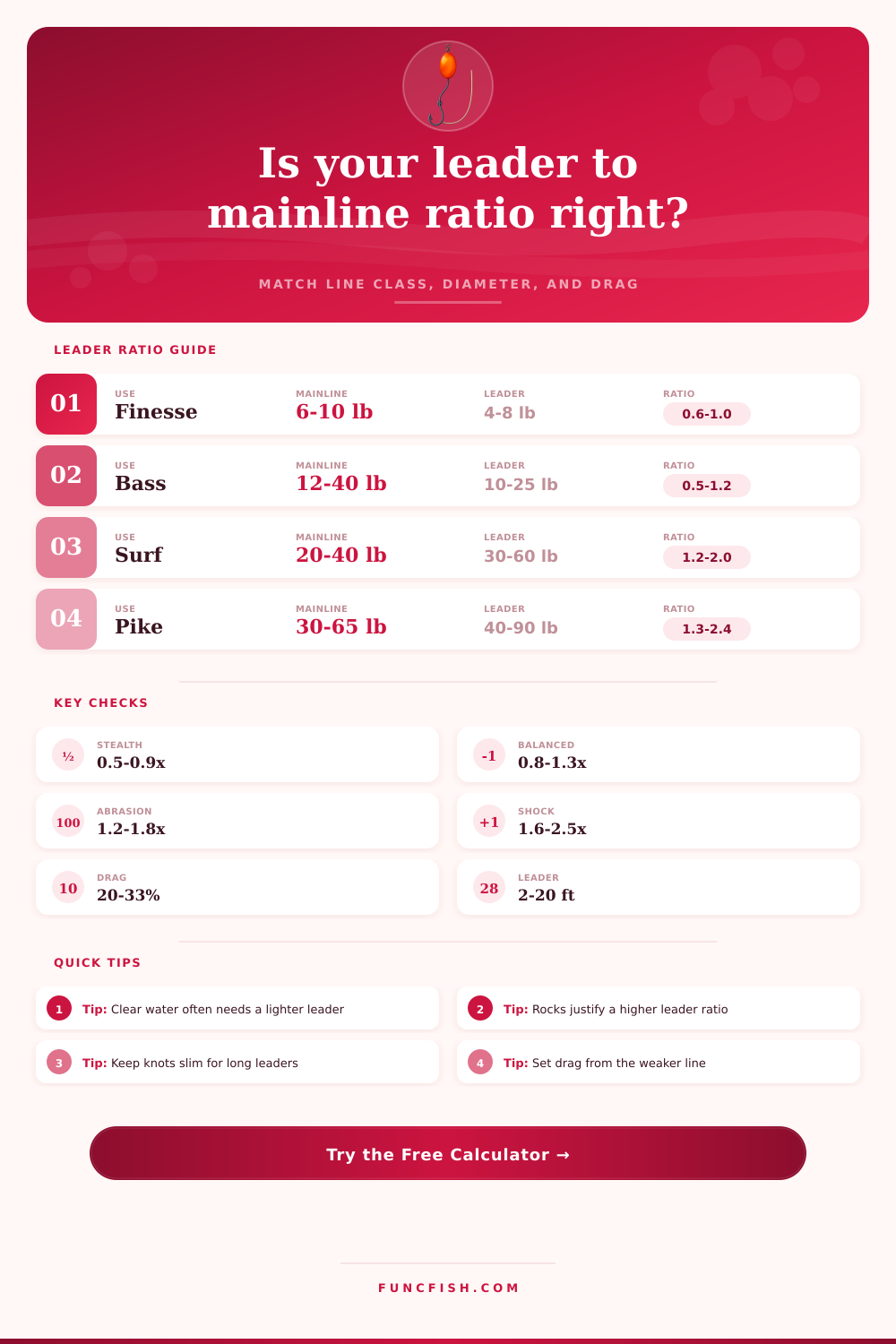
| Fishing scenario | Mainline range | Leader range | Target ratio |
|---|---|---|---|
| Clear finesse bass | 8-15 lb braid | 6-10 lb fluoro | 0.55-0.95 |
| Grass largemouth | 30-50 lb braid | 15-25 lb fluoro | 0.45-0.85 |
| Trout stream | 4-8 lb mainline | 3-6 lb tippet | 0.55-0.90 |
| Walleye jigging | 8-15 lb braid | 8-12 lb fluoro | 0.75-1.25 |
| Surf shock leader | 20-40 lb braid | 40-60 lb mono | 1.50-2.60 |
| Catfish rocks | 30-65 lb braid | 30-60 lb mono | 0.85-1.50 |
| Pike casting | 30-65 lb braid | 40-90 lb wire | 1.25-2.40 |
| Offshore topshot | 50-100 lb braid | 60-130 lb mono | 1.10-1.80 |
| Leader length | Best use | Knot concern | Typical adjustment |
|---|---|---|---|
| 1-3 ft / 0.3-0.9 m | Heavy cover or teeth | Few guide passes | Raise abrasion ratio |
| 4-8 ft / 1.2-2.4 m | General casting | Needs slim knot | Balanced ratio |
| 9-15 ft / 2.7-4.6 m | Clear water stealth | Guide passage matters | Lower diameter ratio |
| 16-30 ft / 4.9-9.1 m | Surf or topshot | Shock load matters | Use stronger leader |
💡Practical checks
Tip: Use the strength ratio for fight reserve and the diameter ratio for knot behavior. A strong leader that is much thicker than the mainline may need a different connection style.
Tip: If the calculator marks drag as the limiting factor, lower the reel setting before changing line classes. A balanced ratio still fails when drag exceeds knot strength.
Choosing the correct leader to mainline ratio involve understanding the importance of balancing the fishing setup. A well-balanced fishing setup allow a person to cast their line more farther and fight their caught fish more effective. A fishing setup that isnt balance can result in the loss of a caught fish and may result in tangled fishing lines.
To determine the proper ratio of leader to mainline, a person must understand how to balance the strength and the diameter of the lines in that fishing setup. The strength of the lines are one of the main factors to consider when choosing the strength of the leader and the mainline. The leader must be able to stand the pressure of the fish, but it must also be weak enough so that it break before the mainline breaks.
How to Choose the Right Leader and Main Line for Fishing
The strength of the lines can also be affected by the connection of the two lines. Any knot will reduce the strength of the line. For instance, if a knot is eighty percent efficient as a line, then a twenty-pound fishing line will only have sixteen pounds of strength.
Calculators is available online to help fishermen choose the correct leader and mainline to determine the strength of a knot. The diameter of a fishing leader is another factor to consider when choosing fishing equipment, but many fisherman often ignore this factor. For the leader and mainline to work together effective, the diameter of the two lines should be compatible with one another.
Using lines of different diameters than each other will cause the leader to catch on the guides and be more visible to the fish. Environmental factors such as the water clarity and the cover of the water will play a major role in determining the proper thickness of the leader. If the water is clear, fish will be less likely to see a thin leader.
However, thin leaders do have less abrasion resistance then thick leaders. If the water cover is heavy, a thick leader will be able to take the abrasion against cover, but will be more visible to fish swimming through the water. The length of the leader can also have an effect on a fishing setup.
Short leaders will eliminate the number of times the knot pass through the guides, but a longer leader will allow for more shock absorption. Thus, fishermen must determine what is more important to them, shock absorption or the number of times the fishing line pass through the guides. Another factor to consider involves the drag settings of the fishing rod.
Many fishermen set their drag according to the strength of their mainline. However, if they do, their leader may break at the knots. The drag should be set so that the drag is set to a lower strength than the knot’s breaking strength, as the knot is the weakest part of the fishing rod.
Setting the drag to this range will protect the fishing rods connection and prevent the leader from being broken at the knot. By understanding each of these factor, fishermen can adjust their fishing setup to accommodate the type of fishing they will be performing. A finesse fish setup will involve a different type of leader and mainline balance than a surf rod fishing setup.
Similarly, a pike fishing rod will require a different type of leader and mainline balance than a trout fishing tippet. By understanding how these different factors interact with one another, fishermen can create the proper mainline and leader for there fishing scenario. By understanding these variable, fishermen can control their results, because controlling the variables will control the mainline and leader.
You’ll find that more practice helps you recieve better results with alot of different setups.