Light Penetration Depth Calculator
Estimate how far useful light reaches through fishing water from Secchi depth, water color, turbidity, sky conditions, sun angle, and target species preference.
📌Named water presets
⚙Light and clarity inputs
Light penetration estimate
Calculation breakdown
📊Clarity data grid
Ultra-clear lake
Clear lake
Green lake
Muddy river
🔍Species light comparison grid
Bass
Walleye
Crappie
Striped bass
📋Reference tables
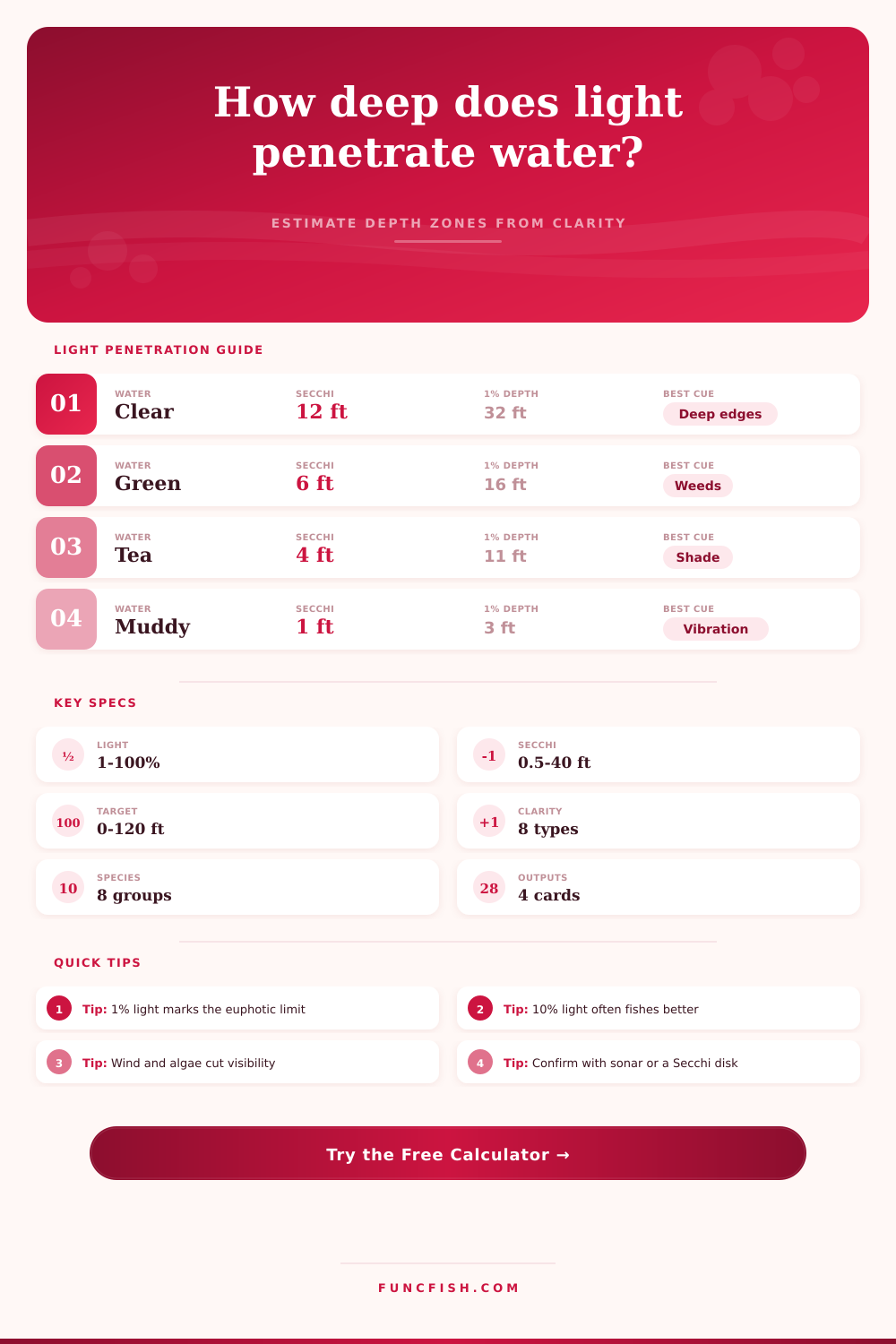
| Clarity class | Typical Secchi | Approx Kd | 1% light depth | Fishing use |
|---|---|---|---|---|
| Ultra-clear lake | 20-45 ft / 6.1-13.7 m | 0.10-0.18 / m | 80-150 ft / 24-46 m | Deep edges, trout, suspended bait |
| Clear natural lake | 8-20 ft / 2.4-6.1 m | 0.18-0.45 / m | 30-80 ft / 9-24 m | Weedline, rock drop, clear-water sight bite |
| Green productive lake | 3-8 ft / 0.9-2.4 m | 0.45-0.90 / m | 12-30 ft / 3.7-9.1 m | Weeds, docks, plankton-stained basin |
| Tea or tannic water | 2-6 ft / 0.6-1.8 m | 0.55-1.20 / m | 10-25 ft / 3.0-7.6 m | Shade edges, dark baits, shallow cover |
| Algae bloom water | 1-4 ft / 0.3-1.2 m | 0.90-1.80 / m | 5-15 ft / 1.5-4.6 m | Upper column, noise, vibration, contrast |
| Muddy river water | 0.3-2 ft / 0.1-0.6 m | 1.80-3.50 / m | 2-8 ft / 0.6-2.4 m | Bank targets, current breaks, scent lanes |
| Light level | Meaning underwater | Depth formula | Fishing interpretation | Presentation match |
|---|---|---|---|---|
| 50% of surface | Bright upper layer | 0.69 / Kd | Good for visual predators but can be spooky | Natural color, speed changes |
| 25% of surface | Moderate light | 1.39 / Kd | Comfortable feeding layer in clear water | Flash, translucent, white |
| 10% of surface | Dim but useful | 2.30 / Kd | Common strike-zone edge for many species | Contrast, vibration, larger profile |
| 1% of surface | Euphotic limit | 4.61 / Kd | Lower edge of meaningful daylight penetration | Vertical, glow, scent, sound |
| Species group | Preferred light lane | Common depth response | Clarity note | Best visibility cue |
|---|---|---|---|---|
| Bass | 8-45% | Move deeper or tighter to shade in bright clear water | Use weedline and dock shade as light filters | Edges, contrast, prey silhouette |
| Walleye | 2-18% | Often feed shallower in stain and lower light | Clear sun can push them to the 10% line | Flash, vibration, slow roll |
| Trout | 10-55% | Hold where cool water and light overlap | Ultra-clear water extends sight distance | Natural drift, small flash |
| Crappie | 6-30% | Suspend near brush, docks, and plankton edges | Stain tightens the vertical strike window | White, chartreuse, glow |
| Catfish | 0.5-10% | Use dim holes, current seams, and scent trails | Light penetration matters less than flow and scent | Scent, vibration, bottom contact |
| Pike or muskie | 12-50% | Use vegetation tops and outside weed edges | Clear water can support long follows | Flash, profile, speed |
| Redfish | 15-60% | Feed high on flats when water remains visible | Mudlines shrink sight lanes quickly | Silhouette, flash, wake |
| Striped bass | 4-25% | Follow bait near the deep light boundary | Use electronics to match bait depth | Flash, vertical profile, speed |
| Color profile | Clear water | Green water | Tea water | Muddy water |
|---|---|---|---|---|
| Natural translucent | Excellent shallow to mid-depth | Fair in top half of euphotic zone | Weak as red and amber fade | Poor beyond a short lane |
| White or pearl | Strong contrast against shadow | Strong in moderate algae stain | Good when backlit near surface | Fair close to fish |
| Chartreuse or firetiger | Visible but can look loud | Excellent in plankton-green water | Good for outline and trigger | Fair with vibration |
| Black silhouette | Good at dawn, dusk, and shade | Good in low light | Very strong silhouette | Strong close-range outline |
| Metal flash | Excellent when sun angle reaches depth | Good through the upper layer | Moderate, short flash cone | Weak unless fish are close |
| UV bright finish | Good deep accent | Good in stained green water | Moderate to good | Fair close-range cue |
💡Calculation tips
Secchi shortcut: If you measured visibility with a disk, the 1% light depth is usually near 2.7 times the Secchi depth before wind, algae, and color corrections.
Fishing shortcut: Treat the 10% depth as a practical search edge, then slide shallower for cover fish or deeper for suspended clear-water fish.
Where do the fish lives in the water? They live where the light is. You witness it when fish moves to deeper structures to hide during a sunny day in clear water.
Light controls all of aquatic life and that changes strike zone. Predators hold in shadows while bait fish suspends in certain zones. Knowing where light goes into the water column matter. It’s not guess work but rather a function of physics and geometry.
How Light Helps You Find Fish
Fortunately there is an easy way to figure it out. Just enter your local conditions into calculator above and let it crunch the numbers for you. No more guessing by feel.
Use a Secchi disk to measure water clarity. As disk descends, you’ll notice the rate at which light fades. If the reading is high then the water is clear. Light penetrates deeply into lake. Striped bass, trout, and other fish goes out deep where they can conceal themselves from predators on structure.
If the reading is low, then the water is muddy. Visibility will be limited to first few feet. When the water’s murky, change your approach to match. Fish seeks out a certain level of light to put them at ease. To reach their comfort zone, they’ll move up and down.
Light is controlled by sky conditions. Upper water layers gets hit with bright sunlight. This shut down visual feeding for most species. They seek shade or cover from the glare.
Overcast skies diffuse the light. Deeper gets good useable light without harsh contrast. Here’s where you can adjust in tool. The tool adjusts for surface intensity first then calculates the drop-off. A cloudy day can makes a six-foot depth feel like twelve feet on a bright day. That moves the whole feeding window.
The rule of light absorption applies to color selection as well. First, the water absorbs red. Often it’s gone in just a few meters. Green and blue penetrates deepest. At depth a red-colored lure might appear black or brown. That won’t entice a bass to bite.
Lures that retain their contrast like white or chartreuse is effective. Against a dark background they remains highly visible. See the reference table for how each color performs in different clarity levels. Use those tables to make your selection.
The light is not equal for all species. Low light is good for walleyes. They will hunt at 10 percent light level. Rod cells help them see their prey.
Bass are visual hunter. They need high light levels to silhouette and find food. Bass hangs out on drop offs or shadow lines. Bass are happy to hide beneath a cover of their choosing. Matching your depth to the species help you find fish that is actualy active, not just present.
Turbidity and algae introduces suspended particles that scatter light, reducing the range of sight. Particles suspended in water restrict your line of sight. A change in weather like rain and wind can alter a fishery overnight.
The calculator factors all that into the equation. It provides an accurrate estimate of what’s visible to the fish within their light limits. The 1 percent limit marks bottom of photosynthetic zone. Below that, 10 percent is more realistic goal for fishing. At this depth, sight feeding become challenging. Below here fish relies more on smell and movement.
Light is used like bait. It’s about knowing sky conditions and clarity to fish certain areas. When you know that, you could of quit blind casting.
Look at the sky before fishing. Notice how clear the water is. Allow light to decide your depth selection. The fish are already there.
Shade is where they hide, not what you can’t see.