Line Retrieve Length Per Crank Calculator
Estimate real line pickup per handle crank from gear ratio, spool fill, line diameter, line out, retrieve load, and handle cadence.
📌Scenario presets
⚙Reel, spool, and line inputs
Line retrieve per crank forecast
Calculation breakdown
🎣Reel pickup comparison grid
Slow Power
Round and trolling reels trade speed for torque, useful with heavy rigs and deep pull.
18-25 intypical per crank
All-Purpose
Mid-size spinning and moderate baitcasters recover slack without over-speeding small lures.
26-32 intypical per crank
Fast Lure
High-speed baitcasters help burn baits, pick up slack, and reset quickly after pitches.
33-39 intypical per crank
Large Spool
Surf and offshore reels can exceed fast freshwater pickup when the spool stays full.
40+ intypical per crank
🧵Line and spool data grid
Mono
Fluoro
Braid
Wire
Lead Core
Level Wind
Cross Wrap
Uneven Lay
📊Reference tables
| Reel family | Common gear range | Filled diameter | Typical retrieve | Fishing fit |
|---|---|---|---|---|
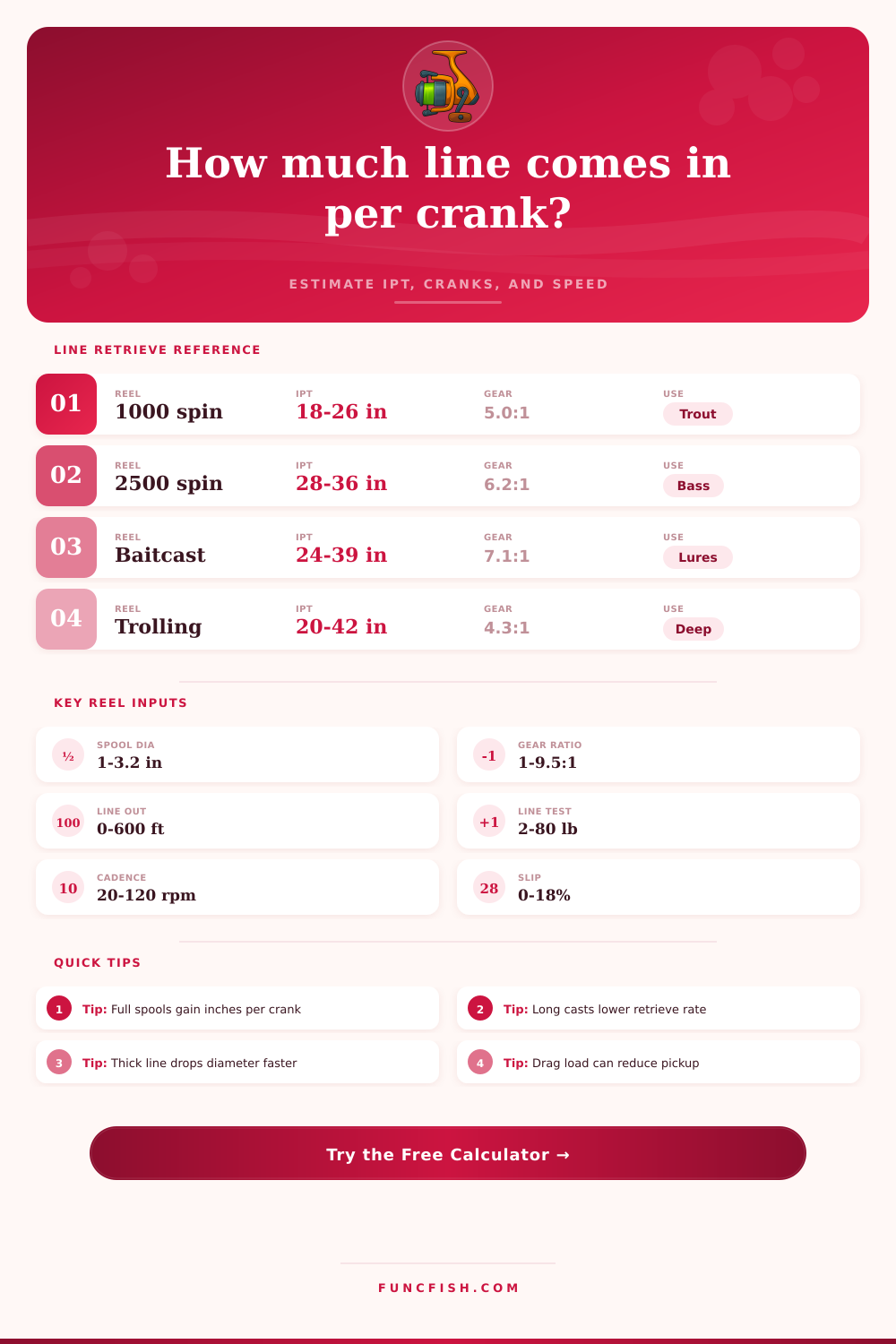
| 1000 spinning reel | 5.0:1 to 6.2:1 | 1.0 to 1.35 in / 2.5 to 3.4 cm | 18 to 26 in / 46 to 66 cm | Trout, panfish, finesse stream work |
| 2500 spinning reel | 5.2:1 to 6.4:1 | 1.35 to 1.75 in / 3.4 to 4.4 cm | 28 to 36 in / 71 to 91 cm | Bass, walleye, light inshore, jigging |
| 4000 spinning reel | 5.0:1 to 6.2:1 | 1.65 to 2.2 in / 4.2 to 5.6 cm | 32 to 44 in / 81 to 112 cm | Inshore, pike, salmon, heavier lures |
| Low-profile baitcaster | 6.3:1 to 9.5:1 | 1.1 to 1.55 in / 2.8 to 3.9 cm | 24 to 39 in / 61 to 99 cm | Bass casting, pitching, spinnerbaits, frogs |
| Round baitcast reel | 4.7:1 to 6.4:1 | 1.35 to 1.9 in / 3.4 to 4.8 cm | 22 to 34 in / 56 to 86 cm | Catfish, swimbaits, pike, heavy cover |
| Conventional reel | 3.8:1 to 6.2:1 | 1.7 to 2.7 in / 4.3 to 6.9 cm | 20 to 42 in / 51 to 107 cm | Trolling, bottom fishing, offshore drops |
| Line material | Typical diameter behavior | Spool-fill effect | Load behavior | Calculation note |
|---|---|---|---|---|
| Monofilament | Medium diameter for its breaking strength | Moderate diameter drop on long casts | Stretch can soften pickup feel | Use label diameter when known for best accuracy |
| Fluorocarbon | Often slightly dense and stiff | Similar to mono at equal test | Contact lures may add steady load | Expect slightly lower effective pickup under pull |
| Braided PE | Thin diameter for breaking strength | Spool diameter drops slowly | Low stretch keeps pickup direct | Thin braid often retrieves closer to catalog IPT |
| Wire | Firm line with set diameter | Layers pack consistently on trolling reels | Load and rod bend reduce real recovery | Use measured diameter whenever possible |
| Lead-core | Large diameter, heavy construction | Spool diameter falls quickly when line is out | Heavy drag lowers effective line speed | Long lines can be far below full-spool IPT |
| Fly line/backing | Large fly line over thin backing | Effective diameter changes dramatically | Usually low gear, direct drive | Set gear ratio to 1.0 for single-action reels |
| Technique | Useful retrieve band | Line-out sensitivity | Why it matters | Adjustment cue |
|---|---|---|---|---|
| Pitching and flipping | 30 to 39 in per crank | Low to moderate | Fast slack recovery after short presentations | Favor high gear and full spool fill |
| Deep crankbait | 21 to 30 in per crank | Moderate | Too much speed can overpower the lure | Use cadence to control bait speed |
| Finesse jigging | 24 to 34 in per crank | Moderate | Slack control without moving bait too far | Watch IPT after long casts |
| Surf plug casting | 35 to 48 in per crank | High | Long casts shrink working spool diameter | Enter actual line out, not rod length |
| Trolling recovery | 18 to 38 in per crank | Very high | Hundreds of feet out can lower pickup strongly | Use line counter values for line out |
| Fly line pickup | 7 to 16 in per turn | Very high | Large arbor changes as loose line returns | Set gear ratio near 1:1 |
| Spool condition | Effective diameter | Retrieve impact | Common cause | Best calculator input |
|---|---|---|---|---|
| Full lip fill | Largest circumference | Highest IPT | Freshly filled reel | Measure outer line diameter |
| Normal fishing fill | Slightly below lip | 3% to 8% lower IPT | Safe casting fill level | Use current visible diameter |
| After long cast | Reduced outer layers | 5% to 22% lower IPT | Lure or rig is far out | Enter line out before retrieve |
| Deep trolling set | Many layers removed | 15% to 40% lower IPT | Long setback or downrigger lead | Use actual line-counter distance |
| Low backing fill | Closer to arbor | Can be dramatically lower | Underfilled spool | Measure full spool and arbor diameter |
💡Retrieve calculation notes
Full-spool labels are optimistic. Catalog retrieve length usually assumes the spool is filled to its working lip. A long cast, trolling setback, or underfilled spool can cut several inches from every crank.
Measure diameter for the cleanest answer. If the line package lists diameter, enter it. If not, this calculator estimates diameter from material and line test, then models how many outer layers are removed by line out.
Knot security and line strength are what most anglers focus on. But what about retrieve speed? Doesn’t seem like a big deal until you’re trying to bring a bass out of heavy cover. Or if you need to pick up some trolling line before it’s too dark. If there is too much slack, you might lose a fish during those critical moments.
With the calculator above, just input your reel specifications and it will do math for you. So now you don’t have to guess at how many cranks it takes. A retrieval rate is listed by the manufacturer under ideal conditions. It is a clean spool, full to the lip with brand new line. In the back of the catalog it sounds good, out on the water it’s another story entirely.
Why Reel Speed Matters Less Than You Think
Each cast loses some line. As that happens, the diameter shrinks, and the next wrap has to be laid down onto it. It’s akin to pouring water into a bucket that keeps narrowing as you do. The key is knowing what a retrieval rate means when fish gets hooked. At 80 feet, your casting distance, you’re no longer reeling from the outside rim of the spool. Now you’re winding to a smaller and smaller cylinder near the arbor. And with each turn of the handle you bring in much less line then stated on the box.
This shrinking geometry also relies heavily on line material. For its strength, braided line is thin. It stacks well and even after long casts, keeps the spool diameter big. Mono is thicker and stretchy. Its layers peel off quickly to lower working diameter sooner. Fluoro is somewhere in between and has some oddities of its own due to stiffness. All of this is laid out in reference table on the page which shows how various materials impact fill rate and slip factor.
Switching from braid to mono, for instance, without accounting for your new expectations means suddenly having to crank double as hard for only half the distance. Load and drag also come into play. Resistance from a lure that’s hanging stationary in a bed of weeds slows your ability to pick up line effectively. Fighting heavy fish can further decrease real-world line recovery by as much as 15% or more. Drag force will slow the perceived action of each handle turn so most folks wrongly believe they’re locked into one gear ratio. Friction and line stretch will soften what you perceive during the fight under pressure. It’s not simply a matter of cranking speed; it’s a matter of handle tension pulling back on you. You can enter expected drag loads into the calculator which tapers the theoretical maximum into something more realistic.
Power isn’t everything. Turning your reel a hundred times per minute might sound cool, but it gets tiring fast and you lose accuracy. You can crank faster when needed, but keeping it dialed in at a solid pace of fifty or sixty turns allow better rod control. It also helps manage lure action. While high-speed reels excel at burning slack, they ask for consistent input which fatigues the arm during extended fishing trips. Conversely, lower gear ratios provide greater torque for large lures; however, they take longer to catch up. The search for speed versus stamina is where most anglers tend to find their own sweet spot.
That’s why knowing your spool size matters. Measure your real spool diameter. Then input it. If you don’t know the true diameter of your filled spool, eyeball it. Or grab a caliper if you have one. That’s the number you’ll enter along with the line out distance. And then the calculator estimates how far you’ll be cranking in order to get there. In other words, how long does it think it will take to crank that much line off? How will you translate the abstract specs into something tangible? Whether bank fishing or trying to make a tournament cut, this helps. Instead of freaking out every time a fish runs, you can now know “Okay, I got about 60-feet of line out; it’s going to take me forty cranks to bring her back.” Now you can pace yourself.
So much of retrieving speed is about covering ground, but more importantly about controlling the lure. Too fast, you won’t get them to follow and the lures don’t run right. Too slow and you have a bunch of slack that builds up. This will cost you on those critical hooksets. Match how your lure runs with what the fish are doing. Combine that with knowing how fast you can pick it up under real conditions. This gives you an edge that makes fishing a game of calculation rather than guesswork.
Geometry fights empty spools and when that’s all you’ve got, the next time you find yourself standing on the bank with fading light and a tangled line, keep this in mind. A full reel isn’t only good for capacity; it’s good for consistency. Measure often, crank wisely. Believe the math rather than the marketing copy. The fish will always fight harder then your best guess, so you better be ready for the reality of what you’re hauling in.