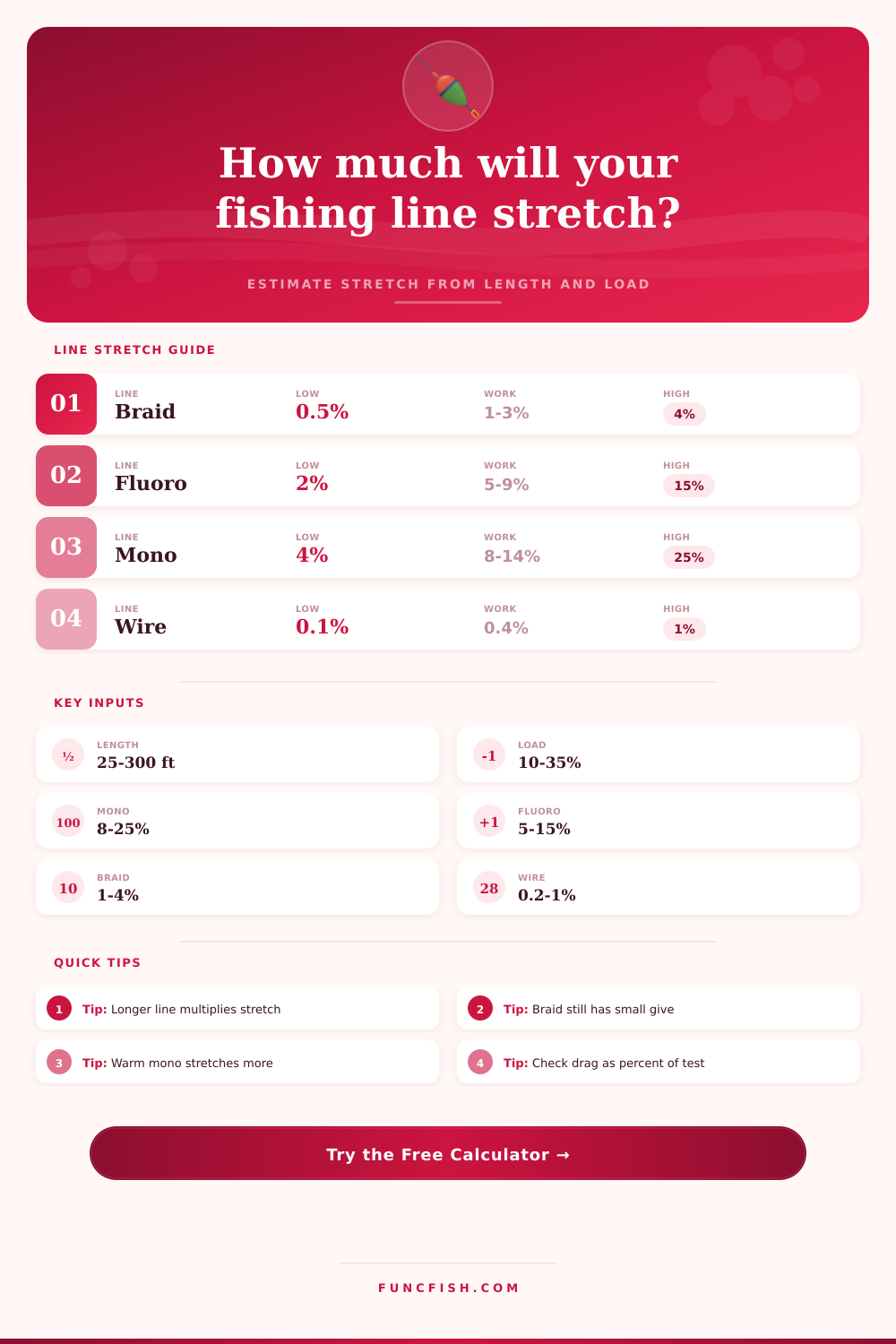
Line Stretch by Length Calculator
Estimate how far fishing line elongates under drag or hookset load based on line length, material, test strength, temperature, and condition.
📌Scenario presets
⚙Line stretch settings
Line stretch estimate
Full breakdown
📋Line material reference grid
Nylon mono
Fluorocarbon
8 carrier braid
Wire leader
📐Stretch reference tables
| Line material | At 15% load | At 25% load | At 40% load | Typical role |
|---|---|---|---|---|
| Nylon monofilament | 5-8% | 8-14% | 14-20% | Shock absorption |
| Copolymer mono | 4-7% | 7-12% | 12-18% | General casting |
| Fluorocarbon | 2-5% | 5-9% | 9-14% | Bottom contact |
| 8 carrier braid | 0.6-1.2% | 1-3% | 2-4% | Direct hooksets |
| Fused superline | 1-2% | 2-4% | 4-7% | Long casts |
| Single strand wire | 0.1-0.2% | 0.2-0.4% | 0.5-1% | Toothy fish |
| Loaded length | 2% stretch | 8% stretch | 14% stretch | What it means |
|---|---|---|---|---|
| 25 ft / 7.6 m | 6 in | 24 in | 42 in | Short pitch |
| 50 ft / 15.2 m | 12 in | 48 in | 84 in | Boat-side cast |
| 100 ft / 30.5 m | 24 in | 96 in | 168 in | Common cast |
| 200 ft / 61.0 m | 48 in | 192 in | 336 in | Long cast |
| 300 ft / 91.4 m | 72 in | 288 in | 504 in | Trolling run |
| Load ratio | Drag use | Stretch behavior | Hookset feel | Calculation note |
|---|---|---|---|---|
| 10-15% of test | Light drag | Low curve zone | Clean but soft | Good for light line |
| 20-30% of test | Normal drag | Working stretch | Balanced response | Most presets land here |
| 35-45% of test | Hard pull | High stretch zone | Delayed on mono | Watch knot margin |
| 50%+ of test | Snag or surge | Near limit zone | Little travel left | Break risk rises fast |
💡Practical checks
Tip: Use the amount of line actually under tension. The line on the spool is not stretching until it takes load.
Tip: Compare stretch distance with available hookset travel. Long casts with mono can absorb most of a short sweep.
Fishing line stretch are a variable that is determined by several different factors. The stretch in fishing lines isnt a fixed length. When the fish pull on the fishing line, the fishing line will stretch.
Several different factors determine the amount of stretch that occurs in the fishing line, the material of the fishing line, the weight on the fishing line, the temperature of the water in which the fishing line is cast, and the length of the fishing line. The longer the fishing line, the more stretch the fisherman will experience. This is why those who use long fishing lines experience more stretch on there fishing lines then do those who use shorter fishing lines.
What Affects Fishing Line Stretch
The type of fishing line that a fisherman uses will determine the baseline amount of stretch that the fisherman experiences. For instance, nylon monofilament fishing lines will stretch more than fluorocarbon fishing lines. Additionally, fluorocarbon fishing lines will stretch more than braided fishing lines.
Braided fishing lines has very little stretch to them, which makes them beneficial for those who require an instant response from their fishing lines. Monofilament lines, on the other hand, have more stretch to them, which helps to absorbing the force of the hook before it begins to move from the fish and to help keep the hooks within the mouth of the fish. The temperature of the water and the condition of the fishing line will also change the amount of stretch that the fisherman experiences when fishing.
Warm water will make the nylon monofilament lines softer, leading to the line stretching more. Cold water will make the fishing line stiffer, leading to less stretch in the line. Additionally, if the fishing line is old or has been used in many fishing trips, the stretch of the fishing line may differ from that of a new fishing line.
These different factor will change the amount of stretch that occurs in the fishing line itself. The way that the fisherman applies force to the fishing line will also affect the stretch of the line. A steady drag will allow the fishing line to stretch over time.
However, applying force to the fishing line very quickly, such as during a hookset, will allow for the fishing line to experience less stretch than if that force were applied more gradual. The force that is applied to the fishing line will change the experience of the same line and fisherman. When fishing line stretch is taken into consideration when setting a hook, the fisherman can control the amount of stretch that the line will experience.
For instance, if a fisherman utilizes long casts with monofilament lines, the line will absorb the movement of the hookset. However, for those who utilize braided lines for short drop, the line will remain connected to the fish but will allow for the movement of every movement of the fish to be directly transmit to the fishing rod. An understanding of how length and material impact the stretch of fishing lines allows a fisherman to adjust the tension of the hook or the drag on the line.
Additionally, if a fisherman understands how much the lines will stretch, they can ensure a clean connection between the line and the fish being target for which they will secure the fish hook in their fight with the fish.