Mainline To Shockleader Ratio Calculator
Calculate the ratio between main line and shockleader strength from casting payload, rod length, drop, cast style, knot efficiency, and line material.
📌Scenario presets
⚙Line and casting inputs
Shockleader ratio results
Your calculated shockleader ratio will appear here.
Calculation breakdown
🧵Line material data
Nylon Mono Main
Braid Main Line
Tapered Leader
Fluoro Leader
📊Shockleader reference tables
| Total casting load | Base surf rule | Power cast allowance | Common leader class |
|---|---|---|---|
| 1 to 2 oz / 28 to 57 g | 10 to 20 lb | 15 to 25 lb | 20 to 30 lb light leader |
| 3 to 4 oz / 85 to 113 g | 30 to 40 lb | 40 to 50 lb | 40 to 50 lb surf leader |
| 5 to 6 oz / 142 to 170 g | 50 to 60 lb | 60 to 70 lb | 60 to 80 lb shockleader |
| 7 to 8 oz / 198 to 227 g | 70 to 80 lb | 85 to 100 lb | 80 to 100 lb heavy leader |
| Spod or bait over 8 oz / 227 g | 80 lb plus | 100 lb plus | Specialist heavy leader |
| Main line class | Typical leader | Ratio band | Best use |
|---|---|---|---|
| 8 to 12 lb mono | 25 to 40 lb | 2.5x to 4.0x | Clean beach, light surf, estuary bait |
| 15 to 18 lb mono | 50 to 60 lb | 3.0x to 4.0x | General surf with 4 to 6 oz leads |
| 20 to 30 lb braid | 50 to 80 lb | 2.5x to 4.0x | Braid surf, lure casting, pier work |
| 30 to 50 lb braid | 80 to 100 lb | 2.0x to 3.3x | Heavy bait, snaggy ground, boat casting |
| 6 to 10 lb light lure | 12 to 25 lb | 1.5x to 3.0x | Lure shock and abrasion protection |
| Connection knot | Typical efficiency | Bulk level | Ratio adjustment |
|---|---|---|---|
| FG knot or PR knot | 85 to 95 percent | Slim | Use normal calculated leader |
| Alberto or Albright | 75 to 85 percent | Medium | Add one leader class when power casting |
| Double uni | 65 to 80 percent | Bulky | Add safety if knot passes through guides |
| Blood or surgeons knot | 55 to 75 percent | Medium to bulky | Use only on lighter, cleaner casts |
| Tapered leader knot | 80 to 90 percent | Small at main line | Strong choice for surf rods |
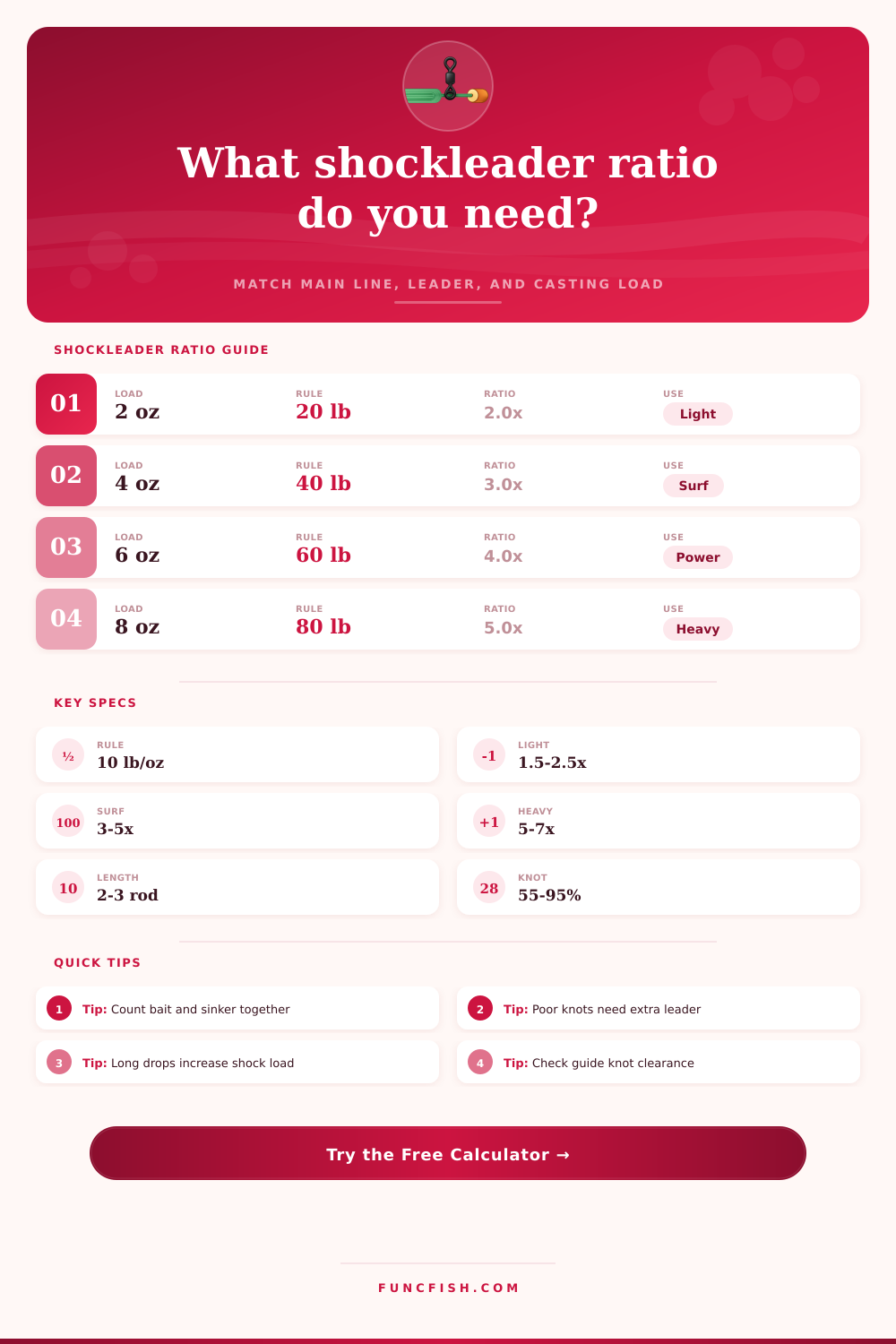
The common surf-casting baseline is about 10 lb of shockleader for each ounce of total casting load. This calculator adjusts that rule for cast style, line stretch, knot efficiency, and conditions.
💡Ratio notes
The ratio is not only about main line strength. A 15 lb main line with a 5 oz bait rig may need a 60 lb leader because the cast load, not the fish, is the limiting force.
If a knot keeps 75 percent of rated strength, a 50 lb leader behaves closer to 37.5 lb at the connection. The calculator shows that effective value.
For surf casting, a practical leader usually runs from the rig, up the rod, and onto the spool for several wraps so the main line is not carrying the hit.
Choose the next heavier leader class for pendulum casts, clipped-down bait rigs, heavy tide, rough ground, or any setup where timing is inconsistent.
So there you are on the bank with a weight in one hand, a line dangling from the other. You made the right call in picking your line. You might choose some braided mainline for distance casting or monofilament for stretch. Yet there’s another component of your rig that make all the difference between a good cast and a broken fishing rod. Yes, I’m talking about your shockleader.
It sounds easy enough; it is a beefed up segment of line that connects to your tippet. But therein lies the issue: most folks don’t get their ratio correct. Once they plug in their knot strength and their payload into the calculator above, the rest are done for them. There is no more guesswork about what size leader class will live through the launch.
How to Choose the Right Shockleader
So here’s where we get back to root of the issue: Force when casting doesn’t differentiate between type of fish you’re trying to catch. Only mass and acceleration matters. The bigger your lure or weight is, the more casting force is created by its mass and acceleration, and the harder it will decelerate at the end of the cast sending a shock wave all the way up the line. That energy needs to be absorbed somehow and if your mainline is thin braid, there is essentially zero stretch in it to do so. So it goes somewhere usually by snapping leader or bending your rod tip backwards until one thing or another give.
In either case, this means the ratio is much more important then the actual strength of each line. You’ll always fail if you have a weak leader paired with a strong mainline. And it won’t matter how good of a caster you are. Then there’s the whole fixation about the breaking strain of the leader itself. Someone sees “fifty-pound test” on the package and think they’re covered. Not so fast. Knots matter.
No knot holds the full rated strength of line. Twenty to thirty percent gets lost right at the tie because of a bulky connection point like a double uni. That reduction in efficiency means you’re basically fishing a lighter leader than you believe if you don’t account for it. So the tool does that for you. You can compensate for kind of knot you use. This makes you face facts about how well you realy tie. Bad knots requires beefier leaders. It may seem like nothing, but it matters big-time when you’re testing your limits.
The other factor in determining the ratio is the material. Braid doesn’t absorbs shock and stretch like nylon does. So when it comes to braid, you want your leader to be much stronger then your mainline. With mono, you can maybe get away with a three-to-one ratio. It is not so with braid. That violent stop will cause a catastrophic failure if you don’t have enough strength in your leader. This is why they has those great tables showing the ratios and how different materials affect the safety margins. It’s not simply about purchasing line; it’s controlling energy transfer.
The other variable that’s forgotten is length. You want your shockleader long enough so that the mainline hasn’t already taken up any load by the time the sinker enters the water or reaches the bottom. For example, in surf casting that can mean two to three times your rod length. Why? Because short leaders places extra strain on connection point closest to the guide eyes. When the rig comes back down it transitions to a longer leader, smoothing out the process. With drop-shotting or pendulum casts, gravity increases the shock load significantly. In these cases, the sinker is falling vertically from some height. You won’t find your regular overhead cast numbers relevant. Often more length and additional strength are required to cushion that vertical fall.
It is all about managing the risks. You don’t want the weak link in your system to be where your leader meets your mainline. You’d rather it be where your leader meets your sinker swivel. Wherever it happens, you’d rather it happen on terminal tackle than because a loop blew out at the reel spool. Then you’ll have time to make a quick change and keep fighting. Broken leader is annoying, shredded line is a day-ruiner.
So what do you want to give up? What are you willing to lose? Work backward from there. Always work toward isolating heavy lifting into the part of rig that was built for it. And let the rest of your rig remain intact when physics get gnarly.