Minnow Quantity Calculator
Estimate how many live minnows to bring for a fishing trip, including hook changes, bite losses, recast losses, warm-water mortality, travel time, reserve bait, dozens, scoops, and holding water.
📌Fishing trip presets
⚙Trip and bait inputs
Minnow quantity estimate
Calculation breakdown
📊Minnow size planning grid
Crappie, bluegill, perch, and small trout hooks.
All-around fatheads for trout, crappie, and light walleye.
Shiners for walleye, bass, river drifting, and jigging.
Bass, pike, catfish, and larger hook live-bait rigs.
⚖Comparison grid
Conservative shop order
0 dozenRounds up to the next full dozen so the trip does not depend on exact bait count.
Lean short-trip order
0 dozenUseful when bait is nearby and you prefer fewer leftovers after a quick session.
Warm-water stress load
0%Estimated extra mortality and handling allowance from temperature, time, and aeration.
Container crowding
GoodCompares your available bait water with the recommended holding volume.
📘Reference tables
| Minnow type | Typical length | Approx. weight per dozen | Common uses |
|---|---|---|---|
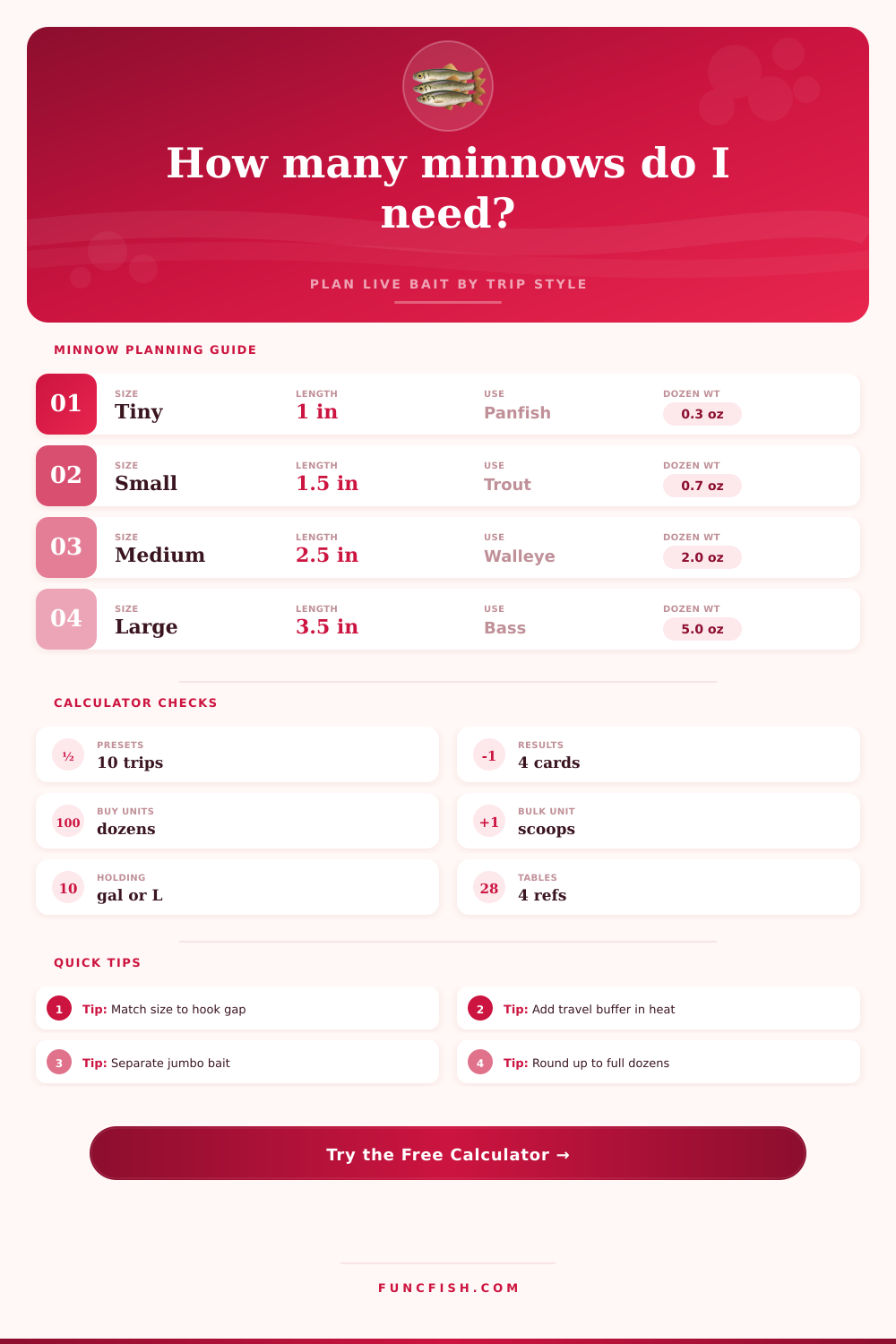
| Tiny crappie minnows | 0.75-1.25 in / 1.9-3.2 cm | 0.3 oz / 9 g | Panfish, perch, and small float rigs. |
| Small fathead minnows | 1.25-2.0 in / 3.2-5.1 cm | 0.7 oz / 20 g | Trout, crappie, and light walleye presentations. |
| Medium shiners | 2.0-3.0 in / 5.1-7.6 cm | 2.0 oz / 57 g | Walleye jigging, bass, and general gamefish rigs. |
| Large shiners | 3.0-4.25 in / 7.6-10.8 cm | 5.0 oz / 142 g | Bass, pike, catfish, and larger float rigs. |
| Jumbo suckers / chubs | 4.5-6.5 in / 11.4-16.5 cm | 16 oz / 454 g | Pike, muskie, trophy catfish, and big live-bait sets. |
| Killifish / mud minnows | 2.0-3.5 in / 5.1-8.9 cm | 2.8 oz / 79 g | Inshore, brackish, dock, and kayak live bait. |
| Fishing style | Typical change rate | Bite-loss tendency | Quantity note |
|---|---|---|---|
| Vertical jigging | 0.5-1.2 minnows per line per hour | Moderate, often one minnow per fish | Good control, but active schools can burn bait quickly. |
| Slip bobber | 0.4-1.0 minnows per line per hour | High when small fish peck bait | Add reserve when panfish or perch are mixed in. |
| Bottom rig | 0.3-0.8 minnows per line per hour | Moderate, depends on current and bait stealers | Less recasting, but damaged bait may need replacing. |
| Casting live bait | 0.8-1.8 minnows per line per hour | Higher from casting shock and weeds | Use a larger handling-loss percentage. |
| Ice fishing | 0.2-0.7 minnows per line per hour | Low to moderate | Cold water lowers mortality, but sorting still matters. |
| Slow trolling / drifting | 0.7-1.5 minnows per line per hour | Moderate to high in current or grass | Allow for speed damage and missed strikes. |
| Target fish | Common bait size | Planning range | Hook fit note |
|---|---|---|---|
| Panfish / perch | Tiny to small | 1-3 dozen per angler for a busy half-day | Use small hooks so the minnow can still move. |
| Crappie | Tiny to small | 2-4 dozen per boat for slip bobbers | Thin-wire hooks reduce bait damage. |
| Walleye | Small to medium | 2-6 dozen per boat for jigging or drifting | Hook through lips, back, or tail based on current. |
| Bass | Medium to large | 1-3 dozen larger shiners for focused trips | Match gap to bait depth and strike size. |
| Pike / muskie | Large to jumbo | 6-18 large baitfish for set lines or casting | Large bait needs much more water per dozen. |
| Catfish | Large chubs or shiners | 1-3 dozen depending on current and bait stealers | Plan extra when small fish pick at bait. |
| Holding condition | Suggested density | Metric equivalent | Planning adjustment |
|---|---|---|---|
| Cold water, strong aeration | Up to 5 dozen small minnows per gallon | Up to 16 dozen per 12 L | Lower survival buffer is usually enough. |
| Normal bucket, basic bubbler | 2-3 dozen small minnows per gallon | 6-10 dozen per 12 L | Use a moderate reserve buffer. |
| Warm day, long drive | 1-2 dozen small minnows per gallon | 3-6 dozen per 12 L | Increase reserve and change water carefully. |
| Large shiners or suckers | 0.5-1.5 dozen per gallon | 1.5-5 dozen per 12 L | Separate big bait from small delicate bait. |
💡Planning tips
There’s a particular kind of live bait remorse reserved for anglers who go out to fish. It usually comes near end of the day when you discover you have exactly one shiner left and two hungry walleyes waiting. Do you try to stretch your single last bait? Or do you clutch at thin air as line grabs down? The outcome seldom has anything to do with ability. It has everything to do with math.
Impulse is a terribble way to purchase live bait. A glance at a bagful is all it takes for most fishermen to grab a bag at the shop. No thought goes into whether there is enough baits for a trip, how far the bait has to travel in the trunk of a hot car, or how long it might take to get home. Guessing at those details results in a costly education in science of logistics.
How to Plan Your Live Bait Needs
To do so, it converts these fuzzy parameters into cold hard numbers. It requires only inputs relevant to the real world, such as expected bite activity. How many angler will be out there? What about your expected hourly catches? Your planned hours? These factors gets plugged into the calculator above (available here), which then makes projections about what percentage of bait your fish will eat.
It even factors in handling fatigue, casting errors and snag losses to account for what doesn’t make it into the fishs mouth. Since they won’t stop breathing until you put them in the tank, the calculator includes some reserve buffer for travel time too. This moves the thought process away from counting and instead into biology; a July heat wave changes the survivability of a minnow in a crowded bucket vs. Another is chilling in a livewell inside an ice shack. So the calculator takes this into consideration, dialing down or up its recommendations depending on both your water temp and aeration quality. That way when you get to the ramp, your bait isn’t half dead.
The other level of planning is understanding bait turnover. Anglers fail to realize just how fast live bait tire under pressure. You can hook a minnow through the lip and maybe get an hour’s worth of action out of it. But it will tire out. It will stop swimming naturaly and no longer hold as much appeal for the eye of any predator fish before it expires.
Even when they’re not biting, frequent bait rotation is key. The plan includes extra turns to account for the loss of bait from actual hookups. With vertical jigging, you may want to rotate your bait every 20 minutes to keep things fresh. For slip-bobber fishing for crappie, you’ll go through bait because those little ones will be stripping the hook off before a lunker ever gets a look at it. Both of these situations will chew up inventory faster then your gut tells you until you’ve seen it projected.
The other factor is size. Catfish suckers and large pike suckers will make your arms tired fast since they are heavy. On the other hand small crappie minnows hardly weigh anything at all, which allows you to carry dozens of them in a single pound! Conversely, large suckers are much more water hungry; they requires significantly more water volume per dozen to stay alive. The chart below breaks this down for you and will help you convert how many fish you want to get to actual amounts such as bags or scoops. For example, a “scoop” is the industry standard for ordering bulk quantities, but a scoop means nothing if you don’t know the size of each bait. If you know that medium shiners weigh around two ounces per dozen, now you have an idea of how many should fit in your cooler with enough water to keep them oxygenated for the day.
Crowding is the quiet assassin in live bait trips. You could purchase every fish alive in town but crowd them into a tiny bucket with insufficient aeration and they’ll be dead before you pull out of the parking lot. The tool compares your holding water volume to suggested densities and alerts you when you’re overloading. That’s particularly important with bigger bait such as jumbo suckers that generate lots of waste and consume more oxygen. Don’t mix big bait with smaller, fragile minnows; it stresses them out and causes them to eat each other. Both stress and crowding reduce survival rates regardless of water temps.
Finally, we have the reserve buffer. Who wants to purchase 20 percent excess supply? Seems like a waste of money… until bad luck strikes. No restocking is available on remote launches and tournament pressure lasts for many hours. Running out of bait at the wrong second will put a major damper on your day. You’ll never regret having too much bait in the livewell, whereas running dry in the middle of prime fishing can be extremely frustrating.
Always try to maintain how much you can hold while controlling how fast you use it. Your strategy should have survive the entire journey, not merely the first cast. Keep ’em wet and alive as long as humanly possible.