Mooring Line Stretch Calculator
Estimate mooring line elongation, deck movement, line load as a percent of breaking strength, and remaining reserve for fishing boats, tenders, skiffs, and marina tie-ups.
📌Mooring presets
⚙Line stretch inputs
Mooring stretch results
Formula breakdown
🧵Material stretch data
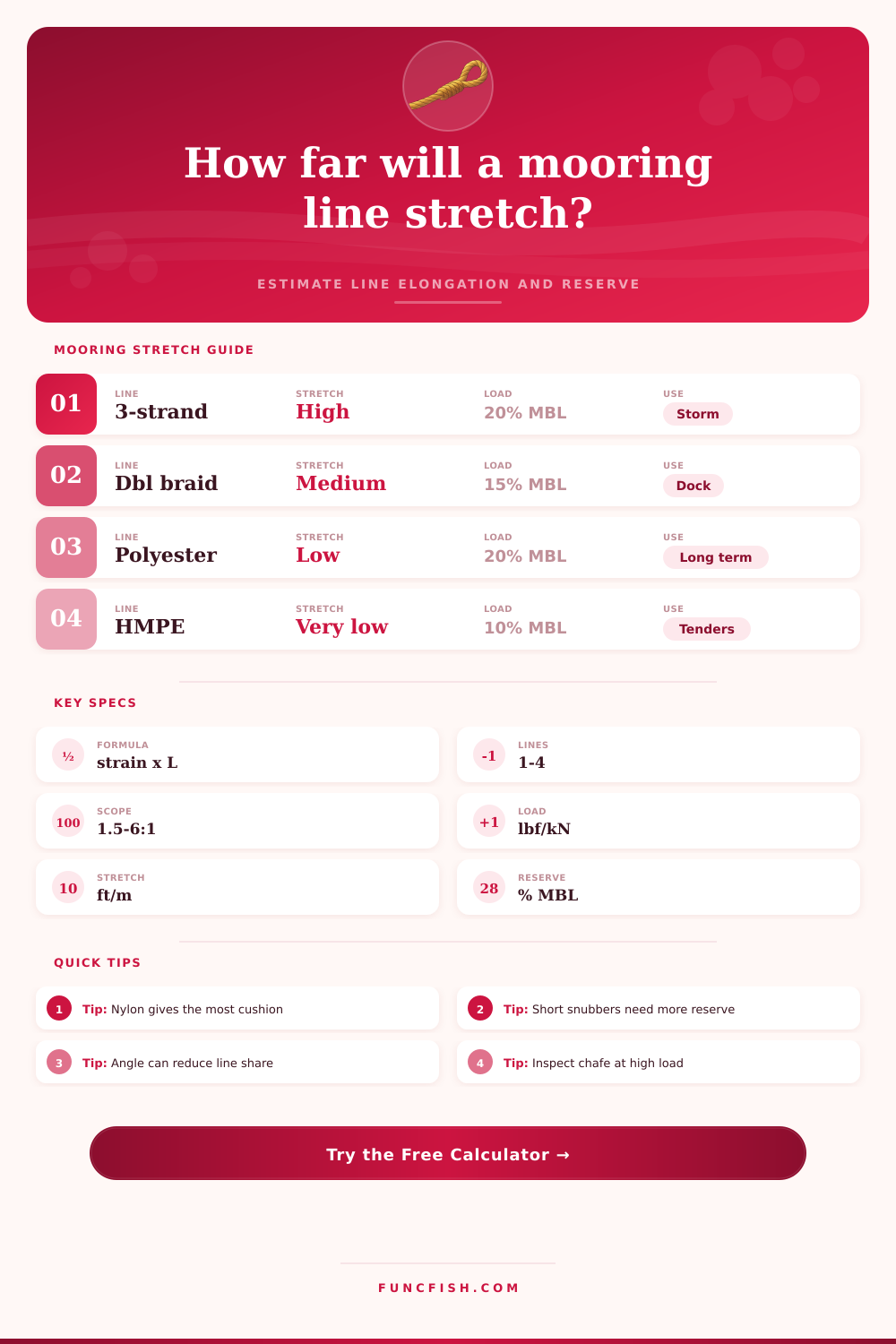
Approximate elongation near 30% of MBL; useful shock cushion.
Less elastic than 3-strand but common for dock lines.
Lower stretch and good long-term dimensional stability.
Very low elongation; often needs a separate snubber.
🐟Gear and species trip comparison
Nylon dock line handles short slip loads for smaller freshwater rigs.
Double braid gives manageable stretch for tidal marina and ramp docks.
Heavier displacement and side ties benefit from higher line reserve.
Longer exposed moorings need reserve plus controlled shock absorption.
📊Reference tables
| Material | Typical stretch at 10% MBL | Typical stretch at 30% MBL | Best mooring use |
|---|---|---|---|
| Nylon 3-strand | 5.5% | 16% | Anchor rodes, storm snubbers, shock absorption |
| Nylon double braid | 3.5% | 10% | Dock lines, spring lines, marina use |
| Polyester double braid | 1.8% | 5% | Long-term moorings where low creep matters |
| Polypropylene | 4% | 12% | Floating utility lines with modest reserve |
| HMPE / Dyneema | 0.4% | 1.2% | Low stretch leads paired with snubbers |
| Nylon rode with chain lead | 3% | 9% | Mixed anchor rode where chain limits elastic length |
| Nominal diameter | Nylon 3-strand MBL | Nylon double braid MBL | Polyester double braid MBL |
|---|---|---|---|
| 1/4 in / 6 mm | 1,490 lbf / 6.6 kN | 1,700 lbf / 7.6 kN | 1,600 lbf / 7.1 kN |
| 5/16 in / 8 mm | 2,290 lbf / 10.2 kN | 2,600 lbf / 11.6 kN | 2,500 lbf / 11.1 kN |
| 3/8 in / 10 mm | 3,340 lbf / 14.9 kN | 4,200 lbf / 18.7 kN | 3,800 lbf / 16.9 kN |
| 1/2 in / 12 mm | 5,750 lbf / 25.6 kN | 7,500 lbf / 33.4 kN | 6,500 lbf / 28.9 kN |
| 5/8 in / 16 mm | 9,350 lbf / 41.6 kN | 12,200 lbf / 54.3 kN | 10,400 lbf / 46.3 kN |
| 3/4 in / 18 mm | 14,200 lbf / 63.2 kN | 18,800 lbf / 83.6 kN | 16,000 lbf / 71.2 kN |
| Load percent of adjusted MBL | Stretch behavior | Status | Common reading |
|---|---|---|---|
| Under 10% | Small elastic movement | Low working strain | Normal light docking or protected mooring |
| 10% to 20% | Noticeable cushion | Useful working band | Good for gusts if chafe is controlled |
| 20% to 35% | Rapidly increasing stretch | Heavy load band | Check hardware, leads, and snubbers |
| Over 35% | High strain and heat risk | Reduce load or increase line | Storm or surge planning needs more reserve |
| Scope ratio | Typical setup | Movement factor used | Interpretation |
|---|---|---|---|
| 1.2:1 | Tight dock breast line | 0.92 | Most stretch becomes boat movement |
| 1.5:1 | Short marina dock line | 0.82 | Useful for slip checks and cleat clearance |
| 2:1 | Spring line or longer dock lead | 0.71 | Some stretch goes into geometry change |
| 3:1 | Lunch-hook or short mooring rode | 0.58 | More stretch is absorbed along the rode |
| 5:1 to 7:1 | Open mooring or storm rode | 0.38 to 0.45 | Elastic length is high but deck movement is muted |
💡Stretch calculation tips
It’s a gusty day when you cleat off at marina slip with a heavy swell running and catch a gust of wind on your hull. How far does that rope stretch with increased force? Will it hold? Knowing this make all the difference between seasoned captains and weekenders resetting lines first thing in the morning.
It’s not always simply a matter of breaking strength, it is a matter of elasticity. Knowing how far mooring line stretches lets you know if your boat will bounce back into dock cleat or drift safely away during a surge. With this calculator you’ll be able to see how much before you even have to tie off.
Why Boat Rope Stretch Matters
For many boater, they simply look at minimum break load and think that’s the better result; if it’s higher, it must be safer. That’s an oversimplification that can be dangerous. Stretchy nylon will actualy absorb some of the shock by elongating and holding up to high loads. But a stiffer line may withstand more load before finally snapping apart.
So the chart above allows you to choose material, double braid polyester vs. For example, three-strand nylon accounts for specific way each type of fiber stretches. Nylon stretch dramatically at light loads, protecting your boat from effects of sudden wind changes. Polyester stretches less, staying put on the boat but transmitting more force to chafe points and cleats. Know what kind of behavior best fits your scenario.
You must provide inputs because it is not a straight line to moorage. In real life there is angles, different lengths of scope, and multiple lines that bear the load. Enter in how many lines are loaded, and system calculates the proportion of force they divide up. Are two lines bearing unequal loads? One may be taking all the weight while other is dangling free. Angle adjust for that geometrical fact. A line pulled at 45 degrees takes less effective load than one coming right ahead. Over-confidence comes from ignoring those factors.
The other important variable that alters effect of stretch on your boat is scope. A tight dock line with low scope means almost every inch of rope elongation moves the hull, while a long anchor rode with high scope absorb much of that stretch within the curve of the line itself. The calculator takes this into account and lets you view estimate of real deck motion instead of simply rope stretching. That’s important when trying to avoid damaging contact with fenders or chafing against railings.
And then there’s material condition. A new piece of rope acts different from one that’s been exposed for several years to salt water and the sun’s bleaching effects. And so the tool would of back off and make up for diminished strength based off its condition. Remember that age of your inventory is also important, not just the diameter. What may be half an inch in diameter on paper might have a significantly lower working reserve due to weathering. That’s where breakdowns occurs in the storm.
The presets are useful when considering different boats for which they was designed. Open water on an offshore charter vs. A protected slip for a bass boat is different. The reference information gives typical stretch for different fibers at specific loads. Knowing that HMPE stretches less than two percent at thirty percent of break strength while nylon stretches sixteen percent provides insight into pairing high-tech line with a snubber. The stiff line holds position and the elastic snubber eats the shock.
So finally it’s all about using energy. You are not fighting against force but using energy to manage it. Do you need to make it stiff so that it doesn’t suddenly pop off or do you need to have some give so it keeps away from whatever is snagging on it? The calculator lets you run those numbers to establish what might happen.
We aren’t guessing anymore; we are planning with information. Knowing ahead of time that this line will only stretch four feet instead than six means knowing whether you’ll have a secure night or if you’ll be untangling yourself from the pile in the morning when the water rises and the wind kicks up. That makes it worth figuring out beforehand.