Multi-Trip Average Fishing Calculator
Turn a fishing log into trip averages, catch per hour, keeper ratio, zero-trip drag, consistency, and a realistic next-trip forecast.
📌Scenario presets
⚙Trip log inputs
Multi-trip average summary
Full breakdown
📊Average quality bands
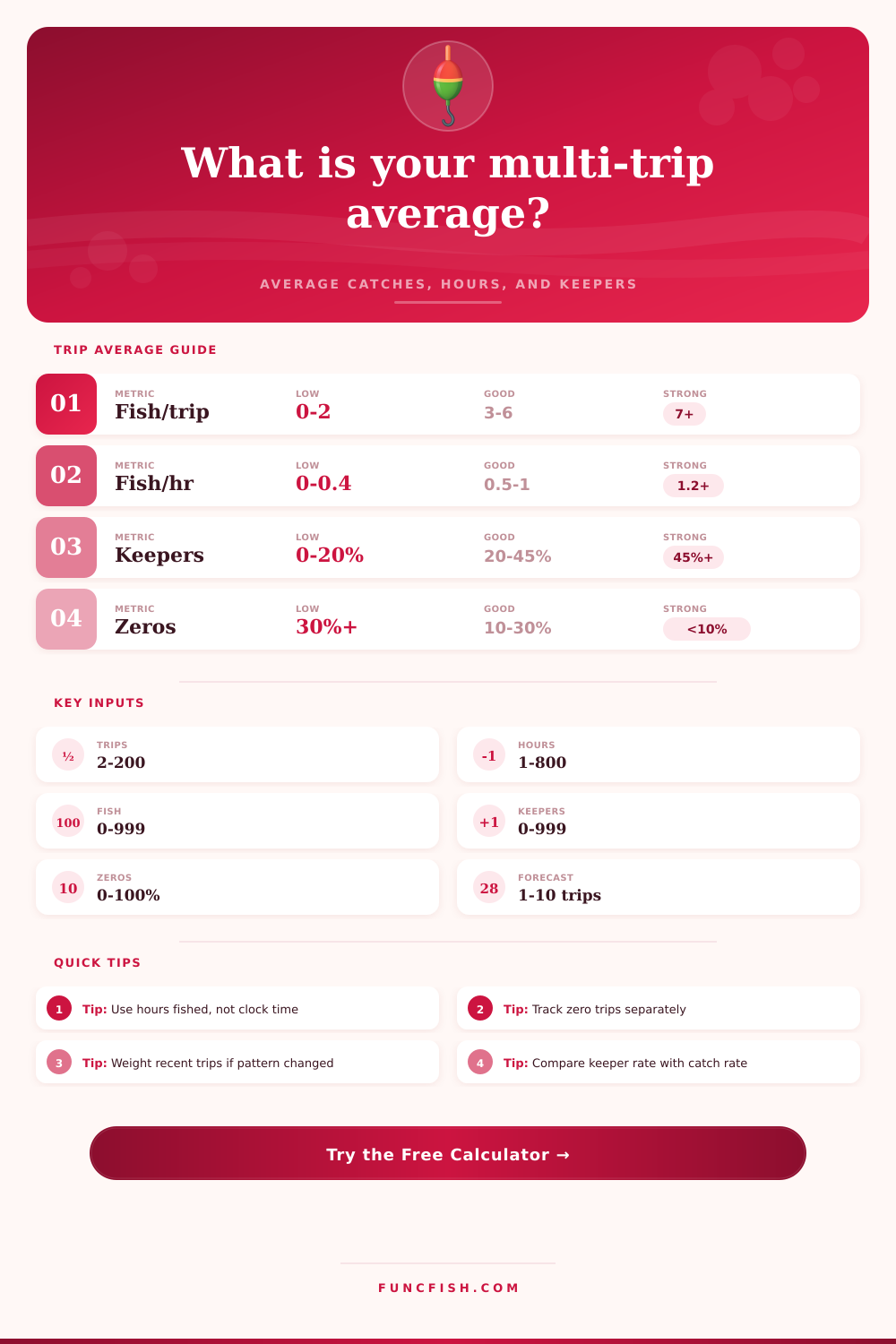
Best for quick comparisons when trip length stays similar across the log.
Catch per unit effort compares short trips, long trips, and different waters fairly.
Zero trips show how often the pattern fails, even when the best trip is strong.
Keeper or target-size rate separates high numbers from higher-quality catches.
📋Fishing log reference tables
| Target style | Typical fish/trip | Typical fish/hour | Keeper share | Use this average first |
|---|---|---|---|---|
| Panfish pond | 8-30 | 2.0-8.0 | 10-45% | Fish per active hour |
| Trout stream | 2-10 | 0.8-3.0 | 20-70% | Fish per mile or hour |
| Bass casting | 1-8 | 0.3-1.8 | 15-55% | Fish per trip and zeros |
| Walleye jigging | 1-6 | 0.25-1.2 | 30-70% | CPUE and keeper share |
| Catfish bottom | 1-10 | 0.2-1.5 | 25-80% | Fish per soak hour |
| Surf striped bass | 0-5 | 0.0-1.0 | 20-65% | Zero-trip rate |
| Kayak inshore | 1-12 | 0.4-2.5 | 20-60% | Fish per hour |
| Offshore trolling | 0-8 | 0.0-0.8 | 50-90% | Catch per boat hour |
| Log metric | Formula | What it tells you | Watch-out |
|---|---|---|---|
| Fish per trip | Total fish / trips | Simple trip expectation | Can overrate long trips |
| Fish per hour | Total fish / hours | Efficiency by effort | Needs honest fishing time |
| Keeper ratio | Keepers / fish | Quality of catch | Zero fish needs special handling |
| Zero-trip rate | Zeros / trips | Pattern reliability | Short scouting trips can distort it |
| Recent weight | Recent avg blended in | Pattern change signal | Small samples swing hard |
| Forecast band | Average +/- spread | Likely range ahead | Not a guarantee |
⚖Species average comparison
| Species group | High-number signal | Quality signal | Volatility | Best tracking unit |
|---|---|---|---|---|
| Largemouth bass | 5+ per trip | 30% keepers | Medium | Trip and hour |
| Smallmouth bass | 6+ per trip | 35% keepers | Medium | Hour and water type |
| Trout | 8+ per trip | 50% target size | Low-medium | Hour and distance |
| Walleye | 4+ per trip | 45% keepers | Medium-high | Hour and depth pattern |
| Catfish | 6+ per trip | 55% keepers | Medium | Soak hour |
| Striped bass | 3+ per trip | 40% keepers | High | Tide window |
| Redfish | 5+ per trip | 35% slot fish | Medium | Hour and tide stage |
| Offshore mixed | 4+ per trip | 70% target fish | High | Boat hour |
💡Calculation notes
Keep total hours and active hours separate. Active hours remove long moves, rigging, and weather pauses so the efficiency number reflects actual fishing effort.
Use recent weighting when the bite has changed. A seasonal shift, new technique, or different water can make a full-year average less useful for the next trip.
A multi-trip average calculator are a tool that will help you to organize your fishing data. Furthermore, a multi-trip average calculator will help to show you how your fishing goes by converting each of your fishing trips into a single data set. Most anglers uses their memories to show how successful they are with their fishing effort.
Unfortunately, memories are not always the most accurate in measuring fishing success. Thus, a multi-trip average calculator will prevent this inaccuracy in reporting an angler’s fishing statistics. First, you must decide how you will measure your fishing efforts.
How to Use a Multi-Trip Average Calculator for Fishing
One method of calculating fishing efforts may use the total number of hours that you are on the water during your fishing trips. This can include hours spent traveling to and from the fishing spot, waiting for the weather to change, and hours spent not fishing. An alternative method of calculating fishing efforts is to use only the number of hours that you are active fishing, such as hours spent actively casting your lines or hours spent actively soaking them in the water.
Each angler may spend the same amount of time on the water, but the active fishing times may be different. Thus, each angler may have different efficiency figure. However, the multi-trip average calculator can separate these two figures so that each angler can have an efficiency figure that accurate reflects their fishing efforts.
Another way of calculating fishing efforts is to weight each angler’s more recent fishing trips more than their older fishing trips. Many fishing trips have changing conditions in the water, such as changes in water temperature and the movements of the forage in the water. Thus, a more recent weighting of fishing trips will provide a more accurate reflection of an angler’s fishing effort.
For instance, the plain average will calculate each fishing trip in the angler’s log with the same weight. However, a recent-weighted average will provide more importance to the recent fishing trips of the angler. Thus, the recent-weighted average will be more current with fishing condition.
However, the recent-weighted average may change based on only one particularly good or bad fishing day. Another measurement of an angler’s fishing efforts is by calculating the keeper ratio. Anglers may catch a high number of small fish during their trips.
However, if the number of small fish that are caught does not meet the size requirements for which the angler is fishing, then the angler’s fishing efforts may not be successful. Thus, this ratio provides an angler with insight as to whether their fishing efforts are successfully targeting the types of fish that they want to catch. Furthermore, this can allow anglers to compare their fishing efforts to those of other angler who may be fishing the same body of water.
Another consideration in an angler’s log is the number of trips that featured a zero catch amount. These zero trips are important in that they can help to display the reliability of an angler’s fishing pattern. An angler might have high counts of fish during some trips, but there may be a great number of trips with a zero catch amount.
The consistency score calculates both the number of zero fishing trips, as well as the difference in catch between the highest and lowest number of fish that were caught during fishing trips logged in the record of an angler. This consistency score displays the reliability of an angler’s fishing patterns. Thus, a low consistency score does not necessarily mean that an angler is less successful than an angler with a high consistency score; it may simply indicate that the angler’s fishing patterns are more volatile, or that they have not logged enough fishing trips to display a true consistency score.
The reference tables can help to provide context for an angler’s calculated fishing results. For instance, a five-fish average may be a strong fishing effort for an angler who is targeting trout fish. However, a five-fish average may be an ordinary fishing effort for an angler whose fishing trips are targeting striper fish.
Thus, these reference tables will help to provide anglers with an understanding of whether their calculated fishing averages are high or low results, preventing anglers from making misinterpretations of their fishing data. The forecast for an angler can be determined with the data from their fishing log. The forecast section of a multi-trip average calculator will allow anglers to determine the likely range of number of fish that they will catch during their future fishing trips.
Thus, the range that is calculated will provide for planning of fishing trips. Furthermore, the range is likely to be wider for anglers whose fishing log indicates a high volatility in fishing efforts. Additionally, the calculator will provide a wider range for anglers whose fishing conditions have recently changed.
Finally, anglers can utilize the output from the average calculator to test new variables in their fishing. For instance, the output can be used to determine the effect of introducing a new fishing technique or moving to a new location. Furthermore, the output can help anglers understand the effect of recent change in the weather.
However, the average calculator does not replace the time that anglers spend fishing. Instead, the data from anglers’ fishing trips will become more legible and understandable as a result of utilize this fishing data calculator.